Climate change worsened deadly Africa floods, scientists say

1 / 4
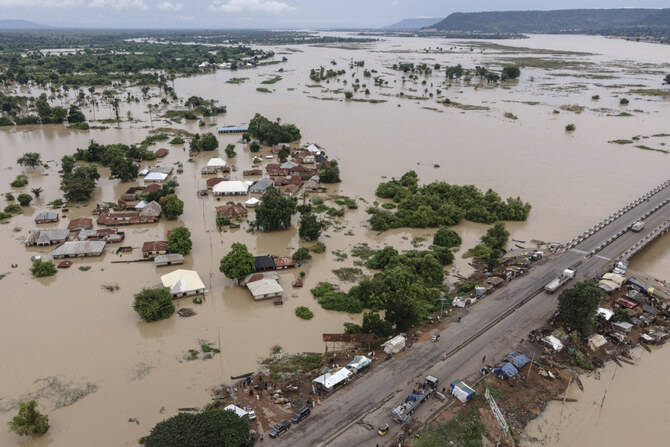
This areal view shows houses submerged by water in a flooded area in Adaha, Nigeria, on October 22, 2024. (AFP)
2 / 4
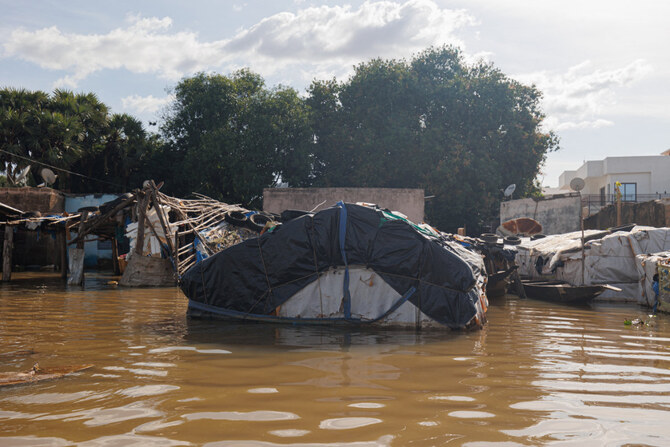
Houses are seen submerged in water in a flooded area of the Badalabougou district in Bamako on October 3, 2024, following havy rains across the Sahel region. (AFP)
3 / 4
People unload supplies from a pirogue onto a bus that was blocked after flood waters flowed too deep over the road in Odobere in Senegal on October 22, 2024. (AFP)
4 / 4
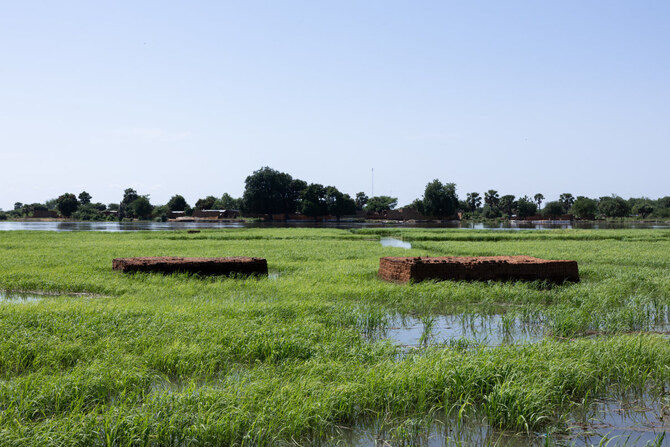
A general view of the The Logone, which separates the ninth arrondissement of Ndjamena from Cameroon, is in flood, on October 8, 2024. (AFP)
Short Url
Updated 03 November 2024
Follow

Climate change worsened deadly Africa floods, scientists say

  • A new analysis by the World Weather Attribution network of scientists found warming driven by the use of fossil fuels had exacerbated the flooding in Sudan
  • The researchers said there was a clear link between the extreme rainfall and a warming planet

ABUJA, Nigeria: Human-caused climate change worsened floods that have killed hundreds of people and displaced millions in Cameroon, Chad, Niger, Nigeria and Sudan this year, according to a study published on Wednesday.
The intense rainy season has unleashed a humanitarian crisis across large areas of the Sahel region bordering the Sahara desert.
A new analysis by the World Weather Attribution (WWA) network of scientists found warming driven by the use of fossil fuels had exacerbated the flooding in Sudan.
The researchers also said climate change would have made this year’s torrential rains around five to 20 percent more intense across the Niger and Lake Chad basins, citing a previous WWA study of similar floods in 2022.
“This is only going to keep getting worse if we keep burning fossil fuels,” said Clair Barnes from the Center for Environmental Policy at Imperial College London.
Speaking at a briefing ahead of the study’s publication, she said such downpours “could happen every year” if global temperatures increase to two degrees Celsius (35.6 Fahrenheit) above pre-industrial levels.
“It’s pretty serious,” she said.


Global warming is not just about rising temperatures — the extra heat trapped in the atmosphere and seas has knock-on effects and can result in more intense downpours and storms.
The researchers said there was a clear link between the extreme rainfall and a warming planet.
In the study, they focused on war-torn Sudan, where millions of displaced people have been uprooted by conflict and driven into flood-prone areas.
The scientists used modelling to compare weather patterns in our world and one without human-induced warming, and found that month-long spells of intense rainfall in parts of Sudan had become heavier and more likely due to climate change.
At the current 1.3 degrees Celsius of warming, they said similar periods of rainfall are expected to occur on average about once every three years, and have become about 10 percent heavier due to climate change.


A Sudanese man pulls his donkey across a flooded street in Tokar in the Read Sea State following recent heavy flooding in eastern Sudan, on October 3, 2024. (AFP)


“These results are incredibly concerning,” said Izidine Pinto, one of the study’s authors and a researcher at the Royal Netherlands Meteorological Institute.
He warned that “with every fraction of a degree of warming, the risk of extreme floods will keep increasing,” and called for the UN’s COP29 climate summit to “accelerate the transition away from fossil fuels” when it meets in Azerbaijan next month.
Joyce Kimutai, a researcher at Imperial’s Center for Environmental Policy, said the floods underscored the need for a loss and damage fund for nations devastated by climate change.
A key meeting ahead of COP29 earlier this month ended with countries making little progress over how to finance a deal for poorer nations.
“Africa has contributed a tiny amount of carbon emissions globally, but is being hit the hardest by extreme weather,” Kimutai said.
The role of climate change in the floods was compounded by other human-made problems, the researchers said, and they called for better maintenance of dams and investment in early warning systems.


Winter storm packing snow and strong winds to descend on Great Lakes, Northeast

Updated 30 December 2025
Follow

Winter storm packing snow and strong winds to descend on Great Lakes, Northeast

  • The fierce winds on Lake Erie sent water surging toward the basin’s eastern end near Buffalo, New York, while lowering water on the western side in Michigan to expose normally submerged lakebed — even the wreck of a car and a snowmobile

NEW YORK: A wild winter storm was expected to bring strong winds, heavy snow and frigid temperatures to the Great Lakes and Northeast on Tuesday, a day after a bomb cyclone barreled across the northern US and left tens of thousands of customers without power.
The storm that hit parts of the Plains and Great Lakes on Monday brought sharply colder air, strong winds and a mix of snow, ice and rain, leading to treacherous travel. Forecasters said it intensified quickly enough to meet the criteria of a bomb cyclone, a system that strengthens rapidly as pressure drops.
Nationwide, more than 127,000 customers were without power Tuesday morning, more than a third of them in Michigan, according to Poweroutage.us.

BACKGROUND

The storm that hit parts of the Plains and Great Lakes on Monday brought sharply colder air, strong winds and a mix of snow, ice and rain, leading to treacherous travel.

As the storm moved into Canada, the National Weather Service predicted more inclement weather conditions for the Eastern US, including quick bursts of heavy snow and gusty winds known as snow squalls. Blustery winds were expected to add to the arctic chill, with low temperatures dipping below freezing as far south as the Florida panhandle, the agency said.
New York Gov. Kathy Hochul warned that whiteout conditions were expected Tuesday in parts of the state, including the Syracuse metro area.
“If you’re in an impacted area, please avoid all unnecessary travel,” she said in a post on the social platform X.
Snow piled up quickly in Michigan’s Upper Peninsula on Monday, where as much as 2 feet (60 centimeters) fell in some areas, according to the National Weather Service. Meteorologist Ryan Metzger said additional snow was expected in the coming days, although totals would be far lighter.
Waves on Lake Superior that were expected to reach 20 feet (6 meters) on Monday sent all but one cargo ship into harbors for shelter, according to MarineTraffic.com.
The fierce winds on Lake Erie sent water surging toward the basin’s eastern end near Buffalo, New York, while lowering water on the western side in Michigan to expose normally submerged lakebed — even the wreck of a car and a snowmobile.
Kevin Aldrich, 33, a maintenance worker from Monroe, Michigan, said he has never seen the lake recede so much and was surprised on Monday to spot remnants of piers dating back to the 1830s. He posted photos on social media of wooden pilings sticking up several feet from the muck.
“Where those are at would typically be probably 12 feet deep,” he said. “We can usually drive our boat over them.”
Dangerous wind chills plunged as low as minus 30 F (minus 34 C) across parts of North Dakota and Minnesota on Monday. And in northeast West Virginia, rare, nearly hurricane-force winds were recorded on a mountain near Dolly Sods, according to the National Weather Service.
In Iowa, after blizzard conditions eased by Monday morning, high winds continued blowing snow across roadways, keeping more than 200 miles (320 kilometers) of Interstate 35 closed. State troopers reported dozens of crashes during the storm, including one that killed a person.
On the West Coast, the National Weather Service warned that moderate to strong Santa Ana winds were expected in parts of Southern California through Tuesday, raising concerns about downed trees in areas where recent storms had saturated the soil. Two more storms were forecast later this week, with rain on New Year’s Day potentially soaking the Rose Parade in Pasadena for the first time in about two decades.