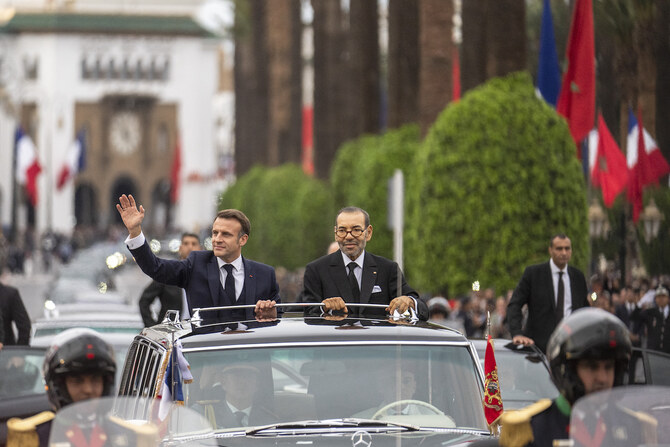
RABAT: French President Emmanuel Macron landed in Morocco’s capital Rabat on Monday for a three-day state visit aimed at mending relations with the North African country after years of tensions.
His trip comes following an invitation in late September by King Mohammed VI who had called the visit an opportunity for “a renewed and ambitious vision covering several strategic sectors.”
The two countries are set to sign several agreements, including on energy, infrastructure, education and national security.
A delegation of French ministers and business leaders is accompanying Macron to Rabat, where French and Moroccan flags fly alongside each other in the city’s main throughfares.
French Interior Minister Bruno Retailleau, Economy Minister Antoine Armand and Culture Minister Rachida Dati — herself of Moroccan origin — are all accompanying Macron.
The heads of French energy groups Engie and TotalEnergies, as well as space manufacturer Thales Alenia Space and others, are also in the delegation.
The visit follows years of strained relations between Paris and Rabat over a range of issues including France’s ambiguous stance on the disputed Western Sahara and Macron’s quest for a rapprochement with Algeria.
Western Sahara, a former Spanish colony, is largely controlled by Morocco but claimed by the Algeria-backed Polisario Front, which in 2020 declared a “self-defense war” and seeks the territory’s independence.
It is considered by the United Nations to be a “non-self-governing territory.”
Macron in July eased tensions with Rabat by saying Morocco’s autonomy plan for the territory was the “only basis” to resolve the decades-old conflict.
France’s diplomatic turnabout had been awaited by Morocco, whose annexation of Western Sahara had already been recognized by the United States in return for Rabat normalizing ties with Israel in 2020.
Monday’s visit also comes after Macron’s rapprochement efforts with Algeria appear to have hit a dead end.
A state visit by Algerian President Abdelmadjid Tebboune to Paris was rescheduled multiple times before being called off by Algiers earlier this month.
After Macron endorsed Morocco’s autonomy plan, Algeria promptly withdrew its ambassador to Paris and has yet to send a replacement.
Morocco now has the potential to “constitute a hub between Europe and Africa,” strategically but also in terms of infrastructure, particularly electricity, Macron’s office said ahead of his visit.
Rabat and Paris have also been at odds after France in 2021 halved the number of visas it granted to Moroccans.


![]()
France’s Macron in Morocco for a diplomatic reset
Short Url
https://arab.news/bunnm
France’s Macron in Morocco for a diplomatic reset
- The two countries are set to sign several agreements, including on energy, infrastructure, education and national security

Latest updates


© 2026 SAUDI RESEARCH & PUBLISHING COMPANY, All Rights Reserved And subject to Terms of Use Agreement.