

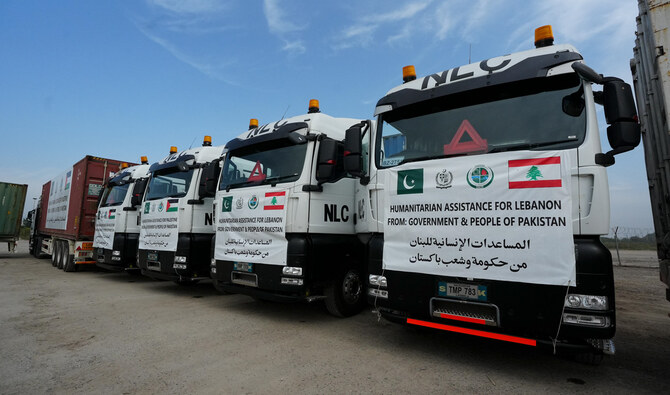
Pakistan dispatches 16th relief consignment for war-afflicted people of Gaza, Lebanon

This handout photo, taken and released by Pakistan’s National Disaster Management Authority on October 27, 2024, shows trucks of relief goods being dispatched to Gaza and Lebanon, in Islamabad. (Photo courtesy: NDMA)
Short Url
Updated 27 October 2024
Follow

Pakistan dispatches 16th relief consignment for war-afflicted people of Gaza, Lebanon

  • Each consignment contains 100 tons of winterized tents and blankets, says Pakistan’s disaster management agency 
  • Pakistan vows to continue relief shipments for Gaza and Lebanon, where Israeli military has killed thousands since last year

ISLAMABAD: Pakistan’s National Disaster Management Authority (NDMA) on Sunday dispatched the 15th and 16th consignment of relief items for the war-affected people of Gaza and Lebanon, vowing to continue relief supplies to the areas amid Israel’s ongoing military campaigns.
The consignments were dispatched through road convoys from Islamabad to Amman in Jordan for the people of Gaza and Beirut. The relief items included 100 tons each of winterized tents and blankets, the NDMA said in a press release.
“In total 1,598 tons of relief items have been dispatched to affected people of Gaza and Lebanon,” the NDMA said.
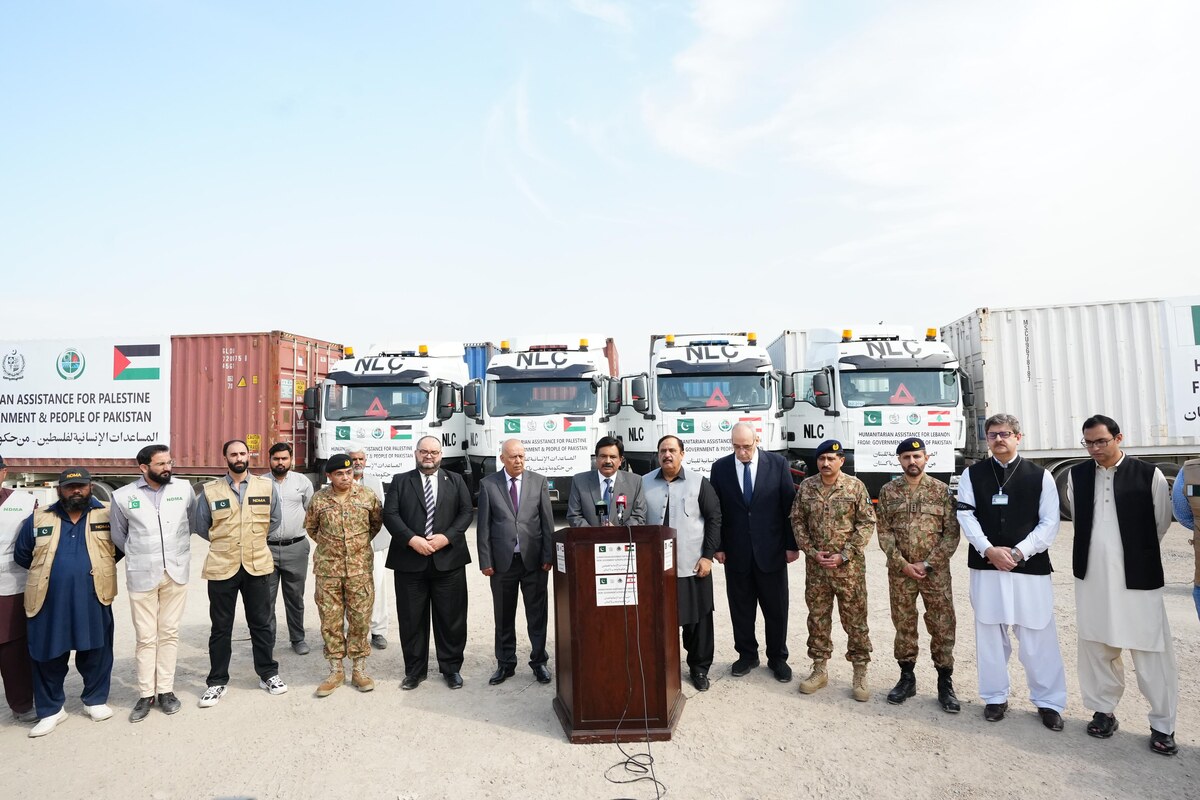


In this handout photo, taken and released by Pakistan’s National Disaster Management Authority on October 27, 2024, officials hold press briefing as trucks of relief goods being dispatched to Gaza and Lebanon, in Islamabad. (Photo courtesy: NDMA)

The send-off ceremony was held at Islamabad International Airport. Parliamentarians Malik Ibrar and Raja Qamar ul Islam, Palestinian Ambassador to Pakistan Zuhair Darzaid and Lebanon’s Ambassador to Pakistan Ghassan Khatib were present at the ceremony.
“During the ceremony, the Parliamentarians emphasized the urgent need to provide relief to the war-affected populations of Palestine and Lebanon, considering the ongoing conflict and the needs of the affected communities,” the NDMA said.
“They reaffirmed the Government of Pakistan’s commitment to supporting their brothers and sisters in distress and stressed the importance of collaboration by welfare organizations and the Pakistani public in strengthening these efforts.”
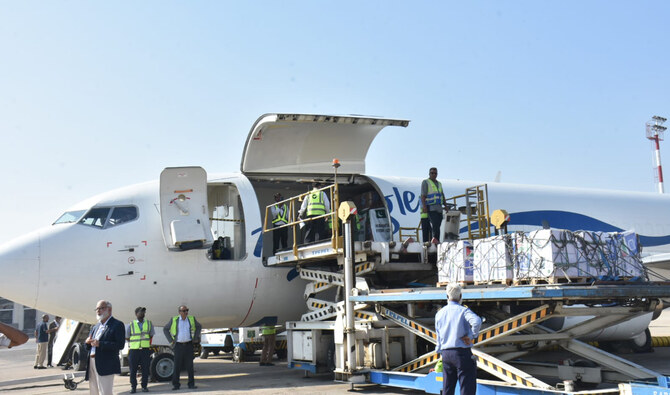


In this handout photo, taken and released by Pakistan’s National Disaster Management Authority on October 27, 2024, airport officials load consignment of relief goods being dispatched to Lebanon, in Karachi. (Photo courtesy: NDMA)

Earlier on Sunday, Pakistan dispatched the 14th consignment of relief items from the southern port city of Karachi to Beirut. 
Pakistan has also set up a special account titled: “Prime Minister’s Relief Fund for Gaza and Lebanon,” under PM Shehbaz Sharif’s directions, for donations for the people of Gaza and Lebanon.
Pakistan does not recognize nor have diplomatic relations with Israel and calls for an independent Palestinian state based on “internationally agreed parameters” and the pre-1967 borders with Al-Quds Al-Sharif as its capital.
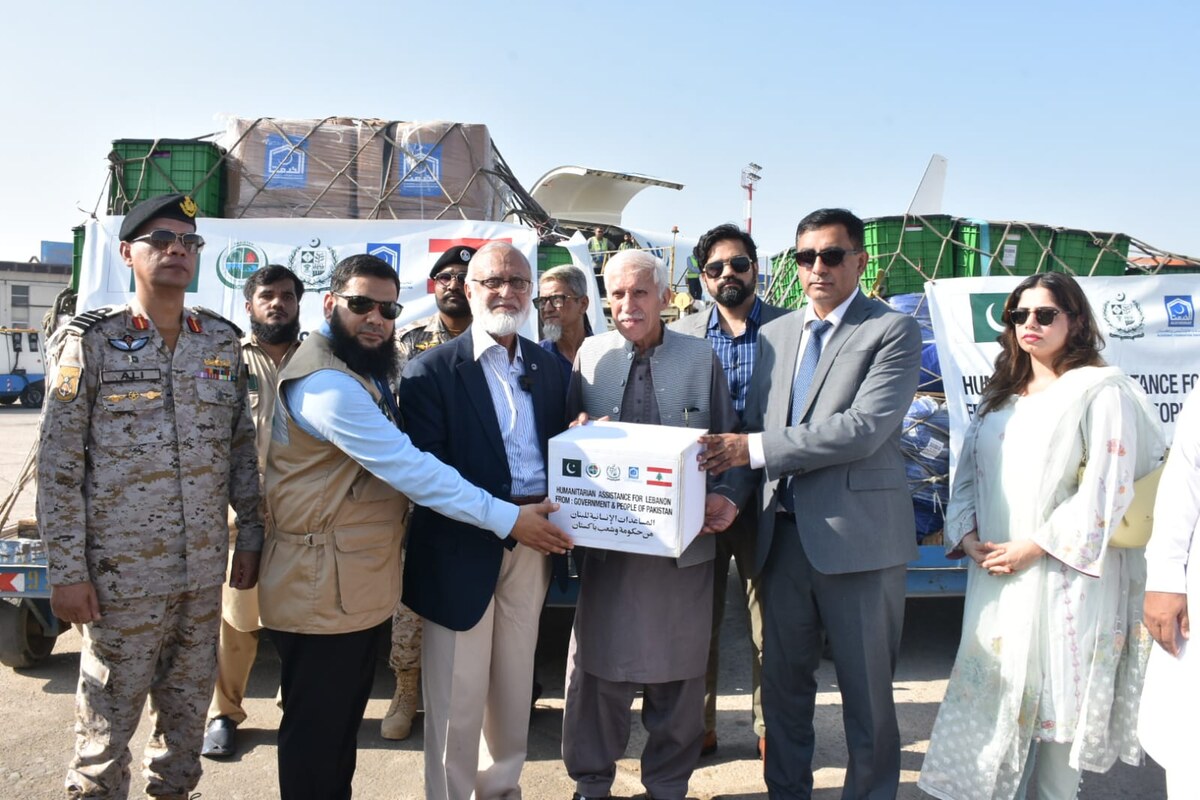


In this handout photo, taken and released by Pakistan’s National Disaster Management Authority on October 27, 2024, Pakistani government and Al-Khidmat Foundation officials gesture for a group photo next to consignment of relief goods being dispatched to Lebanon, in Karachi. (Photo courtesy: NDMA)

Since the beginning of Israel’s war on Gaza, Pakistan has repeatedly raised the issue at the United Nations, the Organization of Islamic Cooperation (OIC) and other multilateral platforms and demanded international powers and bodies stop Israeli military actions in Gaza.


Pakistan eyes collaboration with Saudi Arabia, Indonesia, China for local vaccine production

Updated 5 sec ago
Follow

Pakistan eyes collaboration with Saudi Arabia, Indonesia, China for local vaccine production

  • Pakistan last week held talks with a visiting Saudi delegation on partnering to manufacture vaccines locally
  • Government working on “war footing” to ensure local production of vaccines by 2030, says health minister

ISLAMABAD: Pakistan is eyeing collaboration with Saudi Arabia, Indonesia and China to produce vaccines locally, Health Minister Syed Mustafa Kamal said on Thursday, adding that Islamabad was exploring both government-to-government and business-to-business opportunities in this regard. 

Kamal told Arab News last week that Islamabad was “very close” to an agreement with Saudi Arabia that would enable Pakistan to manufacture vaccines locally. The development took place as a Saudi delegation, led by the Kingdom’s senior adviser to the minister of industry Nizar Al-Hariri, arrived in Pakistan last week and held talks with health officials on a partnership with Pakistan which would enable it to manufacture vaccines locally. 

The efforts take place amid Pakistan’s push to strengthen its health security and industrial capacity. The country of more than 240 million currently imports all vaccines used in its national immunization campaigns, relying heavily on international partners to help cover the costs.

“Mustafa Kamal said Pakistan is exploring collaboration with Saudi Arabia, Indonesia and China for local production of these vaccines,” state broadcaster Radio Pakistan reported. 

Kamal said the government is working on a “war footing” to ensure the local production of vaccines before 2030. 

The health minister reiterated that Pakistan has the potential to locally produce raw materials of the 13 vaccines that it provides free of cost. He added that the government will also export vaccines once it starts producing them at home. 

“Mustafa Kamal said the government is exploring both government-to-government and business-to-business collaboration to achieve our objectives in vaccine production,” Radio Pakistan said. 

Pakistan’s health ministry has said it imports all 13 vaccines that it provides masses for free at an annual cost of about $400 million.

International partners currently cover 49 percent of these costs, with the remainder borne by the Pakistani government. This external support, Kamal has warned, is expected to end after 2030.