Pakistan’s deputy PM calls for equitable global financial system at Commonwealth meeting

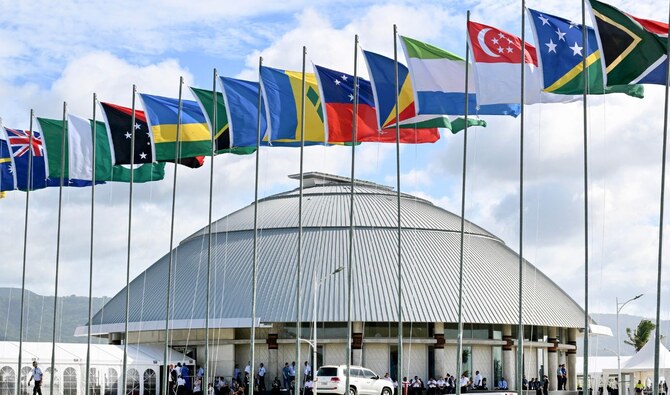
This photo shows a general view of the Parliament of Samoa during the Commonwealth Heads of Government Meeting (CHOGM) in Apia, Samoa, on October 25, 2024. (AFP)
Short Url
Updated 26 October 2024
Follow

Pakistan’s deputy PM calls for equitable global financial system at Commonwealth meeting

  • Dar says Pakistan wants to spend on health, education but lacks access to global financial markets
  • He maintains the world should prioritize debt relief and restructuring along with climate financing

ISLAMABAD: Pakistan’s Deputy Prime Minister Ishaq Dar called for an equitable global financial architecture during the Executive Session of the Commonwealth Heads of Government Meeting in Samoa, state-owned media reported on Saturday, stressing the need to support developing countries in meeting their economic needs.
Dar, who also holds the foreign ministry portfolio, is leading Pakistan’s delegation at the Commonwealth gathering, which began on Monday, to present Islamabad’s stance on key global issues.
The Commonwealth is a voluntary association of 56 independent nations, with roots tracing back to the British Empire. Today, any country can be part of it, with Gabon and Togo being the most recent members, joining in 2022.
“Addressing the gathering, he said the global community should prioritize debt relief and restructuring, sustainable investments in resilient infrastructure, enhanced access to climate financing and digital and financial inclusion in addition to strengthening multilateral cooperation,” Radio Pakistan reported.
“Ishaq Dar said Pakistan recognizes the pressing need for investments in health, education and infrastructure, yet it faces significant challenges due to the limited access to international financial markets and impacts of climate change,” it added.
Dar also highlighted Pakistan’s active participation in Commonwealth working groups on the digital economy and sustainable finance, saying it reflecting the country’s commitment to integrating innovative solutions into its economic strategy.
He also engaged with the heads of delegations from other Commonwealth member states on the sidelines of the conference.


Pakistani migrant’s death in UAE shatters economic future of families back home

Updated 11 sec ago
Follow

Pakistani migrant’s death in UAE shatters economic future of families back home

  • Pakistani driver killed by falling debris during missile interception in Abu Dhabi amid escalating Middle East conflict
  • Death leaves more than a dozen dependents in Pakistan without income after eight years of overseas work

ISLAMABAD: For days, Nazar Ali told his daughter-in-law a gentle lie: authorities in the United Arab Emirates (UAE) had confiscated all mobile phones and her husband, Mureeb Zaman, would call home as soon as he got it back.

In reality, Zaman, a 40-year-old Pakistani driver who had spent eight years working in the UAE to lift his family out of poverty, had already been killed by missile fragments during an aerial interception over Abu Dhabi amid an escalating conflict in the Middle East.

The conflict began on Feb. 28 after the United States and Israel launched strikes on Iran following weeks of escalating tensions between Tehran and its regional adversaries. The attacks triggered retaliatory drone and missile strikes by Iran targeting commercial and US-linked interests across the Gulf region, prompting air defense systems in several countries to intercept projectiles in the skies above major cities.

As interceptors met incoming missiles over the Emirati capital that night, falling debris struck Zaman, ending years of work he hoped would secure a better future for his five children in one of Pakistan’s most volatile regions.

“I found out the same day because nowadays it is the age of the Internet,” Ali, Zaman’s father, told Arab News during a condolence gathering at his residence last week.

“I myself was in the market at that time when I received the news [of his death], but I did not tell the family.”

Zaman had been supporting three households in his hometown in Pakistan’s northwestern Bannu district, including the family of his late younger brother. The region, located in the province of Khyber Pakhtunkhwa near the Afghan border, has witnessed a surge in militancy and counterinsurgency operations in recent years.

The 40-year-old was one of millions of Pakistani migrant workers in Gulf countries whose remittances are a vital source of foreign exchange for Pakistan’s fragile economy.

He is also among the first reported Pakistani casualties of the recent escalation. Two Pakistani nationals have been killed so far in aerial interceptions in the UAE, while another Pakistani died last week in a similar incident in Iranian waters off Pakistan’s southwestern Balochistan province, according to authorities.

Zaman’s life abroad was measured in long-distance phone calls and carefully saved earnings, while his wife, four daughters and one son lived in a single room at their family home in Bannu.

“He used to say that ‘When I come on Eid, God willing, I will build a room for you’,” Ali, his grieving father, said.

For Zaman, working in the UAE represented an escape from the insecurity and economic hardship that have long plagued his hometown, where militant attacks targeting security forces and civilians have periodically disrupted daily life.

Family members said he had hoped to return home for the upcoming Eid Al-Fitr holiday, encouraged by military operations against militant groups in Khyber Pakhtunkhwa that had raised hopes of greater stability in the region.

Adnan Gul, Zaman’s nephew, remembered his uncle as a warm and optimistic man who often spoke about building a better future for his family.

“His wish was to have a good home, a settled family, and a good, peaceful life,” Gul said.

Recalling Zaman as a cheerful man who loved food and rarely lost his temper, Gul added: “With younger people he behaved like one of them, and with elders he behaved like an elder.”

“He had many wishes, but unfortunately all those wishes remained unfulfilled.”

Now, Zaman’s death has left his extended family facing an uncertain future.

Relatives fear the loss of his income could disrupt the education of his children, who attend school while also memorizing the Holy Qur’an.

“He used to say these things and tell me ‘Not to tire yourself too much because you have already done a lot of hard work’,” Ali, his father, said, his voice trailing off.

“But such a day came that Allah Almighty once again left us [helpless], and we don’t know what will happen next.”

Buried in his hometown, Zaman is remembered through the photographs he shared with family members on WhatsApp and the Eid gifts he had already purchased before his death.

“When a person leaves this world, only memories remain,” Gul said.