

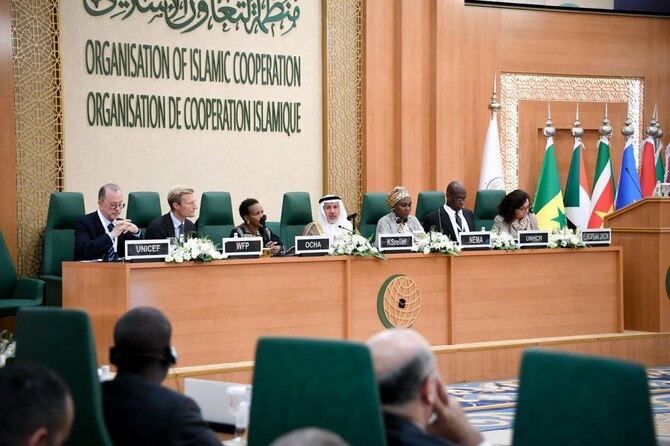


JEDDAH: After years of international neglect, the worsening humanitarian crisis in the Sahel and Lake Chad Basin region finally commanded global attention on Saturday as international leaders, humanitarian organizations, and government representatives convened in Jeddah for the High-Level Ministerial Donors Conference.
Co-hosted by Saudi aid agency KSrelief and the Organization of Islamic Cooperation, the event focused on the plight of more than 33 million people across six countries — Nigeria, Niger, Chad, Cameroon, Burkina Faso, and Mali — struggling with conflict, displacement, and hunger.
“The fact that we are all here today is already a success,” Dr. Abdullah Al-Rabeeah, supervisor-general of KSrelief, told Arab News on the sidelines of the event. “This conference has brought a forgotten crisis back to the forefront, where it deserves to be, and we are giving voice to millions who have been ignored for too long.”
A crisis long overlooked by the world
For years, the multifaceted crisis in the Sahel and Lake Chad Basin region has failed to capture the sustained attention of the global community. Despite the destabilizing effects of violent extremism, environmental degradation, and deep-seated poverty, the region has struggled to secure the international resources needed for an effective response.
Speaking to Arab News on the sidelines of the conference, Gilles Fagninou, UNICEF’s regional director for West and Central Africa, described the dire state of affairs.
“This is one of the most severe humanitarian crises we face, yet it receives far less attention than others,” Fagninou said. “Millions of women, children, and families are trapped in a cycle of suffering that the world seems to have forgotten.”
The violence that is responsible for much of the displacement of the local population in the area has largely been caused by armed groups such as Boko Haram and the Islamic State West Africa Province, which continue to spread terror across northern Nigeria and the broader region. Their brutal insurgencies have forced more than 11 million people from their homes, creating one of the largest displacement crises globally.
Patrick Youssef, regional director for Africa at the International Committee of the Red Cross, emphasized this during his interview with Arab News. “Every year, we see more displacement, more conflict, and an ever-widening gap between humanitarian needs and the resources available,” he said. “Conflict and climate change are converging, making the suffering of these populations unimaginable.”
A human catastrophe: displacement, hunger, and desperation
The humanitarian fallout from the crisis is staggering. Families displaced by conflict now reside in overcrowded camps where basic necessities — food, clean water, and medical care — are in critically short supply.
Al-Rabeeah stressed the human cost, saying: “The numbers are not just statistics — behind every figure is a person who has lost their home, their livelihood, and their sense of safety.”
With more than 3 million internally displaced persons in Nigeria alone and millions more across Chad, Niger, and Burkina Faso, the region’s humanitarian needs are overwhelming.
A particularly pressing concern is food security. According to UNICEF, 13 million people are at immediate risk of malnutrition, with children disproportionately affected. Fagninou warned that the situation is on the verge of spiraling further into disaster.
“We are on the brink of a catastrophe,” he said. “If the international community does not act now, millions of lives are at stake. This crisis is happening now — it is not a distant threat.”
Climate change: a growing threat to stability
Compounding the region’s instability is the devastating impact of climate change. Lake Chad, once the heartbeat of economic and social life for nearly 30 million people across Nigeria, Chad, Niger, and Cameroon, has shrunk by a staggering 90 percent over the last 50 years due to climate change and unsustainable water use.
The loss of so much of the lake has severely undermined local economies, particularly in fishing and agriculture, while desertification is forcing nomadic herders and farmers into direct competition over dwindling resources.
Youssef highlighted the brutal reality of these interconnected crises in his interview, saying: “The interplay between violence, resource scarcity, and environmental degradation is overwhelming communities.
“We are seeing the catastrophic effects of climate change in real-time. Livelihoods are collapsing, and displaced populations are struggling to find even the most basic resources, such as water and food.”
Erratic weather patterns, including droughts and floods, have further worsened the situation, with agricultural production becoming increasingly unreliable. The Sahel region is now seeing the expansion of arid lands, driving migration and intensifying conflicts over resources.
As Al-Rabeeah noted, addressing these environmental challenges is key to long-term stability. “It is not enough to provide immediate relief; we need to invest in sustainable development and climate adaptation strategies that can prevent future crises,” he said.
The urgent need for international action
Despite the magnitude of the crisis, it remains one of the most underfunded humanitarian emergencies in the world. The UN and international NGOs have repeatedly called attention to the funding gaps that have hampered efforts to meet basic needs, such as food, healthcare, and education.
Al-Rabeeah underscored the importance of a sustained international commitment: “While food security and healthcare are immediate priorities, we must also focus on building resilience and creating pathways for development. This is not just a short-term emergency — it requires a multifaceted, sustained response.”
Both Fagninou and Youssef echoed his sentiments. Fagninou, speaking on the role of the global community, said: “The international community must recognize the urgency of this crisis and provide the necessary resources. Local governments are doing their part, but they cannot tackle this alone.”
Youssef, reflecting on the broader needs, remarked: “Humanitarian assistance alone will not end the suffering. We need a commitment to peace and stability, alongside humanitarian efforts. Without addressing the root causes of conflict, the cycle of violence and displacement will only continue.”
A path forward: hope amid the crisis
The presence of high-level delegations, UN agencies, and major donor countries at the conference has produced a renewed sense of hope that the Sahel and Lake Chad Basin region will no longer be overlooked, and signals a potential turning point in mobilizing international support. Al-Rabeeah, for one, expressed optimism.
“The fact that so many key stakeholders are at the table — from governments to international donors and UN agencies—means that this crisis is no longer being ignored,” he said. “I believe we can generate significant financial commitments, despite global economic challenges.”
This conference could prove to be a pivotal moment in the international response to one of the world’s most overlooked humanitarian crises. It is a call to action; a reminder that the people of the Sahel and Lake Chad Basin are not forgotten, and that — with the right support — there is still hope for a brighter future.


