

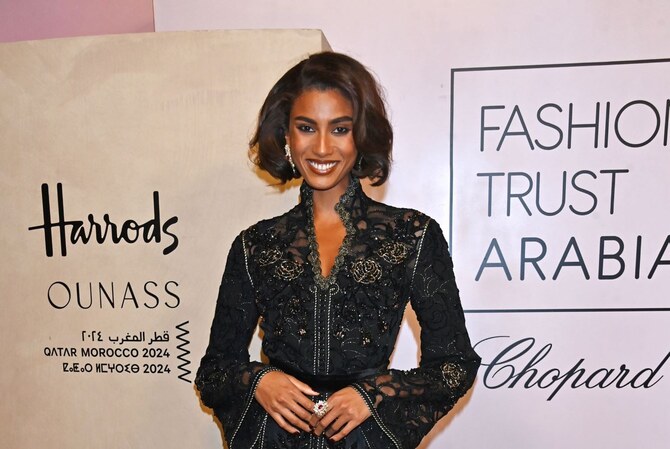
Imaan Hammam pays tribute to Moroccan artistry at FTA Awards

Imaan Hammam wore a black kaftan from Moroccan designer Selma Benomar at the Fashion Trust Arabia Awards in Marrakech. (Getty Images)
Short Url
Updated 26 October 2024
Follow

Imaan Hammam pays tribute to Moroccan artistry at FTA Awards

DUBAI: Dutch-Moroccan-Egyptian model Imaan Hammam took to Instagram to talk about her experience delivering the opening remarks at the highly anticipated Fashion Trust Arabia Awards’ sixth event, which took place in Marrakech, Morocco.

The 28-year-old went on stage in a gorgeous black kaftan from Moroccan designer Selma Benomar. The heavily embroidered look highlighted Moroccan artistry and design, and paid tribute to the country’s royal family.

“So honored to open this year’s @fashiontrustarabia Awards here in the motherland,” wrote Hamman on Instagram. “Celebrating Arab artistry in the place where my roots run deep made this experience truly special. Proud to uplift the creativity that makes our culture unique. A special thank you to @selma_benomar_caftan for designing this gorgeous Moroccan custom-made caftan.”

Though Hammam was born and raised in Amsterdam, her mother is from Morocco and she visits the country frequently.

Hammam is one of the most in-demand models in the industry. She was scouted in Amsterdam’s Centraal Station before making her catwalk debut in 2013 by walking in Jean Paul Gaultier’s couture show.  

Hammam has appeared on the runway for leading fashion houses, such as Burberry, Fendi, Prada, Bottega Veneta, Marc Jacobs, Moschino, Balenciaga and Carolina Herrera, to name a few, and starred in international campaigns for DKNY, Celine, Chanel, Versace, Givenchy, Giorgio Armani, Tiffany & Co. and more. 

Some of the other celebrity guests at the Fashion Trust Arabia ceremony included Emirati singer Balqees Fathi, British model Jourdan Dunn, Egyptian-Dutch model Imaan Hammam, Lebanese-British fashion entrepreneur Karen Wazen and American-Lebanese supermodel Nour Arida.

Meanwhile, Saudi Arabia jewelry label APOA won a top prize at the awards ceremony.

The company, which won in the jewelry category, posted a picture on its Instagram Stories page of the award, with the caption: “Thank you to everyone who’s ever believed in us, supported us, wore our pieces, shared our story, and celebrated us tonight! We love you.”

The Riyadh-born brand was founded by Saudi Arabia princesses Mashael Khalid Al-Saud, Nourah Abdulaziz Al-Saud and Sarah Naif Al-Saud in 2023.

Since its launch in 2023, APOA — “injected with strong Saudi DNA” and inspired by culture, architecture, nature and travel — has dropped four eclectic collections, which the cousins call “chapters.”


The difference between European and Gulf weddings — from a photographer’s point of view

Updated 4 sec ago
Follow

The difference between European and Gulf weddings — from a photographer’s point of view

DUBAI: From her early career in northeast France to working across the Gulf and Europe, wedding photographer Maddy Christina has observed many contrasts between such events in different parts of the world.

Her early years as a photographer were defined by variety; she worked across fashion, family portraits and weddings simultaneously before recognizing how wedding photography brings multiple genres together in a single day. 

Christina said weddings in the region required a shift in both perspective and technique. (Supplied)

“I actually fell into weddings by accident,” Christina told Arab News. “It blends every discipline at once — fashion for the couple session, sports for the reception, documentary work throughout the day, still life with details and jewelry.”

Christina’s connection to the Middle East began through Parisian clients who invited her to Dubai for a post-wedding session: “I instantly connected with the energy of the city,” she said.

Christina’s connection to the Middle East began through Parisian clients who invited her to Dubai for a post-wedding session. (Supplied)

A few years later, a wedding in Kuwait marked the start of her long-term relationship with the region.

Now working extensively across the Gulf Cooperation Council, Christina said weddings in the region required a shift in both perspective and technique.

For Christina, the most meaningful aspect extends beyond the wedding day itself. (Supplied)

“Working across the GCC has opened my mind in ways I didn’t expect,” she said, adding it felt like “resetting everything I thought I knew about weddings” — particularly compared to her experience in Europe.

She said there were clear distinctions between the two regions. “European weddings tend to be more demonstrative and expressive, while brides in the Gulf often place a deeper emphasis on tradition, family bonds and a sense of ceremony,” she said. “The emotional language is different, yet equally beautiful.”

From a technical standpoint, the contrast is just as pronounced: “In the south of France, I was used to shooting outdoors at sunset with couples already comfortable in front of the camera. Here, I often find myself in much smaller spaces, with no windows, artificial light and couples who may be more reserved.”

Christina is drawn to candid moments. (Supplied)

She added that adapting to these conditions pushed her to explore new ways of shaping light and expanded her creative approach.

While Christina is drawn to candid moments, like “guests laughing together, old friends reconnecting, a fleeting emotion passing across someone’s face,” posed pictures remain central to her work.

For Christina, the most meaningful aspect extends beyond the wedding day itself.

“It’s not the decor that makes a wedding unforgettable for me,” she said. “It’s the connection I build with the bride. That long-term bond is what feels truly magical.”