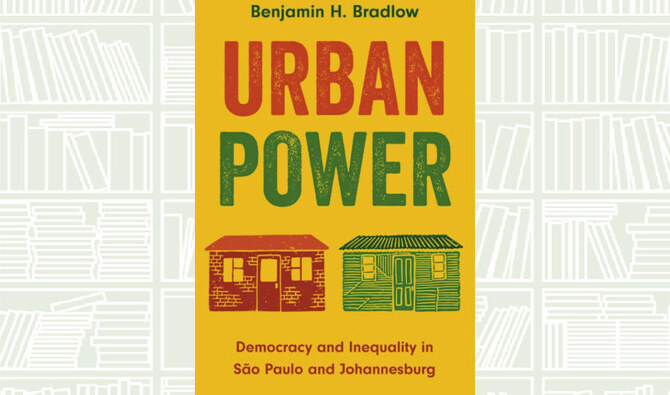
For the first time in history, most people live in cities. One in seven are living in slums, the most excluded parts of cities, in which the basics of urban life—including adequate housing, accessible sanitation, and reliable transportation—are largely unavailable. Why are some cities more successful than others in reducing inequalities in the built environment? In Urban Power, Benjamin Bradlow explores this question, examining the effectiveness of urban governance in two “megacities” in young democracies: Sao Paulo, Brazil, and Johannesburg, South Africa.
Both cities came out of periods of authoritarian rule with similarly high inequalities and similar policy priorities to lower them. And yet Sao Paulo has been far more successful than Johannesburg in improving access to basic urban goods.
Bradlow examines the relationships between local government bureaucracies and urban social movements that have shaped these outcomes.

What We Are Reading Today: Urban Power by Benjamin H. Bradlow
https://arab.news/gjqb7
What We Are Reading Today: Urban Power by Benjamin H. Bradlow
What We Are Reading Today: ‘Collaborating with the Enemy’
- This skill is certainly necessary to acquire and maintain in our increasingly globalized world
The title of the 2017 book “Collaborating with the Enemy: How to Work with People You Don’t Agree with or Like or Trust,” by Adam Kahane, is sure to catch your curiosity.
Printed by the independent, mission-driven publishing company Berrett-Koehler, the book delivers on delving into the topic.
Kahane, a director of Reos Partners — which describes itself as “an international social enterprise that helps people move forward together on their most important and intractable issues” — argues that traditional collaboration, which relies on harmony, consensus and a clear, shared plan, is often impossible to achieve in complex, polarized situations.
Instead, he proposes something called “stretch collaboration,” a framework for working with people you may not agree with, like, or even trust.
This skill is certainly necessary to acquire and maintain in our increasingly globalized world.
Some of the practical techniques and strategies mentioned can arguably be applied beyond the workplace: in fractured families or friendships, for example.
“The problem with enemyfying is not that we never have enemies: we often face people and situations that present us with difficulties and dangers,” Kahane writes.
“Moreover, any effort we make to effect change in the world will create discomfort, resistance, and opposition. The real problem with enemyfying is that it distracts and unbalances us. We cannot avoid others whom we find challenging, so we need to focus simply on deciding, given these challenges, what we ourselves will do next.”
The book boasts a foreword by Peter Block, bestselling author of “Community and Stewardship,” who writes: “The book is really an annotation on the title. The title asks me to collaborate with people I don’t agree with. Not so difficult. But then the stakes are raised, and I am asked to collaborate with people I don’t like. This too is manageable, even common in most workplaces.
“The final ask, though, is tougher: collaborate with people I don’t trust; even people I consider enemies. To make these acts doable is the promise of the book.”
And, in a way, it does. But Kahane seems to also use this book to pat himself on the back. In parts it reads like an expanded LinkedIn testimonial to his own resume.


