

Pakistan, Bangladesh agree to strengthen strategic cooperation at Samoa meeting

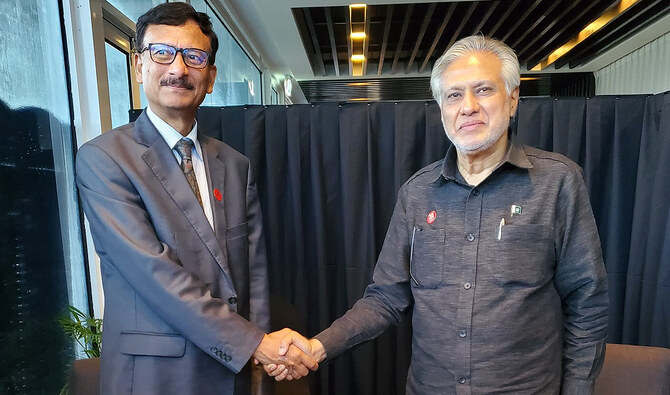
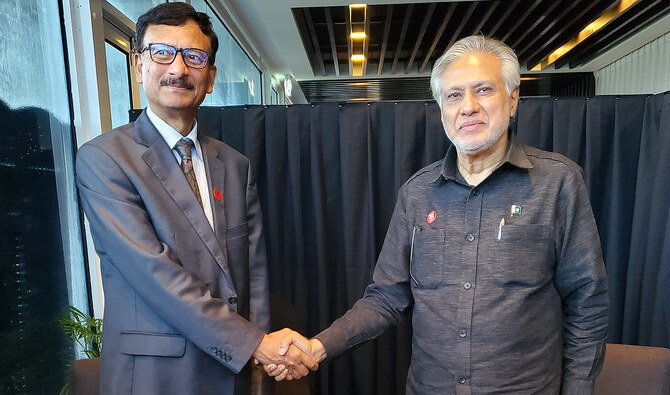
Pakistan Deputy Prime Minister and Foreign Minister Ishaq Dar shakes hands with Bangladesh Adviser for Foreign Affairs Md. Touhid Hossain during a meeting on the sidelines of the Commonwealth Heads of Government Meeting in Samoa on October 25, 2024. (Photo courtesy: MOFA)
Short Url
Updated 25 October 2024
Follow

Pakistan, Bangladesh agree to strengthen strategic cooperation at Samoa meeting

  • Ishaq Dar meets Bangladesh’s foreign affairs adviser on the sidelines of Commonwealth conference
  • The two sides agree to enhance high-level dialogue, discuss trade and cultural exchanges

ISLAMABAD: Pakistan and Bangladesh agreed to enhance high-level dialogue and strengthen strategic cooperation on Friday, as Deputy Prime Minister Ishaq Dar met with Bangladesh’s Foreign Affairs Adviser, Muhammad Touhid Hossain, during the Commonwealth Heads of Government Meeting in Samoa.
Relations between the two countries have mostly remained uneasy since 1971, when Bangladesh gained independence from Pakistan following a violent war. Tensions particularly deepened under the tenure of Sheikh Hasina Wajid, daughter of Bangladesh’s founding leader. However, the downfall of her administration in a popular uprising this year has opened the door for improved cooperation, with both nations signaling a renewed focus on economic ties and diplomatic engagement.
“Deputy Prime Minister Dar and Adviser for Foreign Affairs Hossain agreed to advance high-level dialogue and cooperation between Pakistan and Bangladesh, particularly in the areas of trade, cultural exchanges, and people-to-people contacts,” Pakistan’s foreign office announced in a post on X, formerly Twitter, after the meeting.
“Both sides agreed to strengthen cooperation at various multilateral fora,” it added.

Dar’s meeting with the Bangladeshi official comes after Prime Minister Shehbaz Sharif’s interaction with the top interim administration official in Dhaka, Muhammad Yunus, on the sidelines of the United Nations General Assembly (UNGA) in September.
During this meeting, they discussed various aspects of bilateral cooperation and exchanged pleasantries, marking a notable diplomatic engagement between the two nations following the change of political dispensation in Bangladesh.


Rating firm S&P says it won’t rush Iran war downgrades, sees risks for countries like Pakistan

Updated 12 March 2026
Follow

Rating firm S&P says it won’t rush Iran war downgrades, sees risks for countries like Pakistan

  • Agency says it is monitoring indebted energy importers as higher oil prices strain finances
  • Gulf economies seen better placed to weather shock, though Bahrain flagged as vulnerable

LONDON: S&P Global ‌said it would not make any knee-jerk sovereign rating cuts following the outbreak of war in the ​Middle East, but warned on Thursday that soaring oil and gas prices were putting a number of already cash-strapped countries at risk.

The firm’s top analysts said in a webinar that the conflict, which has involved US and Israeli strikes ‌against Iran and Iranian ‌strikes against Israel, ​US ‌bases ⁠and Gulf ​states, ⁠was now moving from a low- to moderate-risk scenario.

Most Gulf countries had enough fiscal buffers, however, to weather the crisis for a while, with more lowly rated Bahrain the only clear exception.

Qatar’s banking sector could ⁠also struggle if there were significant ‌deposit outflows in ‌reaction to the conflict, although there ​was no evidence ‌of such strains at the moment, they ‌said.

“We don’t want to jump the gun and just say things are bad,” S&P’s head global sovereign analyst, Roberto Sifon-Arevalo, said.

The longer the crisis ‌was prolonged, though, “the more difficult it is going to be,” he ⁠added.

Sifon-Arevalo ⁠said Asia was the second-most exposed region, due to many of its countries being significant Gulf oil and gas importers.

India, Thailand and Indonesia have relatively lower reserves of oil, while the region also had already heavily indebted countries such as Pakistan, Bangladesh and Sri Lanka whose finances would be further hurt by rising energy prices.

“We ​are closely monitoring ​these (countries) to see how the credit stories evolve,” Sifon-Arevalo said.