

Pakistan, Bangladesh agree to strengthen strategic cooperation at Samoa meeting

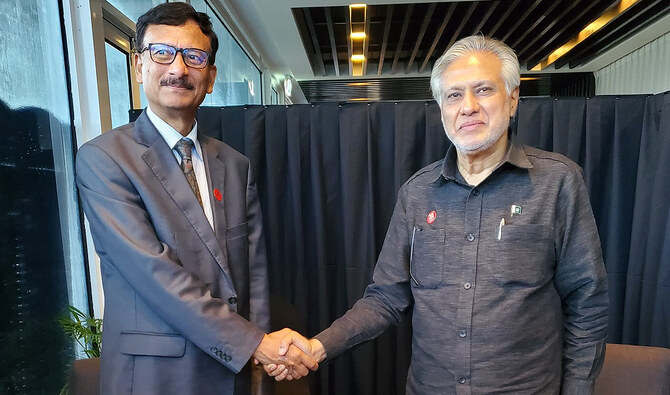
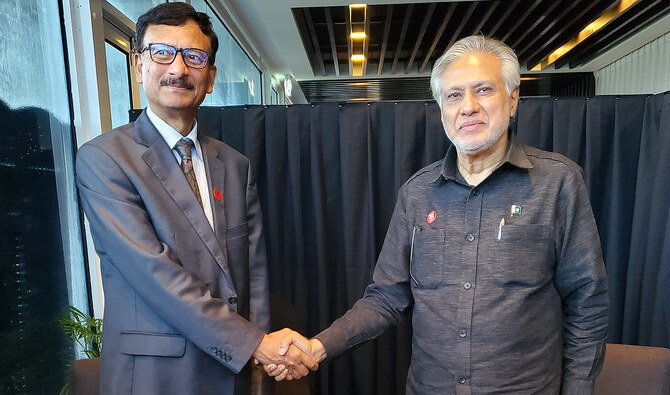
Pakistan Deputy Prime Minister and Foreign Minister Ishaq Dar shakes hands with Bangladesh Adviser for Foreign Affairs Md. Touhid Hossain during a meeting on the sidelines of the Commonwealth Heads of Government Meeting in Samoa on October 25, 2024. (Photo courtesy: MOFA)
Short Url
Updated 25 October 2024
Follow

Pakistan, Bangladesh agree to strengthen strategic cooperation at Samoa meeting

  • Ishaq Dar meets Bangladesh’s foreign affairs adviser on the sidelines of Commonwealth conference
  • The two sides agree to enhance high-level dialogue, discuss trade and cultural exchanges

ISLAMABAD: Pakistan and Bangladesh agreed to enhance high-level dialogue and strengthen strategic cooperation on Friday, as Deputy Prime Minister Ishaq Dar met with Bangladesh’s Foreign Affairs Adviser, Muhammad Touhid Hossain, during the Commonwealth Heads of Government Meeting in Samoa.
Relations between the two countries have mostly remained uneasy since 1971, when Bangladesh gained independence from Pakistan following a violent war. Tensions particularly deepened under the tenure of Sheikh Hasina Wajid, daughter of Bangladesh’s founding leader. However, the downfall of her administration in a popular uprising this year has opened the door for improved cooperation, with both nations signaling a renewed focus on economic ties and diplomatic engagement.
“Deputy Prime Minister Dar and Adviser for Foreign Affairs Hossain agreed to advance high-level dialogue and cooperation between Pakistan and Bangladesh, particularly in the areas of trade, cultural exchanges, and people-to-people contacts,” Pakistan’s foreign office announced in a post on X, formerly Twitter, after the meeting.
“Both sides agreed to strengthen cooperation at various multilateral fora,” it added.

Dar’s meeting with the Bangladeshi official comes after Prime Minister Shehbaz Sharif’s interaction with the top interim administration official in Dhaka, Muhammad Yunus, on the sidelines of the United Nations General Assembly (UNGA) in September.
During this meeting, they discussed various aspects of bilateral cooperation and exchanged pleasantries, marking a notable diplomatic engagement between the two nations following the change of political dispensation in Bangladesh.


Pakistan stocks tumble 2.3% as Middle East conflict rattles investors

Updated 6 sec ago
Follow

Pakistan stocks tumble 2.3% as Middle East conflict rattles investors

  • KSE-100 posts weekly loss of 6.3% as geopolitical tensions trigger sell-off
  • Foreign investors dump $25.5 million in equities amid global energy supply fears

ISLAMABAD: Pakistan’s benchmark stock index fell 2.3% on Friday as investors sold shares ahead of the weekend amid growing fears that the escalating conflict involving Iran could disrupt global energy supplies and trade routes.

The KSE-100 index closed down 3,714.57 points at 157,496.10, after touching an intraday high of 161,435.83 and a low of 157,072.64, according to the Pakistan Stock Exchange (PSX) data. Trading volume stood at about 196 million shares with a value of roughly Rs18.8 billion ($67 million).

The decline capped a volatile week for Pakistani equities, with the benchmark index falling 6.3% week-on-week as geopolitical tensions between Iran, the United States and Israel unsettled investors and triggered risk-off sentiment across regional markets.

“KSE-100 Index declined by -6.3% on a week-on-week basis, and this decline can be attributed to the Middle East conflict (US-Israel vs. Iran), where investors sold their positions in the backdrop of increasing risk to global energy supply and trade routes,” brokerage house Topline Securities said in its weekly review.

Topline said foreign corporate investors were among the largest sellers during the week, offloading equities worth $25.5 million, while mutual funds sold shares worth $54.5 million amid investor redemptions.

Banks, insurance companies and local corporates partly cushioned the sell-off, buying equities worth $36 million, $15.7 million and $14.3 million respectively during the week, according to the review.

Other economic developments during the week included Pakistan’s consumer price inflation for February rising to 6.98% from 5.80% in January and the country’s trade deficit widening to $2.98 billion for the month, up 8% from the previous month and 25% year-on-year.

Average daily trading volumes during the week stood at around 658 million shares, with average daily value reaching about Rs36.2 billion ($130 million), Topline said.