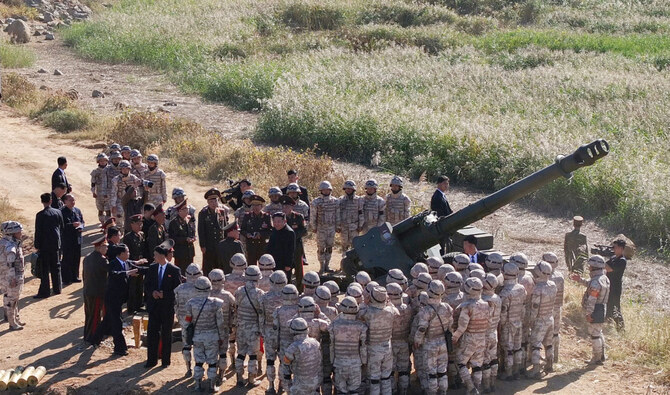
SEOUL: North Korea said on Friday any move to send its troops to assist Russia in its war in Ukraine would be in line with international law, although it stopped short of confirming that such a deployment had taken place.
Ukraine, the United States and other Western allies say they have evidence that Pyongyang has sent thousands of troops to Russia for possible deployment against Ukraine.
Previously both Pyongyang and the Kremlin had dismissed such reports as baseless
rumors.
But when asked about the reports on Thursday, Russian President Vladimir Putin
stopped short of denying them.
Ukraine says North Korean participation in the war, which began with Russia’s full-scale invasion of Ukraine in Feb. 2022, could amount to the crime of aggression under international law.
In a statement reported by North Korea’s KCNA news agency, Vice Foreign Minister Kim Jong Gyu said the foreign ministry was not directly involved in matters handled by the defense ministry and would not comment directly on any deployment.
However, he added: “If there is such a thing that the world media is talking about, I think it will be an act conforming with the regulations of international law.”
North Korea and Russia have developed closer relations since the war began, including signing a new mutual defense pact. Ukraine and Western countries have previously accused North Korea of supplying weapons to Russia, which Pyongyang and Moscow have denied.
Putin said on Thursday it was up to Moscow and Pyongyang how to conduct their mutual defense agreement, and accused the West of escalating the Ukraine war.
Ukrainian President Volodymyr Zelensky said on Friday that Russia plans to deploy North Korean troops to the battlefield starting Oct. 27-28, citing intelligence reports.
Ukrainian military intelligence said on Thursday that around 12,000 North Korean troops, including 500 officers and three generals, were already in Russia, and training was taking place on five military bases.
The United States has said it has seen evidence of North Korean troops in Russia, and South Korean lawmakers said about 3,000 soldiers had been sent, with more to follow.


![]()


North Korea says any deployment to aid Russia would be lawful
Short Url
https://arab.news/p6csa
North Korea says any deployment to aid Russia would be lawful
- Ukraine, the United States and other Western allies say they have evidence that Pyongyang has sent thousands of troops to Russia for possible deployment against Ukraine
- Previously both Pyongyang and the Kremlin had dismissed such reports as baseless rumors


Prolonging the Middle East conflict would further undermine regional, global stability, China’s top diplomat warns
- Yi made the remarks in a call with his Egyptian counterpart Badr Abdelatty
BEIJING: Prolonging the conflict in the Middle East will bring more suffering to local people, inflict major economic losses and further undermine regional and global stability, China’s top diplomat said on Thursday, state broadcaster CCTV reported.
Chinese Foreign Minister Wang Yi made the remarks in a call with his Egyptian counterpart Badr Abdelatty and called for an immediate ceasefire in the region.
“All parties should urge the parties concerned to press the ‘stop button’ on military operations as soon as possible to prevent the situation from deteriorating further,” Wang was quoted as saying.


Latest updates


© 2026 SAUDI RESEARCH & PUBLISHING COMPANY, All Rights Reserved And subject to Terms of Use Agreement.