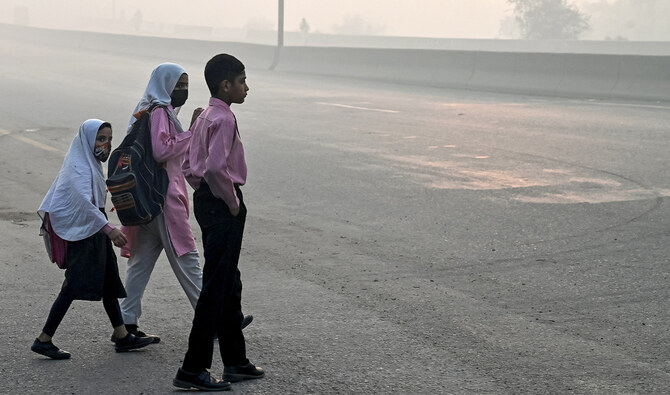
Smog in Pakistan megacity ends outdoor play for schoolkids

Children wearing masks walk to school amid dense smog in Lahore on October 23, 2024. (AFP)
Short Url
Updated 25 October 2024
Follow

Smog in Pakistan megacity ends outdoor play for schoolkids

  • The eastern city of Lahore near the border with India regularly registers among the world’s most polluted cities
  • Smog is particularly bad in winter due to low-grade fuel from factories, vehicles in low-lying city of 14 million

LAHORE: Schoolchildren in Pakistan’s second-largest city of Lahore have been banned from outdoor exercise until January because of hazardous smog levels, officials said Friday.
The eastern megacity near the border with India regularly registers among the world’s most polluted cities, this week recording more than 20 times the level deemed safe by the World Health Organization (WHO).
Smog is particularly bad in winter as a result of low-grade fuel from factories and vehicles in the low-lying megacity of 14 million, where denser cold air traps emissions at ground level.
Seasonal crop burn-off by farmers on the outskirts of Lahore is also a major contributing factor.
This week the Environmental Protection Agency of eastern Punjab province said that outdoor school activities in Lahore would end from Monday.
A Punjab School Education Department spokesman told AFP on Friday the ban would last for three months until January 31.
School hours will also be cut in the morning to prevent children traveling when the pollution is most punishing.
Lessons will start no earlier than 8:45 am (0345 GMT), cutting 15 minutes off learning hours for public schools and more than an hour for most private schools.
Breathing the toxic air has catastrophic health consequences, with WHO saying strokes, heart disease, lung cancer and respiratory diseases could be triggered due to prolonged exposure.
According to UNICEF nearly 600 million children in South Asia are exposed to high levels of air pollution.
Schools in Pakistan’s most populous province of Punjab in particular are increasingly disrupted by extreme heat in the summer and choking smog in the winter.
In an editorial on Friday, Pakistan’s leading English-language newspaper Dawn said measures such as shutting schools were “akin to putting band-aids on gaping wounds.”
“The long-term strategies needed to combat this environmental crisis remain elusive,” it said.



Pakistan terms climate change, demographic pressures as ‘pressing existential risks’

Updated 06 December 2025
Follow

Pakistan terms climate change, demographic pressures as ‘pressing existential risks’

  • Pakistan has suffered frequent climate change-induced disasters, including floods this year that killed over 1,000
  • Pakistan finmin highlights stabilization measures at Doha Forum, discusses economic cooperation with Qatar 

ISLAMABAD: Pakistan’s Finance Minister Muhammad Aurangzeb on Saturday described climate change and demographic pressures as “pressing existential risks” facing the country, calling for urgent climate financing. 

The finance minister was speaking as a member of a high-level panel at the 23rd edition of the Doha Forum, which is being held from Dec. 6–7 in the Qatari capital. Aurangzeb was invited as a speaker on the discussion titled: ‘Global Trade Tensions: Economic Impact and Policy Responses in MENA.’

“He reaffirmed that while Pakistan remained vigilant in the face of geopolitical uncertainty, the more pressing existential risks were climate change and demographic pressures,” the Finance Division said. 

Pakistan has suffered repeated climate disasters in recent years, most notably the 2022 super-floods that submerged one-third of the country, displaced millions and caused an estimated $30 billion in losses. 

This year’s floods killed over 1,000 people and caused at least $2.9 billion in damages to agriculture and infrastructure. Scientists say Pakistan remains among the world’s most climate-vulnerable nations despite contributing less than 1 percent of global greenhouse-gas emissions.

Aurangzeb has previously said climate change and Pakistan’s fast-rising population are the only two factors that can hinder the South Asian country’s efforts to become a $3 trillion economy in the future. 

The finance minister noted that this year’s floods in Pakistan had shaved at least 0.5 percent off GDP growth, calling for urgent climate financing and investment in resilient infrastructure. 

When asked about Pakistan’s fiscal resilience and capability to absorb external shocks, Aurangzeb said Islamabad had rebuilt fiscal buffers. He pointed out that both the primary fiscal balance and current account had returned to surplus, supported significantly by strong remittance inflows of $18–20 billion annually from the Middle East and North Africa (MENA) and Gulf Cooperation Council (GCC) regions. 

Separately, Aurangzeb met his Qatari counterpart Ali Bin Ahmed Al Kuwari to discuss bilateral cooperation. 

“Both sides reaffirmed their commitment to strengthening economic ties, particularly by maximizing opportunities created through the newly concluded GCC–Pakistan Free Trade Agreement, expanding trade flows, and deepening energy cooperation, including long-term LNG collaboration,” the finance ministry said. 

The two also discussed collaboration on digital infrastructure, skills development and regulatory reform. They agreed to establish structured mechanisms to continue joint work in trade diversification, technology, climate resilience, and investment facilitation, the finance ministry said.