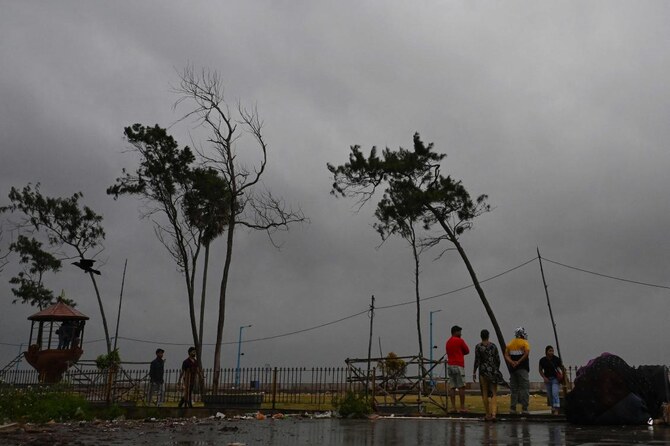
KOLKATA: Cyclone Dana uprooted trees and power lines after making landfall on India’s east coast, with officials warning of more fierce weather on Friday.
Cyclones — the equivalent of hurricanes in the North Atlantic or typhoons in the northwestern Pacific — are a regular and deadly menace in the northern Indian Ocean.
At least 1.1 million people in the states of Odisha and West Bengal were relocated to storm shelters before the eye of the cyclone reached the coast just after midnight.
District official Siddarth Swain said that the storm had left a “trail of destruction” in the coastal town of Puri.
“Many trees and electric poles are uprooted,” he added. “Makeshift shops on the sprawling beach have been blown away.”
No casualties have been reported so far.
Dana flooded parts of the coast after triggering a surge in sea levels of up to 1.15 meters (3.75 feet).
On landfall the storm had gusting winds up to 120 kilometers per hour, Kolkata-based weather bureau forecaster Somenath Dutta said.
The Sundarbans, the largest mangrove forest in the world, was hit by a “gale force wind” that caused hundreds of trees to be uprooted, West Bengal minister Bankim Chandra Hazra said.
“The cyclone also damaged hundreds of homes, blowing off roofs in coastal areas,” he added.
Major airports have been shut since Thursday night in Kolkata, India’s third-biggest city and a key travel hub, which was lashed by heavy rains.
Scientists have warned that storms are becoming more powerful as the world heats up due to climate change driven by burning fossil fuels.
Warmer ocean surfaces release more water vapor, which provides additional energy for storms, strengthening winds.
A warming atmosphere also allows storms to hold more water, boosting heavy rainfall.
But better forecasting and more effective evacuation planning have dramatically reduced death tolls.
In May, Cyclone Remal killed at least 48 people in India and at least 17 people in Bangladesh, according to government figures.

Trees and power lines flattened as Cyclone Dana hits India
https://arab.news/z8e9m
Trees and power lines flattened as Cyclone Dana hits India
- Cyclones are a regular and deadly menace in the northern Indian Ocean
- At least 1.1 million people in the states of Odisha and West Bengal were relocated to storm shelters
Europeans push back at US over claim they face ‘civilizational erasure’
- “Contrary to what some may say, woke, decadent Europe is not facing civilizational erasure,” Kallas told the conference
MUNICH: A top European Union official on Sunday rejected the notion that Europe faces “civilizational erasure,” pushing back at criticism of the continent by the Trump administration.
EU foreign policy chief Kaja Kallas addressed the Munich Security Conference a day after US Secretary of State Marco Rubio offered a somewhat reassuring message to European allies. He struck a less aggressive tone than Vice President JD Vance did in lecturing them at the same gathering last year but maintained a firm tone on Washington’s intent to reshape the trans-Atlantic alliance and push its policy priorities.
Kallas alluded to criticism in the US national security strategy released in December, which asserted that economic stagnation in Europe “is eclipsed by the real and more stark prospect of civilizational erasure.” It suggested that Europe is being enfeebled by its immigration policies, declining birth rates, “censorship of free speech and suppression of political opposition” and a “loss of national identities and self-confidence.”
“Contrary to what some may say, woke, decadent Europe is not facing civilizational erasure,” Kallas told the conference. “In fact, people still want to join our club and not just fellow Europeans,” she added, saying she was told when visiting Canada last year that many people there have an interest in joining the EU.
Kallas rejected what she called “European-bashing.”
“We are, you know, pushing humanity forward, trying to defend human rights and all this, which is actually bringing also prosperity for people. So that’s why it’s very hard for me to believe these accusations.”
In his conference speech, Rubio said that an end to the trans-Atlantic era “is neither our goal nor our wish,” adding that “our home may be in the Western hemisphere, but we will always be a child of Europe.”
He made clear that the Trump administration is sticking to its guns on issues such as migration, trade and climate. And European officials who addressed the gathering made clear that they in turn will stand by their values, including their approach to free speech, climate change and free trade.
British Prime Minister Keir Starmer said Saturday that Europe must defend “the vibrant, free and diverse societies that we represent, showing that people who look different to each other can live peacefully together, that this isn’t against the tenor of our times.”
“Rather, it is what makes us strong,” he said.
Kallas said Rubio’s speech sent an important message that America and Europe are and will remain intertwined.
“It is also clear that we don’t see eye to eye on all the issues and this will remain the case as well, but I think we can work from there,” she said.


