

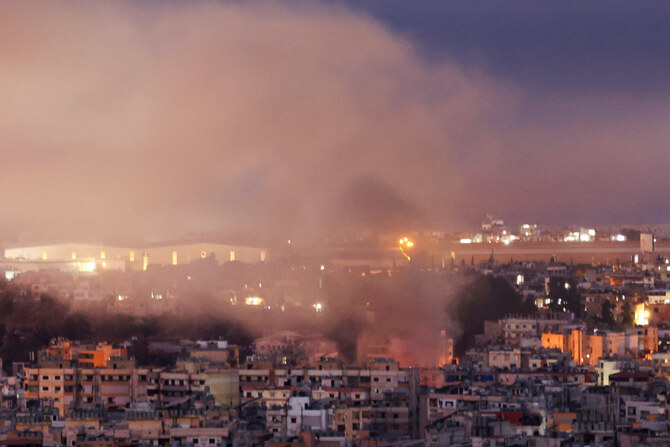
IMF official calls on international community to bring end to Lebanon conflict
A recent United Nations Development report estimated that Lebanon’s GDP would be 9.2 percent smaller as a “direct consequence” of the conflict
Updated 25 October 2024
AFP
WASHINGTON: The international community should work to end the conflict in the Middle East and address the “huge” humanitarian crisis that has engulfed countries in the region, the head of the IMF’s Middle East and Central Asia department said Thursday.
Jihad Azour spoke to AFP in Washington, where the annual meetings of the International Monetary Fund and the World Bank are currently taking place.
In updated economic estimates, the Fund slightly downgraded its outlook for economic growth in the Middle East and North Africa to 2.1 percent this year, while maintaining its 4.0 percent growth outlook for 2025.
However, these estimates do not take into account the economic impact of the recent escalation of conflict in southern Lebanon, where Israel has invaded to fight Hezbollah.
Azour, a former Lebanese finance minister, noted that the most severely affected places, including Lebanon and the Palestinian territories, were facing a “huge humanitarian problem” which has devastated their economies.
“You have massive loss in output, you have a massive destruction in infrastructure, and you have a huge set of needs for additional spending, for shelter, for health and so on,” he said.
“We expect that growth will be negative in those cases, and we expect that the recovery would take longer to materialize,” he added.
The IMF has suspended its forecasts for the Lebanese economy, citing an “unusually high degree of uncertainty.” But a recent United Nations Development report estimated that the country’s GDP would be 9.2 percent smaller as a “direct consequence” of the conflict.
“You have massive destruction of infrastructure in a large region, which is the south, and mass destruction of livelihood, because this is an agricultural region that was severely affected,” Azour said, adding that almost 20 percent of Lebanon’s population had been displaced.
“We encourage the international community, we encourage the friends of Lebanon, to provide grants,” he continued, calling on the international community “to put its utmost effort in order to solve the problem, in order to reduce the suffering of people.”
For countries indirectly affected by the conflict, like Jordan and Egypt, the impact of Israel’s ongoing military campaigns in Gaza and Lebanon has been felt differently.
While Egypt has been hit hard by a 70 percent fall in revenues from ships traversing the Suez Canal, Jordan’s economy has suffered from a steep decline in tourism, Azour said.
The IMF recently expanded an existing loan program with Egypt from $3 billion to $5 billion, in return for painful and wide-ranging economic reforms, including a shift to a more flexible exchange rate and an emphasis on tackling inflation and high debt levels.
Azour said that while the Fund was currently focused on helping countries in the region address immediate concerns, it also had a role to play in bringing the region together to help with post-conflict reconstruction.
“We think that there is a regional play here, whereby countries could trade and exchange more and can grow better together,” he said.
Mexico fears more violence after army kills leader of powerful Jalisco cartel
Updated 1 sec ago
GUADALAJARA: School was canceled in several Mexican states and local and foreign governments alike warned their citizens to stay inside, as widespread violence erupted following the army’s killing of the powerful leader of the Jalisco New Generation Cartel. Nemesio Rubén Oseguera Cervantes, known as “El Mencho” was the boss of one of the fastest-growing criminal networks in Mexico, notorious for trafficking fentanyl, methamphetamine and cocaine to the United States and staging brazen attacks against government officials who challenged it. He was killed during a shoot-out in his home state of Jalisco as the Mexican military attempted to capture him. Cartel members responded with violence across the country, blocking roads and setting fire to vehicles. President Claudia Sheinbaum urged calm and authorities announced late Sunday they had cleared most of the more than 250 cartel roadblocks across 20 states. The White House confirmed that the US provided intelligence support to the operation to capture the cartel leader and applauded Mexico’s army for taking down a man who was one of the most wanted criminals in both countries. Mexico hoped the death of the world’s biggest fentanyl traffickers would ease Trump administration pressure to do more against the cartels, but many remained hunkered down and on edge as they waited to see the powerful cartel’s reaction. Many fear more violence Guadalajara, the capital of Jalisco state and Mexico’s second-largest city, was almost completely shut down on Sunday as fearful residents stayed home. Passengers arriving to the city’s international airport Sunday night were told it was operating with limited personnel because of the burst of violence. Jacinta Murcia, a 64-year-old nutrition products vendor, was among those nervously walking late Sunday night through the airport, where earlier in the day travelers sprinted and ducked behind chairs fearing violence. Most flights into the city were suspended on Sunday. Murcia anxiously scrolled through news stories on social media showing the face of “El Mencho” and sent messages to her children, who were tracking her location as she tried to travel across the city to her house after dark. “My plan today leaving the airport is to see if there are any taxis, but I’m scared of everything. That there are blockades, that there’s a curfew, that something could happen,” she said. “I’m all alone.” Authorities in Jalisco, Michoacan and Guanajuato reported at least 14 other people killed Sunday, including seven National Guard troops. Videos circulating on social media showed tourists in Puerto Vallarta walking on the beach with smoke rising in the distance. In another part of the airport a group of elderly Mexicans gathered, discussing how to get home. “We better all go together,” one said. “Go with God.” A blow against a cartel could be a diplomatic coup David Mora, Mexico analyst for International Crisis Group, said the capture and outburst of violence marks a point of inflection in Sheinbaum’s push to crack down on cartels and relieve US pressures. US President Donald Trump has demanded Mexico do more to fight the smuggling of the often-deadly drug fentanyl, threatening to impose more tariffs or take unilateral military action if the country does not show results. There were early signs that Mexico’s efforts were well received by the United States. US Amb. Ron Johnson recognized the success of the Mexican armed forces and their sacrifice in a statement late Sunday. He added that “under the leadership of President Trump and President Sheinbaum, bilateral cooperation has reached unprecedented levels.” But it may also pave the way for more violence as rival criminal groups take advantage of the blow dealt to the CJNG, Mora said. “This might be a moment in which those other groups see that the cartel is weakened and want to seize the opportunity for them to expand control and to gain control over Cartel Jalisco in those states,” he said. “Ever since President Sheinbaum has been in power, the army has been way more confrontational, combative against criminal groups in Mexico,” Mora said. “This is signaling to the US that if we keep cooperating, sharing intelligence, Mexico can do it, we don’t need US troops on Mexican soil.” ‘El Mencho’ was a major target Oseguera Cervantes, who was wounded in the operation to capture him Sunday in Tapalpa, Jalisco, about a two-hour drive southwest of Guadalajara, died while being flown to Mexico City, the Defense Department said in a statement. During the operation, troops came under fire and killed four people at the location. Three more people, including Oseguera Cervantes, were wounded and later died, the statement said. White House Press Secretary Karoline Leavitt said via X that the US government provided intelligence support for the operation. “‘El Mencho’ was a top target for the Mexican and United States government as one of the top traffickers of fentanyl into our homeland,” she wrote. She commended Mexico’s military for its work. The US State Department had offered a reward of up to $15 million for information leading to the arrest of El Mencho. The Jalisco New Generation Cartel is one of the most powerful and fastest growing criminal organizations in Mexico and began operating around 2009. In February 2025, the Trump administration designated the cartel as a foreign terrorist organization. Sheinbaum has criticized the “kingpin” strategy of previous administrations that took out cartel leaders, only to trigger explosions of violence as cartels fractured. While she has remained popular in Mexico, security is a persistent concern and since US President Donald Trump took office a year ago, she has been under tremendous pressure to show results against drug trafficking. The Jalisco cartel has been one of the most aggressive cartels in its attacks on the military — including on helicopters — and is a pioneer in launching explosives from drones and installing mines. In 2020, it carried out a spectacular assassination attempt with grenades and high-powered rifles in the heart of Mexico City against the then head of the capital’s police force and now federal security secretary.