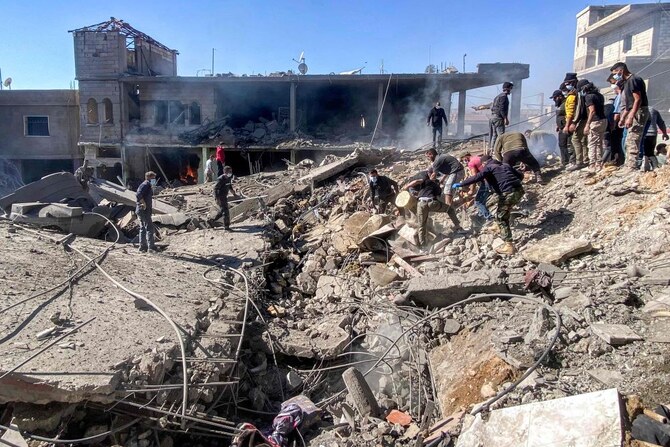

BEIRUT: Residential buildings in Khodor, Baalbek, were targeted in Israeli raids on Thursday, leaving victims trapped beneath rubble for several hours. An initial attack left seven people dead and 14 injured.
Residents of the area, where most people rely on agriculture for a living, urged the authorities and the Red Cross to send bulldozers and heavy equipment to rescue those who were trapped.
Attacks continued during Thursday, reaching the city of Byblos for the first time. Israeli warplanes attacked the Almat area, which has no residential homes. Their target is not yet known.
An Israeli drone chased a car between Kahale and Aley in Mount Lebanon, killing the driver and one passenger, who was his brother, and severely injuring two children. Identified as Hussein and Haidar Srour, from the southern border village of Aita Al-Shaab, they were transferred to Hezbollah’s Al-Rassoul Al-Azam Hospital for treatment.
Beirut’s southern suburb witnessed the most violent attacks since the expansion of Israel’s hostilities against Hezbollah, with some 17 raids launched on areas surrounding Laylaki and Haret Hreik.
One residential complex was completely destroyed with a fire visible from far away. Those who live there evacuated the area some weeks ago, traveling to Beirut, Mount Lebanon, Tripoli or the north.
Emergency Committee Coordinator and caretaker Environment Minister Nasser Yassin, in Paris on Thursday for a conference to rally support for Lebanon, said: “Lebanon will need $250 million a month to help more than a million people displaced by Israeli attacks, and to cover the costs of war and displacement consequences on key sectors.”
He said the government response, helped by local initiatives and international aid, only covered 20 percent of the needs of around 1.3 million people. He estimated the damage caused to southern Lebanon, Bekaa, Beirut and the capital’s southern suburb ran to billions of dollars.
The twelfth plane operated by KSrelief as part of the Saudi aid effort landed at Beirut’s Rafik Hariri International Airport on Thursday carrying essential humanitarian supplies including food and medical stocks.
Meanwhile, southern Lebanon was heavily hit, especially Jbaa, Houmine Al-Tahta, Kfar Dounine, Aita Al-Shaab and Beit Lif. The Israeli army continued bombing houses on the outskirts of border town Aita Al-Shaab, while another raid on a house in Yater, Bint Jbeil, resulted in numerous deaths and injuries. Two paramedics were hurt as Israeli warplanes targeted the same area during rescue efforts.
A series of raids on Tyre destroyed a number of buildings, while a motorcycle rider was killed and his passenger injured after being targeted by a drone. Aita Al-Shaab and Ramyah were targeted at dawn by artillery shelling and heavy machine gun fire, while airstrikes on Bori Qalaouiye killed town mayor Hassan Rmeity.
On Wednesday, a Lebanese army officer and two soldiers were killed trying to evacuate the wounded following an airstrike on Yater. They were named as Maj. Mohammad Farhat, Sgt. Moussa Mehanna and Pvt. Mohammed Nazzal.
The General Directorate of Internal Security Forces announced it was mourning Sgt. Ali Jihad Farhat, killed on Wednesday in a strike on his hometown of Arabsalim in the Nabatieh region.
Israeli army spokesman Avichay Adraee said: “The Israeli Air Force planes targeted more than 160 Hezbollah targets, including rocket launchers, military buildings and infrastructure across Lebanon.
“The army found a housing area used by Hezbollah members, as well as dozens of weapons, including Kalashnikov rifles and shoulder-fired rockets, inside a house in southern Lebanon, in addition to combat means including rocket launchers, mortars, weapons and ammunition, and weapons depots containing hundreds of anti-armor rockets and mortar shells.”
Meanwhile, Hezbollah announced it had shelled the St. Jean logistics base between the settlement of Nahariya and the city of Acree and targeted two gatherings of Israeli forces in the settlements of Al-Manara and Misgav Am. It also attacked the settlement of Karmiel and shelled Kiryat Shmona, the city of Nahariya, the city of Safed and the Zevulun military-industrial base in the north of Haifa.
Hezbollah has stopped naming those who were killed since thousands of communications devices exploded in September.