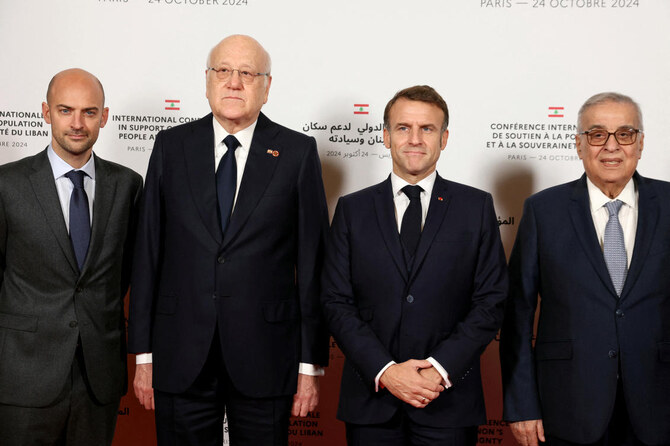
PARIS: France’s foreign minister said an international conference for Lebanon raised $1 billion in pledges for humanitarian aid and military support to help the country where war between Hezbollah militants and Israel has displaced a million people, killed over 2,500, and deepened an economic crisis.
Jean-Noël Barrot said: “We have collectively raised $800 million in humanitarian aid and $200 million for the security forces, that’s about $1 billion,” in his closing speech at the Paris conference, which gathered over 70 nations and international organizations.
“We’re up to the challenge,” Barrot said.
The United States pledged to provide about $300 million, he said.
French President Emmanuel Macron had called on participants to bring “massive aid” to support the country, as France promised $100 million.
The United Nations had previously estimated the urgent humanitarian needs in Lebanon to be $426 million.
Germany pledged a total of 96 million euros in humanitarian aid to both Lebanon and neighboring Syria, also deeply affected by escalating violence in the Middle East. Italy announced this week an additional 10 million euros ($10.8 million) in aid for Lebanon.
However, experts warn that delivering aid could be challenging as Lebanon’s growing dependence on informal and cash economy increases lack of transparency and corruption risks.
The Paris conference also aimed at coordinating international support to strengthen Lebanon’s armed forces so they can deploy in the country’s south as part of a potential deal to end the war. Such a deal could see Hezbollah withdraw its forces from the border.
This support to the Lebanese military includes “helping with health care, fuel, small equipment, but also supporting the plan to recruit at least 6,000 additional soldiers and to enable the deployment of at least 8,000 additional soldiers in the south,” Macron said.
Paris also seeks to help restore Lebanon’s sovereignty and strengthen its institutions. The country, where Hezbollah effectively operates as a state within a state, has been without a president for two years while political factions fail to agree on a new one.
UN Secretary-General António Guterres, in a pre-recorded video, called on Lebanon’s leaders “to take decisive action to ensure the proper functioning of state institutions in order to meet the country’s urgent political and security challenges.”
Acting Lebanese Prime Minister Najib Mikati urged the international community to take action.
“The devastating impact of this war on our nation cannot be overstated, and it has left a trail of destruction and misery in its wake. The Israelis’ aggression has not only caused immense human suffering and loss of lives, but also inflicted severe damage to the country’s infrastructure, economy and social fabric,” Mikati said Thursday in Paris.
In Lebanon, an Israeli airstrike killed early Thursday three Lebanese soldiers, including an officer, as they were evacuating wounded people in southern Lebanon. The Lebanese army said Israeli forces have targeted it on eight occasions since an all-out war broke out between Israel and Hezbollah in September.
The Israeli army apologized for a strike on Sunday that it said mistakenly killed three soldiers, and on Wednesday said it was looking into whether “a number of soldiers of the Lebanese army were accidentally harmed” after it targeted what it says was Hezbollah infrastructure.
Israel in the past month has launched a major aerial bombardment and ground invasion of Lebanon as it says it’s targeting Hezbollah, with strikes hitting the capital, Beirut, and elsewhere.
The International Organization for Migration has said about 800,000 people are displaced, with many now in overcrowded shelters, while others have fled across the border into Syria. Mikati on Thursday estimated the number of displaced people is over 1.4 million, including 500,000 children.
The cash-strapped Lebanese government is ill-prepared to deal with the crisis or the increased demands on its health system. Several have been evacuated because of nearby airstrikes and fears that they might be targeted.
Lebanon’s army has been hit hard by five years of economic crisis. It has an aging arsenal and no air defenses, leaving it in no position to defend against Israeli incursions or confront Hezbollah.
The Lebanese army has about 80,000 troops, around 5,000 of them deployed in the south. Hezbollah has more than 100,000 fighters, according to the militant group’s late leader, Hassan Nasrallah. The militant group’s arsenal, built with support from Iran, is more advanced.
Conference participants also are to discuss how to support the 10,500-soldier-strong UN peacekeeping mission, UNIFIL. European nations including France, Italy and Spain provide a third of its troops.
Italy, which has over 1,000 troops in UNIFIL, is pushing for the peacekeeping force to be strengthened to “be able to face the new situation” on the ground, an Italian diplomat said, speaking anonymously to discuss ongoing talks.
Guterres said Thursday that “attacks on UN peacekeepers are totally unacceptable and are contrary to international law, contrary to international humanitarian law and may constitute a war crime.”
France’s historic links with Lebanon, a former colony, and its influential diplomacy give Paris momentum to coordinate “a proper response to the massive challenge that the war in Lebanon now poses,” said Middle East expert Rym Montaz, editor-in-chief of Carnegie Europe’s blog Strategic Europe.
“What we do know is that without a strengthened Lebanese armed forces and UNIFIL, there can be no sustainable peace and stability at the border between Lebanon and Israel,” Montaz said. “As such, the French efforts are important and crucial for the way forward.”


![]()

French foreign minister says conference for Lebanon raised $1 billion in pledges
Short Url
https://arab.news/4t6gg
French foreign minister says conference for Lebanon raised $1 billion in pledges
- Jean-Noël Barrot said: “We have collectively raised $800 million in humanitarian aid and $200 million for the security forces, that’s about $1 billion”
- The United States pledged to provide about $300 million, he said


Latest updates


Recommended


© 2026 SAUDI RESEARCH & PUBLISHING COMPANY, All Rights Reserved And subject to Terms of Use Agreement.