

At SCO dinner gala, Pakistani chef crafted meatless menu for Indian delegates

The collage of images created on October 24, 2024, shows Chef Asad Monga posing for a picture with the flag of the Shanghai Cooperation Organization countries (left), and plates lined up for the guests of the summit at Serena Hotel in Islamabad, Pakistan. (Asad Monga)
Short Url
Updated 24 October 2024
Follow

At SCO dinner gala, Pakistani chef crafted meatless menu for Indian delegates

  • Asad Monga was asked to come to Islamabad to oversee the food served to foreign dignitaries
  • He says Pakistan should develop a service-based economy focusing on hospitality, culinary arts

KARACHI: A Karachi-based chef, specially flown to Islamabad to oversee meals for foreign dignitaries at the Shanghai Cooperation Organization (SCO) Summit, said this week his team ensured diversity in the menu to respect cultural sensitivities, recalling they avoided serving red meat to the Indian delegation.

The 23rd SCO Council of Heads of Government took place on October 15 and 16, bringing together political leaders from Russia, China, India, Kazakhstan, Tajikistan and other participating nations, including Pakistan.

Chef Asad Monga, 32, was invited to join the culinary experts at Islamabad’s popular Serena Hotel for the summit’s lunch and dinner services.

He informed the menu not only reflected international flavors but also highlighted local Pakistani dishes such as mutton chops and flatbread with minced meat filling. However, his team was also sensitive to the dietary preferences of the visiting delegates.

“[It was] just a good, well rounded mix of food to showcase our regional capabilities as people and as cooks, and also keeping in mind the diverse set of people that were coming to eat the food so that it registers with their palette also,” he told Arab News on Tuesday.

“We couldn’t serve red meat to the Indian delegates, so we had a vegetarian and chicken-based menu for that,” he added.
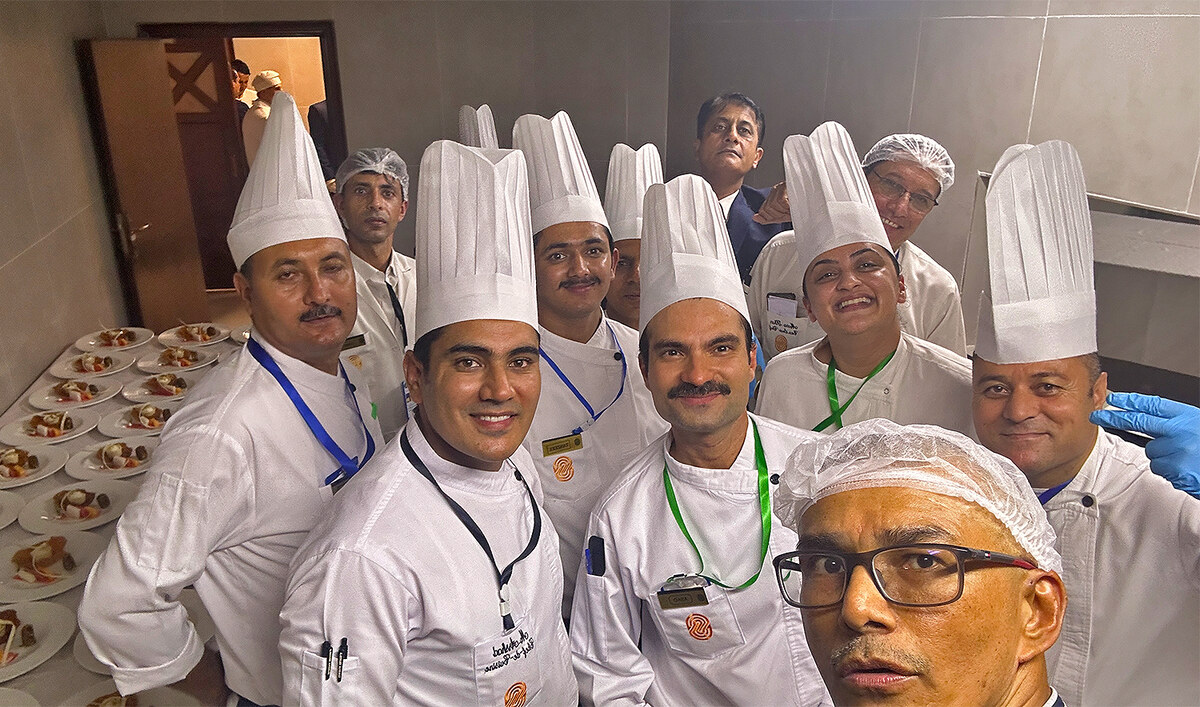


Chef Asad Monga (center in the first row) poses for a picture with other chefs during Shanghai Cooperation Organization (SCO) Summit held in Pakistan's capital, Islamabad, on October 15-16, 2024. (Asad Monga)

Indian External Affairs Minister Subramanyam Jaishankar, who led his country’s delegation at the SCO Summit, was the first high-profile official from New Delhi to visit Pakistan in nearly a decade.

Although he did not hold formal bilateral meetings in Islamabad, Pakistani officials described his trip as an “ice breaker” amid hopes in both countries for a thaw in the frosty relations between the two nuclear-armed neighbors.

“The meal started with the Mezze Platter. There was Yousaf Labneh on the menu, and of course, butters were served with Sumac as a condiment,” Monga said.

“The Middle Eastern influence in our region is strong, and when you serve food in a restaurant or a five-star hotel, you will always find some Middle Eastern cuisine on the table,” he added.
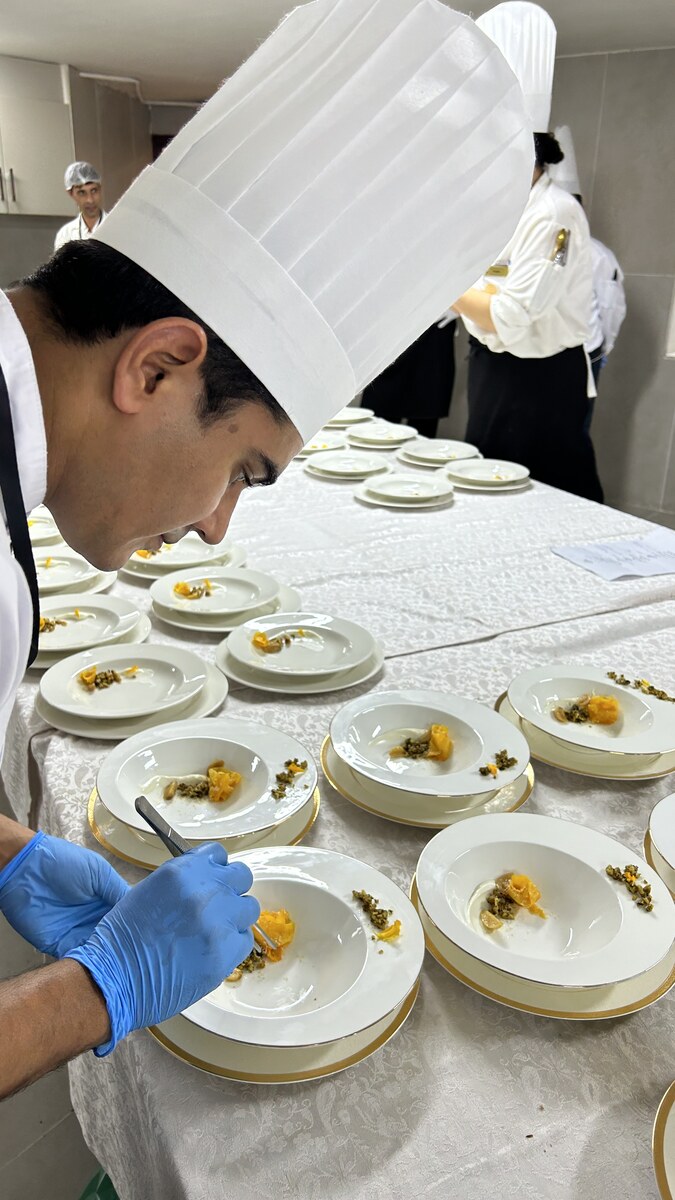


A chef prepares food for the guests at Serena Hotel during Shanghai Cooperation Organization (SCO) Summit held in Pakistan's capital, Islamabad, on October 15-16, 2024. (Asad Monga)

Monga, who was born and raised in Karachi, became passionate about cooking and chose culinary school after A Levels.

He enrolled at Taylor’s University in Kuala Lumpur, Malaysia, in 2011 as part of a dual degree program. After gaining international experience, he returned to Pakistan in late 2016 for personal reasons.

“For Pakistan to succeed in the future, we need to develop a strong service-based economy that focuses on hospitality and the culinary arts,” he reflected, based on his experience of serving the SCO delegates.
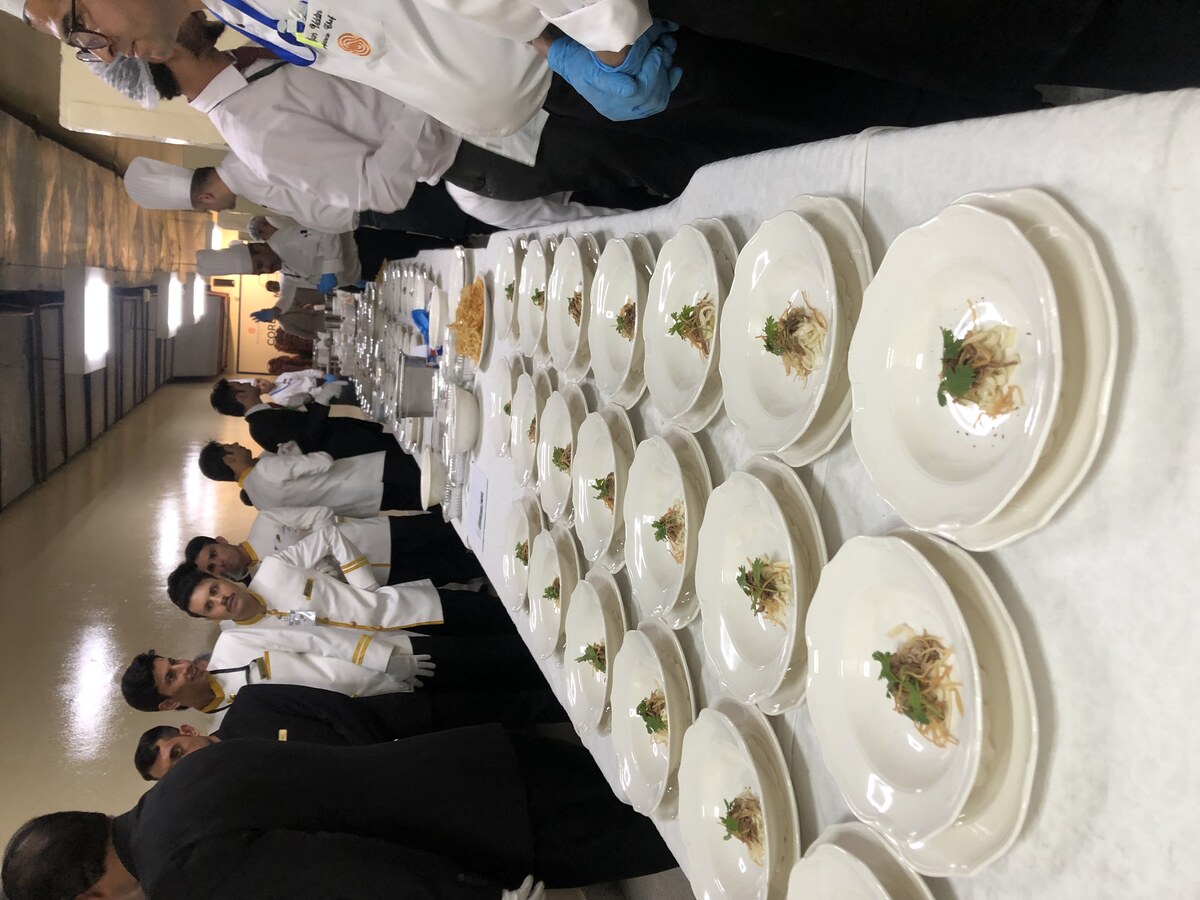


Waiters line up to carry food plates for the guests attending Shanghai Cooperation Organization (SCO) Summit in Islamabad, Pakistan. (Asad Monga)

He noted that by promoting chefs and expanding the hospitality industry, Pakistan could project its warm hospitality to the world and cultivate a softer image.

Monga also shared his desire to set up a small culinary school in the mountains, where he could forage ingredients, ferment them, and develop flavor catalogs.

“I hope to develop a school there where I can teach students who are interested in learning,” Monga said. “They can come and collaborate with me, and together we can shape the future of Pakistani cuisine and its culinary landscape.”


ADB approves $381 million for climate-resilient agriculture, social services in Punjab

Updated 8 sec ago
Follow

ADB approves $381 million for climate-resilient agriculture, social services in Punjab

  • Support will upgrade Punjab’s education and nursing systems, improving learning outcomes and health care capacity
  • Package includes $124 million for agriculture, $107 million for STEM schooling and $150 million for nursing reforms

KARACHI: The Asian Development Bank (ADB) said on Saturday it approved $381 million in financing for Pakistan’s Punjab province to modernize agriculture and strengthen education and health services, with a major focus on building climate resilience after monsoon floods this year caused widespread destruction across the country’s most populous province.

The package includes concessional loans and grants for farm mechanization, STEM education, and nursing sector reforms.

ADB said the investments are intended to help Punjab, home to more than half of Pakistan’s population and a key contributor to its economy, recover from climate shocks and transition toward more sustainable and resilient development.

“Investing in education, health, and agricultural mechanization will play a transformative role in driving the growth of Punjab, a vital pillar of Pakistan’s economy,” said ADB Country Director for Pakistan Emma Fan. “These strategic investments will modernize agriculture, enhance human capital, and significantly improve livelihoods for millions of people across Punjab.”

The bank approved $120 million in concessional loans and a $4 million grant for the Punjab Climate-Resilient and Low-Carbon Agriculture Mechanization Project, which will support 220,000 rural farm households.

The program aims to reduce climate vulnerability by shifting farmers toward modern, low-emission machinery, provide alternative livelihoods for agricultural workers and train 15,000 women in new skills. It will also introduce a financing model to help small farmers access advanced equipment.

Punjab produces most of Pakistan’s wheat, rice, and maize but still relies on outdated machinery, contributing to grain losses and routine burning of crop residues, a major source of air pollution, said ADB.

It noted the new project will promote modern mechanization, including rice harvesters, to address these issues.

ADB also approved $107 million for the Responsive, Ready, and Resilient STEM Secondary Education in Punjab Program, including a $7 million grant from the Asian Development Fund.

The results-based program aims to modernize secondary schooling by expanding inclusive STEM education, improving access and quality across the province.

A further $150 million concessional loan was approved for the Punjab Nursing and Health Workforce Reform Program, which will upgrade nursing curricula, develop disaster-resilient training facilities, strengthen workforce governance, and introduce digital human-resource systems.

The program seeks to expand the pool of qualified nurses to strengthen health service delivery and meet rising national and global demand.

Key components include the establishment of three centers of excellence in Lahore, Multan and Rawalpindi, equipped with simulation labs, digital learning platforms, and gender-responsive hostels.

ADB said it remains committed to supporting climate-resilient and inclusive development across Asia and the Pacific through innovative financing tools and partnerships.