Most Arab Americans hold conservative views on illegal immigration, abortion: Poll

1 / 2
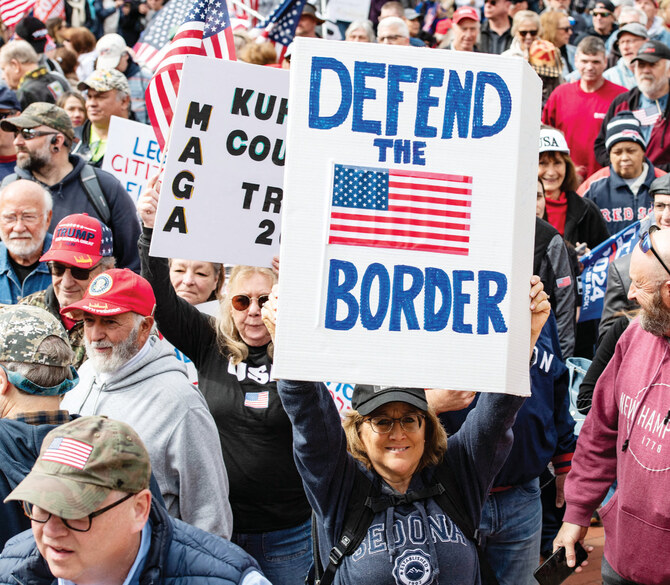
Some 56 percent of Arab Americans surveyed think US border controls should be tightened, a surprising twist for a population of immigrants or descendants of immigrants. (AFP photo)
2 / 2
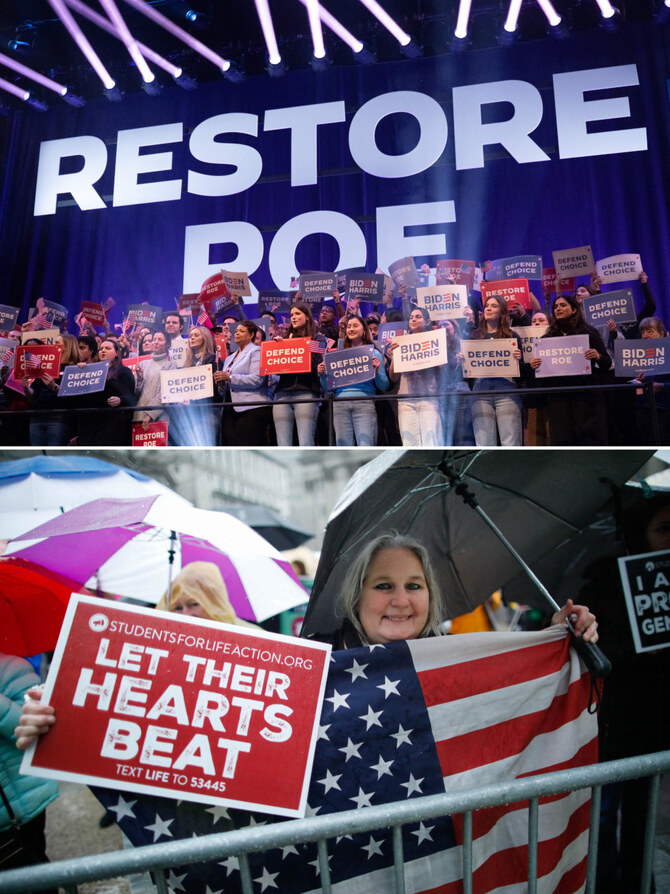
Thirty-eight percent of Arab Americans surveyed 38 percent are in favor of abortion being allowed up to the ninth week of pregnancy, 40 percent agree to allowing abortion only under certain circumstances, including rape and threat to life; and only 14 percent believe abortion should be completely banned. (AFP photos)
Short Url
Updated 29 December 2025
Follow

Most Arab Americans hold conservative views on illegal immigration, abortion: Poll

  • An Arab News-YouGov survey found that a majority would like to see US border controls and rules around abortion tightened
  • Immigration policy and abortion rights are among the key fault line issues between Kamala Harris and Donald Trump

LONDON: A survey conducted for Arab News by YouGov reveals that although 62 percent of Arab Americans describe themselves as politically moderate (35 percent), liberal (13 percent) or very liberal (13 percent), a majority express conservative views on two key domestic issues: illegal immigration and abortion.

Perhaps most surprisingly for a population of immigrants or descendants of immigrants, 56 percent of respondents think US border controls should be tightened.
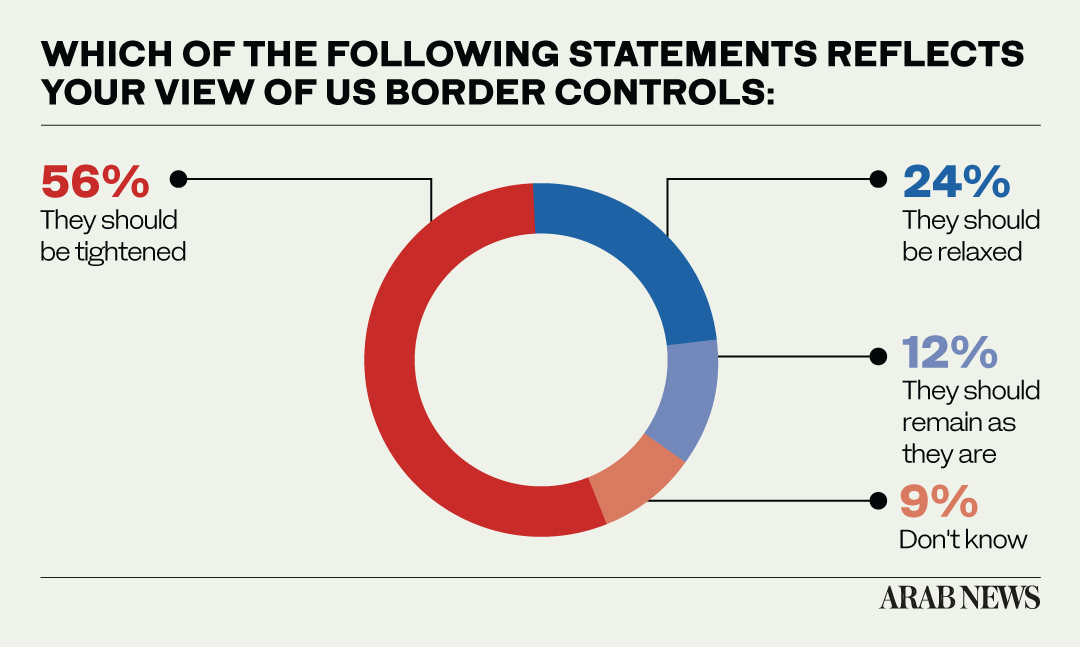
However, 24 percent think border controls should be relaxed — a liberal viewpoint that chimes with the position of neither the Democratic nor Republican candidate. Just 5 percent of over-55s want to see controls relaxed.

Fifty-one percent of respondents believe there are too many illegal immigrants in the US. This view is most common among those over 55 (61 percent) and those with the least education (66 percent).

“Interestingly, immigration seems to rank very highly in the minds of Arab Americans and honestly, as an immigrant myself, I wasn’t completely surprised by this,” Firas Maksad, a senior fellow at the Middle East Institute in Washington, told the Arab News podcast “Frankly Speaking.”

Opinion

This section contains relevant reference points, placed in (Opinion field)

He added: “Those who immigrated here legally and went through the process and paid their taxes tend to feel pretty strongly about those who are cutting in line and not paying their fair share.”

This, he said, could partly explain the large percentage of support for Republican candidate Donald Trump among Arab Americans.

As an issue, “illegal immigration often plays in favor of Trump rather than (Democratic candidate Kamala) Harris,” Maksad added.

However, one in three respondents rejected the suggestion that the US has too many illegal immigrants, while 16 percent said they do not know. 

On abortion, one of the key fault lines between pro-choice Harris and Trump, who is seen as responsible for the Supreme Court overturning the landmark Roe v Wade decision — which since 1973 had guaranteed the right to pregnancy termination in the US — Arab Americans emerge as broadly conservative in their outlook.

Although only 14 percent (17 percent of men and 11 percent of women) believe abortion should be completely banned, 40 percent agree with the proposition: “Abortion should be allowed only under certain circumstances, including rape and threat to life.” Again, more men (44 percent) than women (37 percent) hold this position.

Read our full coverage here: US Elections 2024: What Arab Americans want

However, almost as many (38 percent) are in favor of abortion being allowed up to the ninth week of pregnancy, which is officially when an embryo turns into a fetus. Women (44 percent) are more supportive of this than men (33 percent).

One issue of concern to many Arab Americans is their experience of racism, harassment or hate attacks related to their ethnicity, religion or origins — 46 percent said they had experienced this and 50 percent said they had not. 

Intriguingly, given the support for Trump revealed by the survey (45 percent said they will vote for him, against 43 percent for Harris), 46 percent of respondents said they expect racism and hate attacks against Arab Americans to increase during a Trump presidency, compared with 23 percent if Harris becomes president.

For 39 percent of respondents, Harris is also seen as being more sensitive to the national needs of Arab Americans than Trump (31 percent). 


Tarique Rahman-led BNP set to form Bangladesh’s next government after major election win

Updated 13 February 2026
Follow

Tarique Rahman-led BNP set to form Bangladesh’s next government after major election win

  • Jamaat-e-Islami, banned during Hasina’s government, won 68 seats
  • Majority of Bangladeshis endorsed sweeping reforms in national referendum

DHAKA: The Bangladesh Nationalist Party, led by Tarique Rahman, is set to form the country’s next government after securing a more than two-thirds majority in the first elections since a student-led uprising in 2024 ousted ex-prime minister, Sheikh Hasina.

The BNP has won at least 209 seats out of the 299 contested, according to the latest election results released by the Election Commission on Friday, paving the way for Rahman to become the country’s next prime minister.

Jamaat-e-Islami, banned during Hasina’s 15 years in power, has registered its best performance yet, winning at least 68 seats and emerging as the main opposition party.

The National Citizen Party, which was born out of the 2024 protests, was in third place with six seats, including for its leader Nahid Islam, while Hasina’s Awami League was barred from participating in the elections.

The majority of Bangladeshis also reportedly voted “yes” in a national referendum on the “July National Charter” that was held alongside the general vote on Thursday.

Named after the month when the uprising that toppled Hasina began, the charter is aimed at achieving sweeping democratic reforms to prevent authoritarian administrations, including term limits for premiers, stronger presidential powers and greater judicial independence, while also proposing increased representation of women in parliament.

The BNP-led government is likely to follow the commitments made under the charter, said Prof. A.S.M. Amanullah, vice chancellor of the National University in Dhaka, adding that the implementation of the July charter was also included in the party’s election manifesto that covers reform of the state and rebuilding of the economy.

“Mr. Tarique Rahman is a highly trained politician, highly sensitive politician, and he takes decisions based on facts. I believe he prepared himself to run this country locally and play a role internationally,” Amanullah told Arab News.

Rahman is the son of former Prime Minister Khaleda Zia and former President Ziaur Rahman. He returned to Bangladesh late last year after nearly two decades of self-imposed exile in the UK, and assumed BNP’s leadership days later, following his mother’s death from a prolonged illness.

In an interview with Arab News earlier this week, the 60-year-old pledged to pursue accountability for the former leadership and meet the political and economic expectations of the youth movement that brought about the change.

The new government is likely to be a mix of young and old politicians, Amanullah said, with Jemaat-e-Islami set to balance out the BNP’s rule.

“This is a very good size of opposition to press the issues or to challenge the government on different issues, different policies and decisions of the government. I’m hopeful about Jemaat,” he said.

“The way the people voted for these major two parties, the BNP and Jemaat, I think if they could work jointly, Bangladesh should see a stable political situation in the near future.”

Mohiuddin Ahmad, a political analyst and researcher, described Jemaat-e-Islami as “the most organized party” in Bangladesh and that it would therefore play an “instrumental” role as the opposition party.

Voter turnout averaged 59.44 percent, the EC said, with many Bangladeshis considering this week’s vote as their first “free and fair” election after more than 17 years.

“Such a result of an election we haven’t actually experienced before,” Muhiuddin Iqbal, a history student at Dhaka University, told Arab News.

“The festive feeling has not gone yet, so we’re very much excited about it and hopeful for the future.”