ISLAMABAD: Prime Minister Shehbaz Sharif on Wednesday welcomed Palestinian medical students who recently arrived in Pakistan from war-torn Gaza to pursue their studies here, vowing to facilitate them in pursuing their aspirations despite Israel’s military aggression in the Middle East.
Sharif was addressing a ceremony held in Islamabad to welcome the three batches of over 100 Palestinian students out of a total of 192, who arrived in Pakistan this month to continue their studies in educational institutions here on fully-funded scholarships.
Pakistan’s foreign ministry announced in July that the Pakistan Medical and Dental Council (PMDC) will provide scholarships to over 100 Palestinian students so that they can continue their studies in Pakistan. The initiative, which came amid Israel’s war on Gaza, is a collaboration between Doctors of Rehman, Global Relief Trust and a leading Pakistani non-governmental organization, the Al-Khidmat Foundation.
“Dear students, our brothers, sisters, Pakistan is your second home,” Sharif said at the ceremony attended by Palestinian students and other officials.
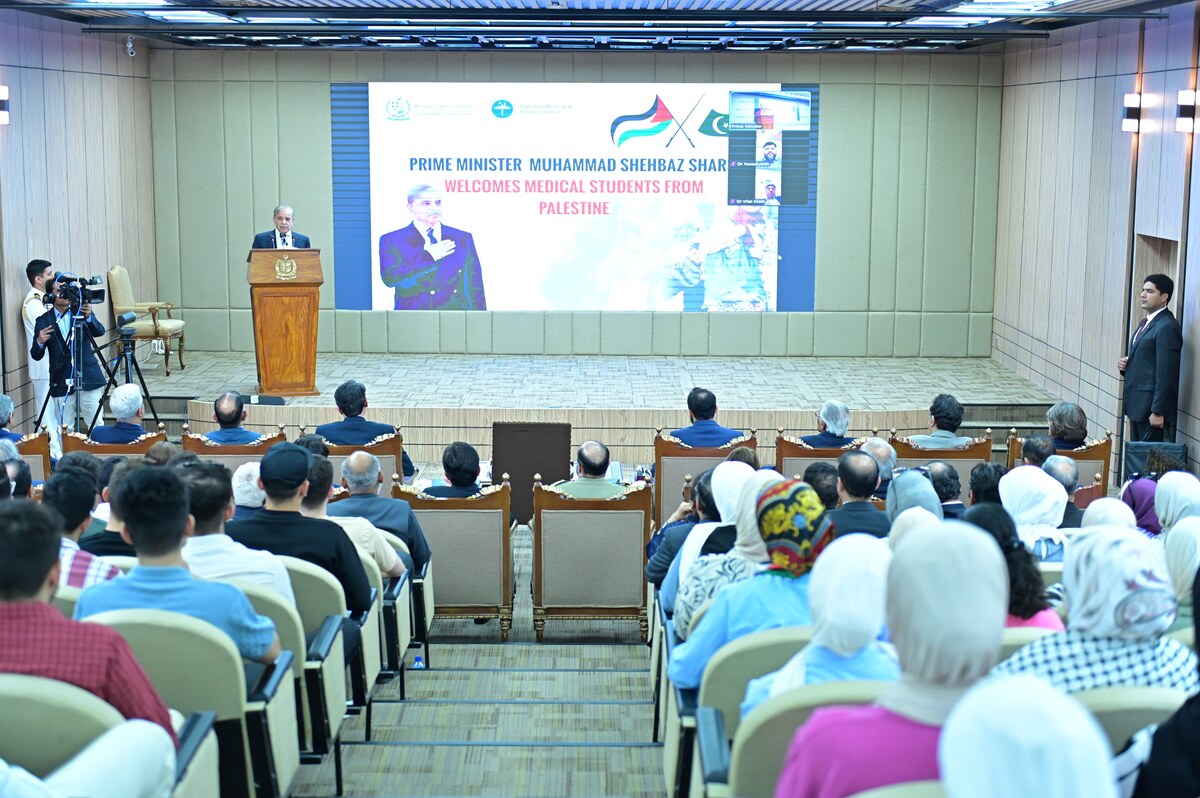
Pakistan Prime Minister Shehbaz Sharif speaks during a ceremony welcoming Palestinian students arrive in Pakistan to complete their studies, in Islamabad on October 23, 2024. (Photo courtesy: PMO)
“Our hearts are there for you, our homes are there for you, our institutions are there for you, our teachers are there for you. Everything that we do will not be enough to make you comfortable here in Pakistan,” he added amid loud applause.
The Pakistani prime minister regretted the world’s silence in Gaza, saying that resolutions and speeches were not enough to stop the “heart-wrenching” war there.
“Blood still flows in the streets of Gaza, schools are being bombarded, hospitals are being smashed and the world is a silent spectator,” Sharif said.
He said Pakistan wished to invite hundreds of other Palestinian students from Gaza to Pakistan on fully funded scholarships, adding that he had requested Pakistani authorities to take action in this regard.
“We will be playing host to you,” the premier said. “Believe me, it is not a favor. It is a responsibility we should have discharged long ago. But it’s never too late.”
Speaking earlier, a Palestinian female student thanked the government of Pakistan, the country’s educational institutions and non-governmental organizations for helping them continue their studies in the South Asian country.
“Praise be to God, you are all looking after us like your own children,” she said, requesting the government to allow Palestinian students studying other subjects to continue their studies in Pakistan as well.
“Because each one of us holds Palestine, our families and our children and we want to continue our lives because we deserve it,” she said. “And so, we can help our people soon in the future.”
ISRAEL’S WAR ON GAZA
Since Oct. 7, 2023, Israel has killed over 42,000 people in Gaza through relentless bombardment despite ceasefire calls and angry protests in several countries around the world. The Jewish state has bombed thousands of buildings, including medical institutions as it carries out airstrikes and ground offensives in Gaza.
There have also been widespread reports of substantial damage to educational institutions along with reports of deliberate targeting of Palestinian academics.
The World Health Organization (WHO) and other sources have documented severe damage to Gaza’s health care facilities, including the largest hospital Al-Shifa, which has been rendered non-functional due to extensive damage in the ongoing conflict.