

RIYADH: The Energy Localization Forum in the Saudi capital Riyadh saw the signing of 124 agreements worth over $27.7 billion with 118 companies.
The deals represent a significant step in the Kingdom’s efforts to localize its energy sector and cover a range of industries, from oil and gas to renewable energy and petrochemicals. They also aim to foster long-term economic growth, reduce import dependency, and position the country as a global energy leader by achieving 75 percent localization by 2030.
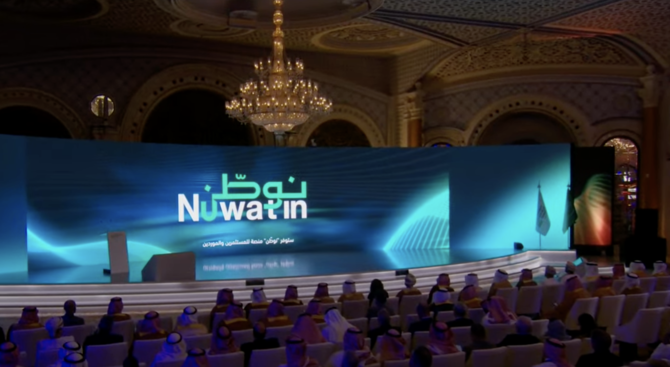
The forum, which takes place from Oct. 23— 24, also highlighted the launch of the “Nuwatin” initiative, a localization enablement program designed to facilitate partnerships between suppliers, investors, and energy sector stakeholders.
The initiative already includes 63 suppliers and 59 energy components and is expected to increase the localization of energy products by up to 20 percent in some areas.
The program will act as a platform for public and private sectors to collaborate and overcome project development challenges, supporting Saudi Arabia’s broader efforts to localize critical aspects of its energy supply chain.
Saudi Aramco played a prominent role at the forum, securing 10 agreements under the “Drilling Equipment and Chemicals” initiative with global leaders such as Baker Hughes, Schlumberger, and Weatherford International.
These deals are set to enhance the localization of key equipment and services within the oil and gas sector. Aramco also signed five deals focused on gas monitoring and control systems with companies like Honeywell and Emerson, reflecting the Kingdom’s commitment to strengthening its domestic energy infrastructure.
The Saudi Electricity Co., known as SEC, also made significant strides, signing two major deals with Siemens Energy and Hitachi Energy to localize high-voltage gas-insulated switchgears, a critical component of Saudi Arabia’s power grid. Additionally, SEC entered into seven agreements to advance the production of electrical components with companies such as Arabian Transformers Co. and Power Transmission & Telecommunication.
In his keynote address, Saudi Minister of Energy Prince Abdulaziz bin Salman highlighted the Kingdom’s unwavering focus on building a fully localized energy supply chain. “We should not be content with just local content but go deeper into materials, components, and minerals,” he said, advocating for a comprehensive approach that spans the entire supply chain — from raw materials to finished products.
The minister added that achieving this goal requires coordinated efforts across sectors, dismissing the idea of siloed strategies. “No matter what you do in silos, you’re not going to achieve anything,” he said.
He reiterated the importance of working cohesively to realize the Kingdom’s localization goals, adding that Saudi Arabia’s energy sector is supported by a broader ecosystem designed to empower companies like Aramco, SABIC, and SEC to achieve ambitious targets.
The forum also showcased the Kingdom’s growing focus on renewable energy. An agreement was announced to localize the manufacturing of wind towers for the country’s wind turbine energy system. The deal, made with Al Yamama and AIC Steel, represents Saudi Arabia’s increasing commitment to renewable energy as part of its sustainability efforts.
Another major development was the launch of the GCC Lab Co. for Technical Services, a collaboration involving key players like SABIC, the Nusaned program, and SNB Capital. This new entity will provide technical services to further support the localization of advanced energy technologies.
These efforts are part of Saudi Arabia’s broader strategy to create a sustainable, self-reliant energy ecosystem. As Prince Abdulaziz highlighted, the Kingdom’s localization goals are deeply tied to its ambition to lead the global energy market while ensuring security and resilience for decades to come.