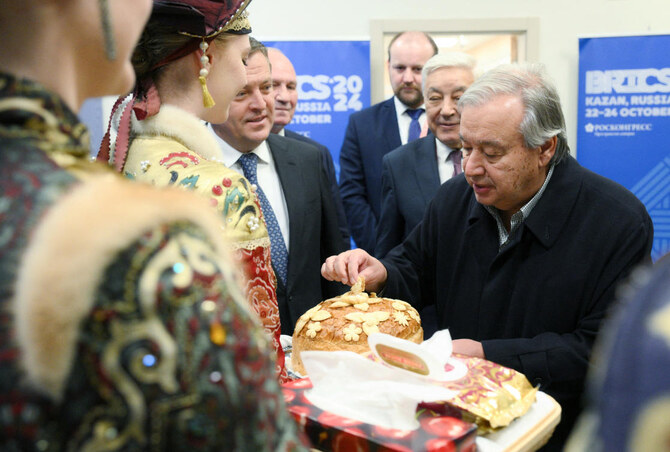
KAZAN, Russia: UN Secretary General Antonio Guterres arrived in Russia on Wednesday to attend the BRICS summit, his first visit to the country for more than two years that has drawn scorn from Ukraine.
The gathering is the largest diplomatic forum in Russia since launching its full-scale military offensive on Ukraine in 2022 and President Vladimir Putin wants to use it to demonstrate that attempts to isolate him on the world stage have failed.
Around 20 world leaders, including China, India, Turkiye and Iran, are in the central city of Kazan, where they will address topics such as developing a BRICS-led international payment system and the conflict in the Middle East.
Moscow sees the platform as an alternative to Western-led international organizations like the G7 — a position supported by Chinese President Xi Jinping.
In bilateral talks on Tuesday, including with Xi and Indian Prime Minister Narendra Modi, Putin hailed Moscow’s close ties and “strategic partnerships” with its partners.
Xi, meanwhile, praised China’s “profound” ties with Russia in what he called a “chaotic” world.
Russia and China’s relations have “injected strong impetus into the development, revitalization and modernization of the two countries,” Xi said.
Putin said he saw relations between Beijing and China as a foundation of global “stability.”
“Russian-Chinese cooperation in world affairs acts as one of the stabilising factors in the global arena. We intend to further increase coordination in all multilateral platforms to ensure global security and a just world order,” he told Xi.
The leaders will hold a summit session on Wednesday where they are expected to tout the organization’s role in bolstering what Moscow and Beijing regularly refer to as a “multipolar world order.”
Underpinning his vision of the BRICS challenge to the West, Putin will hold separate talks with Iran’s President Masoud Pezeshkian and Venezuela’s President Nicolas Maduro on Wednesday.
He will also meet with Turkish President Recep Tayyip Erdogan.
Turkiye, a NATO member, is also casting itself as a possible mediator between Russia and Ukraine and strives for warm relations with Moscow.
Guterres will hold talks with Putin on Thursday, where the pair will discuss the Ukraine conflict, the Kremlin said.
Kyiv has railed against UN chief Guterres’ trip.
“The UN Secretary General declined Ukraine’s invitation to the first Global Peace Summit in Switzerland. He did, however, accept the invitation to Kazan from war criminal Putin,” its foreign ministry said in a post on X.
Guterres’ spokesperson said the trip was part of the UN chief’s regular attendance at “organizations with large numbers of important member states,” and said it offered a chance to “reaffirm his well known positions” on the Ukraine conflict “and the conditions for just peace.”
Modi, who is also casting himself as a possible peacemaker, called for a quick end to the conflict during talks with Putin on Tuesday.
“We have been in constant touch over the conflict between Russia and Ukraine,” Modi told Putin after the two shook hands and embraced.
“We believe that disputes should only be resolved peacefully. We totally support efforts to quickly restore peace and stability,” the Indian leader added.
India has walked a delicate tightrope since the Ukraine conflict began, pledging humanitarian support for Kyiv while avoiding explicit condemnation of Moscow’s actions.
Moscow has been steadily advancing on the battlefield in eastern Ukraine this year as it strengthens ties with the likes of China, Iran and North Korea.


![]()

UN chief in Russia for Putin’s BRICS summit
Short Url
https://arab.news/5q8z4
UN chief in Russia for Putin’s BRICS summit
- Moscow sees the BRICS platform as an alternative to Western-led international organizations like the G7
- UN chief Antonio Guterres’s visit to Russia has drawn scorn from Ukraine


Latest updates


Recommended


© 2026 SAUDI RESEARCH & PUBLISHING COMPANY, All Rights Reserved And subject to Terms of Use Agreement.