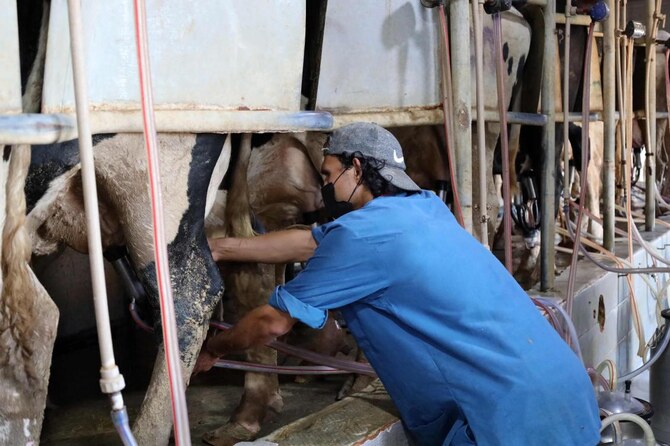
MISRATA: On Najmeddine Tantoun’s farm on the outskirts of the western Libyan city of Misrata, the usual whir of hundreds of dairy milking machines has given way to near silence.
The farmer has lost almost half his cows to an outbreak of foot-and-mouth disease, a highly contagious illness affecting hoofed animals.
The outbreak in Libya has dealt a major blow to many cattle farmers, who say they have yet to receive vaccines for their animals as dairy and meat production suffers.
Most of the North African country’s revenue comes from its oil resources, but Misrata is a major dairy center which used to produce 70,000 liters of milk a day.
Output has now fallen to 20,000 per day, according to Salem Al-Badri, 45, head of the city’s committee of cattle farmers.
Tantoun, 27, said “the future looks bleak.”
“I almost lost everything,” he said. “From 742 cows, we lost about 300. This disease is destroying our livelihoods.”
The disease particularly affects ruminant livestock, such as cattle, sheep and goats. It causes fever, blisters — and sometimes death.
In Misrata, some farmers have reported losing about 70 percent of their cattle to the disease, according to Badri’s committee.
“We are heading toward a catastrophe,” Badri, who is also in charge of the city’s animal health office, said during a visit to Tantoun’s farm.
“The delay in vaccines has cost us dearly,” he added. “Most of the cows in Misrata are now infected and we have no choice but to slaughter them to stop the epidemic.”
The disease has also inflicted financial hardship on consumers as shortages drive up the price of meat and dairy.
Badri said another cattle ailment called lumpy skin disease has also had an impact, with foreign buyers growing wary of importing Libyan cowhide.
Libya is struggling to recover from years of conflict after the 2011 uprising that overthrew longtime dictator Muammar Qaddafi.
It remains split between a United Nations-recognized government of Prime Minister Abdulhamid Dbeibah and the rival authority in the east backed by military strongman Khalifa Haftar.
Cattle farmers blame the authorities’ for a lack of pre-emptive safety measures, as well as a slow response during the outbreak which caused delays in delivering vaccines to the affected regions.
Badri said that “if the vaccines had been delivered last November, we would not be here.”
“I have asked the authorities several times to deliver the vaccines to us in order to save the farms,” he said.
When contacted by AFP, the authorities in Tripoli did not respond.
Authorities in the east and west have rolled out emergency vaccination plans with support from the UN Food and Agriculture Organization, but some farmers said the response had often come too late.
Badri said a group of cattle farmers have filed a lawsuit with the attorney general.
One of the main causes of the spread of these diseases is the illegal importation of animals without veterinary control, the agriculture ministry has said.
Additionally, contamination spreads uncontrollably as cases are not reported to local authorities in time, it said, adding that some cattle might have died without being reported either.
“We depend entirely on these animals for our livelihood,” said Tantoun, adding that he had “given everything” for his farm to succeed.
“Losing so many cows is an economic disaster.”
He called on authorities in Misrata “not only to provide the necessary vaccines” but also “to compensate” cattle farmers whose cows have suffered from the disease.
Farmer Ali Ghabag said he has completely given up on cattle farming “out of fear for the future.”
“Nobody wants to continue in this sector anymore,” the 40-year-old said.
“The risks have become too big, and we don’t know if we will overcome this crisis.”


![]()

Cattle disease wreaks havoc in Libya
Short Url
https://arab.news/y8jhf
Cattle disease wreaks havoc in Libya
- The outbreak in Libya has dealt a major blow to many cattle farmers, who say they have yet to receive vaccines for their animals as dairy and meat production suffers


Latest updates


© 2026 SAUDI RESEARCH & PUBLISHING COMPANY, All Rights Reserved And subject to Terms of Use Agreement.