

US declines to comment on PM Sharif’s request for Dr. Aafia Siddiqui’s release

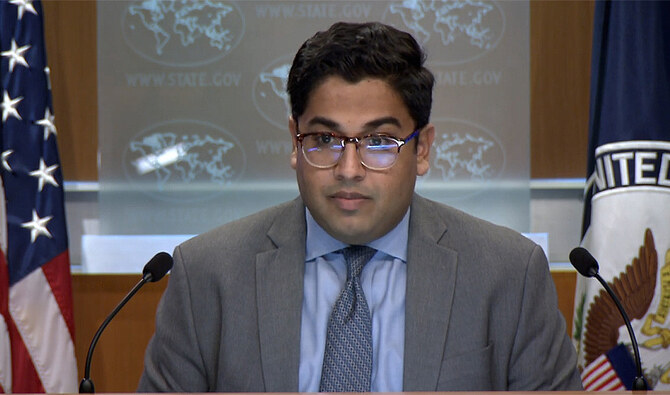
US State Department Principal Deputy Spokesperson Vedant Patel speaks to media during a press briefing in Wahington DC, US, on October 22, 2024. (US State Department)
Short Url
Updated 23 October 2024
Follow

US declines to comment on PM Sharif’s request for Dr. Aafia Siddiqui’s release

  • PM wrote a letter to President Joe Biden earlier this month, seeking her release on humanitarian grounds
  • A State Department official tells a media briefing he will not ‘get into private diplomatic communications’

ISLAMABAD: The United States on Tuesday declined to comment on Pakistani neuroscientist Dr. Aafia Siddiqui’s case, who is serving an 86-year sentence in an American prison on terrorism charges after Prime Minister Shehbaz Sharif requested her release on humanitarian grounds in a letter to President Joe Biden earlier this month.

The information about the letter emerged last Friday after a state lawyer submitted a copy to the Islamabad High Court, which had recently requested a detailed report on the efforts made by Pakistani authorities to extradite Siddiqui.

A US-trained neuroscientist, Siddiqui married a nephew of Khalid Sheikh Mohammed, a self-proclaimed mastermind of the Sept. 11, 2001, attacks, before being convicted in 2010 on multiple charges, including attempting to kill US soldiers in Afghanistan.

In his letter, Sharif noted that Pakistani officials, during consular visits, had raised concerns about her treatment in prison, expressing fears that she might take her own life.

US State Department Principal Deputy Spokesperson Vedant Patel was asked about the prime minister’s letter during a media briefing in Washington, DC, though he refused to comment on the Biden administration’s response to the issue.

“I certainly wouldn’t get into private diplomatic communications,” he said. “And on the case itself, I would refer to the Department of Justice to speak to any inquiries regarding Dr. Siddiqui’s incarceration.”

Siddiqui’s sister, Fauzia, has taken up her case in the media and has visited her in captivity in the US.

During the hearing, she urged the government to make every effort to bring her back to the country, as the court reviewed the details of how the Pakistani neuroscientist ended up in an American prison.

– With input from AP


Pakistan bank enables Shariah-compliant digital payment facility for passengers at Islamabad airport

Updated 23 February 2026
Follow

Pakistan bank enables Shariah-compliant digital payment facility for passengers at Islamabad airport

  • Pakistan is a cash-dominated market where a significant portion of transactions in the informal sector are made without any taxes, officials say
  • The move comes amid Pakistan’s efforts to introduce a cashless model at airports under which only digital service providers can provide services

KARACHI: Aik, Pakistan’s first Islamic digital bank, has enabled fully digital payments at Islamabad International Airport to offer travelers and passengers secure, Shariah compliant digital transaction facility.

The development comes amid Pakistan’s efforts to introduce a cashless model at airports across the country, under which only digital service providers can provide services to customers.

Aik, a subsidiary of Bank Islami, said it has onboarded merchants across the Islamabad airport and integrated QR code deployments at key touchpoints to allow passengers and visitors to make secure, seamless, and Shariah-compliant digital transactions at all counters, retail outlets, and service points.

It said the implementation complies with the regulations and framework set by the State Bank of Pakistan (SBP) and is a working model for a large-scale adoption of cashless systems in public infrastructure.

“This deployment reflects our commitment to building practical digital infrastructure that improves everyday transactions,” Aik Chief Officer Ashfaque Ahmed said in a statement.

“By enabling a fully cashless environment at a major national gateway, we are supporting efficiency, transparency, and financial inclusion at scale. This is not only a project; it is a foundation for Pakistan’s cashless future.”

Pakistan is a cash-dominated market where a significant portion of transactions, particularly in the informal sector, are conducted in cash. Officials say many of these transactions are aimed at avoiding taxes.

In recent years, the SBP has taken steps to ensure a transition toward a more cashless economy so that transactions are more traceable, reducing chances of tax evasion and corruption.

By digitizing Islamabad airport, aik said it continues to invest in secure and accessible financial solutions that “expand digital participation and support national economic modernization.”