Pakistan parliamentary panel picks Justice Yahya Afridi as next chief justice

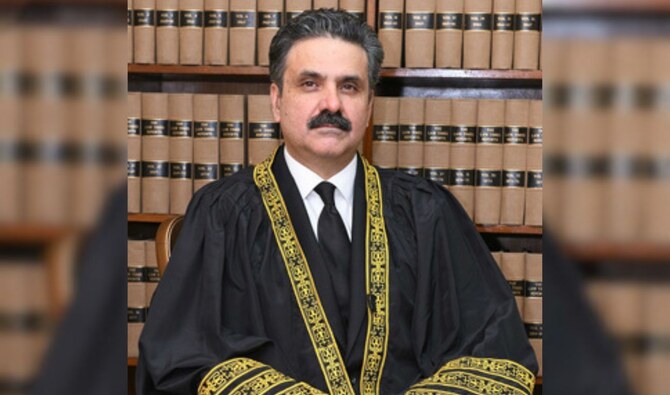
An undated file photo of Justice Yahya Afridi. (Photo courtesy: Supreme court of Pakistan/ website)
Short Url
Updated 22 October 2024
Follow

Pakistan parliamentary panel picks Justice Yahya Afridi as next chief justice

  • Development comes a day after a constitutional amendment empowered parliament to pick top judge
  • Justice Yahya Afridi ranked last on a list of three senior-most judges of the Supreme Court of Pakistan

ISLAMABAD: A 12-member special parliamentary committee, tasked with choosing a name for the new chief justice, on Tuesday picked Justice Yahya Afridi for the key post, Pakistan’s Law Minister Azam Nazeer Tarar said, as the opposition Pakistan Tehreek-e-Insaf (PTI) party lawmakers boycotted the committee’s proceedings.
The committee, which was formed under the contentious 26th constitutional amendment on Monday, was required to pick a name out of the three senior-most judges of the Supreme Court for the post of the chief justice.
Pakistan’s incumbent top judge, Qazi Faez Isa, is set to retire on Friday. The three senior-most judges considered for the key post included Justice Mansoor Ali Shah, Justice Munib Akhtar and Justice Yahya Afridi.
“As per the constitutional requirement, the nomination of Justice Yahya Afridi has been dispatched to the prime minister with two-thirds of majority [of the committee members],” Tarar told reporters in Islamabad.
The development came after the first round of the in-camera meeting of the parliamentary panel, which was earlier postponed as PTI’s Gohar Khan and Senator Ali Zafar boycotted the proceedings.
The contentious constitutional amendment passed by Prime Minister Shehbaz Sharif-led ruling coalition has generated a heated debate in the country, with opposition parties and prominent lawyers alleging the new law aims to curtail the judiciary’s independence.
The government rejects these allegations and says the amendments are aimed at empowering Pakistan’s parliament and providing speedy justice to the country’s citizens by allowing the establishment of constitutional courts among other changes.
Legal experts say there are some clauses in the 26th constitutional amendment that are “problematic,” but it is much better than what was being anticipated.
“There are certain clauses that on the face of it seem to be curtailing the powers of the judiciary. We have also seen that in the past decade or so, judges have misused the power to appoint judges. They have appointed certain judges that were their own favorites,” lawyer Osama Malik told Arab News.
“They deliberately appointed some judges earlier than other judges that they could then become chief justices of the country. The seniority was managed by the senior most judges of the supreme court and that was causing serious problems for everyone. Now perhaps some balance will be found and if not, we will have to rectify it again.”


Curfew extended in Gilgit-Baltistan, probe ordered after deadly Khamenei protests

Updated 03 March 2026
Follow

Curfew extended in Gilgit-Baltistan, probe ordered after deadly Khamenei protests

  • At least 15 people were killed in clashes with law enforcement agencies over the weekend in Gilgit-Baltistan
  • Government also announces a de-weaponization campaign, crackdown on hate speech and cybercrime in region

ISLAMABAD: The government in Pakistan’s Gilgit-Baltistan (GB) region on Tuesday extended a curfew in Gilgit district and ordered a judicial probe into violent protests over the killing of Iranian Supreme Leader Ali Khamenei in US-Israeli strikes last week, an official said.

At least 15 people were killed in clashes with law enforcement agencies over the weekend in GB, where protesters torched and vandalized several buildings, including United Nations regional offices, an army-run school, software technology park and a local charity building.

The violence prompted regional authorities to impose curfew in Gilgit and Skardu districts on March 2-4 as officials urged people to stay indoors and cooperate with law enforcers, amid widespread anger in Pakistan, particularly among members of the Shiite minority, over Khamenei’s killing.

On Tuesday, the GB government convened to review the situation and announced the extension of curfew in Gilgit among a number of security measures as well as ordered the establishment of a judicial commission to investigate the weekend violence in the region.

“The government has made it clear that the law will strictly take its course against elements involved in vandalism at government institutions, private properties and incidents of vandalism in Gilgit and Skardu and no kind of mischief will be tolerated,” Shabbir Mir, a GB government spokesperson, said in a statement.

“In view of the security situation, curfew will remain in force in Gilgit, while the decision to extend the curfew in Skardu will be taken keeping the ground realities and the changing situation in view.”

The statement did not specify how long the curfew will remain in place in Gilgit.

Besides the formation of the judicial commission to investigate the violent clashes, the government also decided to launch a large-scale de-weaponization campaign in the entire Gilgit district, for which relevant institutions have been directed to immediately complete all necessary arrangements, according to Mir.

In addition, a crackdown has been ordered on hate speech, spread of fake news and cybercrime.

“The aim of these decisions is to ensure the rule of law, protect the lives and property of citizens and crack down on miscreants,” he said. “Approval has also been given to immediately survey the affected infrastructure and start their restoration work on priority basis.”

Demonstrators in Pakistan’s southern port city of Karachi also stormed the US Consulate on Sunday, smashing windows and attempting to burn the building. Police responded with batons, tear gas, and gunfire, leaving 10 people dead and more than 50 injured.

Pakistani authorities have since beefed up security at US diplomatic missions across the country, including around the US consulate building in Peshawar, to avoid any further violence.