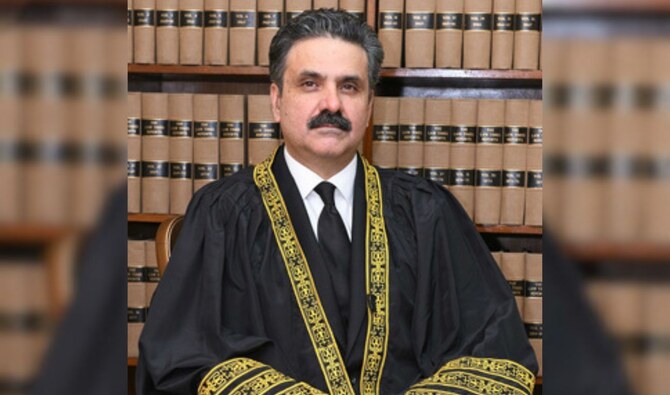
ISLAMABAD: A 12-member special parliamentary committee, tasked with choosing a name for the new chief justice, on Tuesday picked Justice Yahya Afridi for the key post, Pakistan’s Law Minister Azam Nazeer Tarar said, as the opposition Pakistan Tehreek-e-Insaf (PTI) party lawmakers boycotted the committee’s proceedings.
The committee, which was formed under the contentious 26th constitutional amendment on Monday, was required to pick a name out of the three senior-most judges of the Supreme Court for the post of the chief justice.
Pakistan’s incumbent top judge, Qazi Faez Isa, is set to retire on Friday. The three senior-most judges considered for the key post included Justice Mansoor Ali Shah, Justice Munib Akhtar and Justice Yahya Afridi.
“As per the constitutional requirement, the nomination of Justice Yahya Afridi has been dispatched to the prime minister with two-thirds of majority [of the committee members],” Tarar told reporters in Islamabad.
The development came after the first round of the in-camera meeting of the parliamentary panel, which was earlier postponed as PTI’s Gohar Khan and Senator Ali Zafar boycotted the proceedings.
The contentious constitutional amendment passed by Prime Minister Shehbaz Sharif-led ruling coalition has generated a heated debate in the country, with opposition parties and prominent lawyers alleging the new law aims to curtail the judiciary’s independence.
The government rejects these allegations and says the amendments are aimed at empowering Pakistan’s parliament and providing speedy justice to the country’s citizens by allowing the establishment of constitutional courts among other changes.
Legal experts say there are some clauses in the 26th constitutional amendment that are “problematic,” but it is much better than what was being anticipated.
“There are certain clauses that on the face of it seem to be curtailing the powers of the judiciary. We have also seen that in the past decade or so, judges have misused the power to appoint judges. They have appointed certain judges that were their own favorites,” lawyer Osama Malik told Arab News.
“They deliberately appointed some judges earlier than other judges that they could then become chief justices of the country. The seniority was managed by the senior most judges of the supreme court and that was causing serious problems for everyone. Now perhaps some balance will be found and if not, we will have to rectify it again.”

Pakistan parliamentary panel picks Justice Yahya Afridi as next chief justice
https://arab.news/cyasd
Pakistan parliamentary panel picks Justice Yahya Afridi as next chief justice
- Development comes a day after a constitutional amendment empowered parliament to pick top judge
- Justice Yahya Afridi ranked last on a list of three senior-most judges of the Supreme Court of Pakistan
Pakistan mulls enforcing remote work, online classes rules to conserve energy amid Mideast crisis
- Government committee reviews contingency plans as Iran closes Strait of Hormuz, disrupting global oil supply
- Petroleum Division official warns fuel costs may rise if Pakistan is forced to import oil from longer routes
ISLAMABAD: Pakistan is considering a range of options to conserve energy which include ordering corporate offices to ensure work-from-home facility for staff and directing universities to shift classes online, a senior official confirmed on Thursday as the ongoing Middle East conflict threatens to disrupt the global supply of petroleum products.
These proposals were discussed by a cabinet committee constituted by Prime Minister Shehbaz Sharif to monitor petroleum prices on Wednesday. The committee meets daily to review the stock of petroleum products in Pakistan and assess the evolving regional situation.
Tensions in the Middle East have surged since Saturday after the US and Israel’s coordinated strikes against Iran and Tehran’s retaliatory attacks against both and Gulf nations. Iran has closed the crucial Strait of Hormuz waterway, through which roughly 20 percent of global oil and gas supply passes through.
Pakistan relies heavily on Middle Eastern crude oil, with the majority of its energy imports typically transiting through the strait, making any disruption a major risk to domestic fuel supplies.
“Yes, proposals such as work-from-home for corporate offices and online classes for higher education institutions were discussed in the high-level committee,” a senior official of the finance ministry told Arab News on condition of anonymity, as he was not authorized to speak to the media.
“However, final decisions will be taken in a couple of days after the action plan is finalized based on priority areas.”
The official said the government may also advise the public to avoid unnecessary travel, adding that fuel supplies would be ensured for various industries and other critical sectors.
Meanwhile, Pakistani authorities have imposed a ban on the export of petroleum condensate, a chemical used by oil refineries, to secure its domestic supply in case the Middle East crisis worsens further.
A senior official from Pakistan’s Petroleum Division told a Senate committee on Wednesday that the country currently has petroleum reserves sufficient to last around one month.
“The country has around one month of refined petroleum products available, along with more than ten days’ worth of crude oil stocks,” the official said, also requesting anonymity.
He added that the government is working on contingency planning to meet future energy requirements if the conflict continues.
“Pakistan is exploring options to import fuel from Saudi Arabia through the Red Sea to ensure uninterrupted supplies,” he said.
Pakistan’s petroleum ministry confirmed the same in a statement on Wednesday, following Petroleum Minister Ali Pervaiz Malik’s meeting with Saudi Ambassador Nawaf bin Said Al-Malki.
The official warned that petroleum product prices may rise in line with global market trends, particularly if supplies have to be transported through alternative, longer routes.
He added that in the event of a prolonged conflict, Pakistan may consider importing fuel from the US and other countries.


