

India, Pakistan arrest farmers for burning crop waste as pollution rises

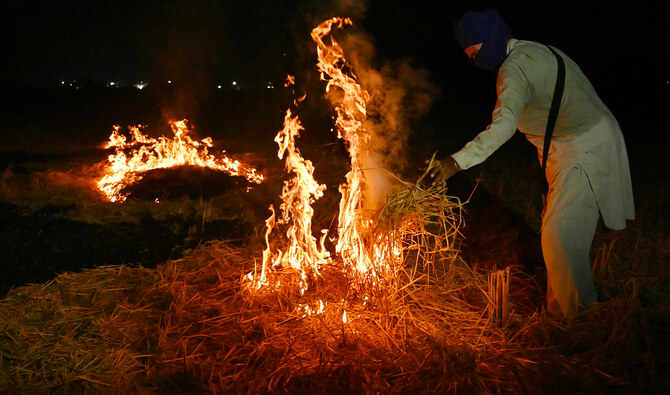
A farmer burns straw stubble after a harvest, at a paddy field on the outskirts of Amritsar on October 21, 2024. (AFP)
Short Url
Updated 22 October 2024
Follow

India, Pakistan arrest farmers for burning crop waste as pollution rises

  • At least 182 complaints have been registered and 71 people arrested for burning stubble and trash in Pakistan's Punjab
  • Provincial minister Marriyum Aurangzeb says resources have also been allocated for artificial rain and other measures

NEW DELHI: At least 16 farmers have been arrested in India's northern state of Haryana for illegally burning paddy stubble to clear fields, a practice that stokes air pollution in the region around New Delhi at the onset of winter, authorities said on Tuesday.

India's national capital region battles pollution each year as temperatures fall and cold air traps construction dust, vehicle emissions and smoke, much of which officials say travels from the neighbouring breadbasket states of Punjab and Haryana.

Police in Haryana's Kaithal region told Reuters that 22 complaints of stubble burning have been registered this year, and 16 people have been arrested.

Birbhan, a deputy superintendent of police, who uses only one name, said those arrested had been released on bail.

Investigations have been launched against almost 100 farmers across Haryana, while fines have been imposed on more than 300, local media reported.

Delhi recorded "very poor" air on Tuesday morning, according to the Central Pollution Control Board (CPCB), with an air quality index (AQI) of 320. An AQI of 0-50 is considered good while anything between 400-500 poses health dangers.

It was the second-most polluted city in the world on Tuesday, a live ranking by IQAir indicated, after only Lahore in neighbouring Pakistan's Punjab province, whose chief minister earlier urged 'climate diplomacy' with India to combat smog.

At least 182 complaints have been registered and 71 people arrested for burning stubble and trash, operating prohibited brick-kilns and driving smoke-emitting vehicles, Punjab police said.

"Resources have also been allocated for artificial rain and other measures," said senior Punjab minister Marriyum Aurangzeb, adding each instance of artificial rain will cost between 5 million rupees ($18,000) and 7 million rupees ($25,200).

India's environment ministry said Delhi's air quality was likely to stay in the 'Very Poor' category (300-400) in coming days due to unfavourable meteorological and climatic conditions.

To curb Delhi's pollution authorities have ordered water sprinkling on roads to tackle dust, increasing public bus and metro services and higher parking fees to discourage car use.

Environmentalists say the measures are inadequate.

"These are only emergency measures...This air pollution mitigation needs a long-term comprehensive solution rather than these ad hoc measures," said environmentalist Vimlendu Jha.


Pakistan PM calls for faster CPEC implementation, pledges security for Chinese workers

Updated 27 February 2026
Follow

Pakistan PM calls for faster CPEC implementation, pledges security for Chinese workers

  • Shehbaz Sharif pushes expanded cooperation in agriculture, IT and mining under CPEC phase two
  • Chinese envoy reaffirms Beijing’s support for Pakistan’s sovereignty and economic development

ISLAMABAD: Prime Minister Shehbaz Sharif on Friday called for speeding up projects under the China-Pakistan Economic Corridor (CPEC) and pledged stronger security guarantees for Chinese workers and investments, during a meeting with China’s ambassador in Islamabad.

Sharif made the remarks as the two countries strive to launch the second phase of CPEC, a multibillion-dollar infrastructure and energy initiative launched in 2015 as part of China’s Belt and Road Initiative (BRI).

CPEC’s first phase focused largely on power generation and transport infrastructure aimed at easing Pakistan’s chronic energy shortages and improving connectivity. The second phase seeks to expand cooperation into industrial development, with an emphasis on special economic zones and export-oriented growth.

“While highlighting the importance of accelerating ongoing CPEC projects, the Prime Minister stressed on the need to enhance cooperation in agriculture and IT and mining & minerals,” said a statement circulated by the PM Office after the meeting.

“He also underscored Pakistan’s resolve to provide a secure and conducive environment for Chinese personnel, investments, and institutions in Pakistan,” it added.

Chinese nationals and projects in Pakistan have faced security threats in the past, including attacks by militant groups targeting infrastructure sites and convoys. Islamabad has repeatedly vowed to tighten security and has deployed special protection units for Chinese workers.

China is Pakistan’s closest ally in the region and a key economic partner, with CPEC widely regarded by Islamabad as central to long-term economic growth.

During the meeting, the prime minister conveyed greetings to Chinese President Xi Jinping and Premier Li Qiang, particularly on the occasion of the Chinese New Year.

China’s Ambassador to Pakistan, Jiang Zaidong, reiterated Beijing’s support for Pakistan’s sovereignty and socioeconomic development, according to the statement. Both sides also exchanged views on regional and international issues and agreed to maintain close coordination.