GENEVA: The poverty rate across the Palestinian territories will almost double this year to 74.3 percent after months of fighting in Gaza, according to a report by the UN Development Programme (UNDP) released Tuesday.
“The immediate consequence of the war, not just in physical infrastructure destruction, but also in terms of poverty, livelihoods and loss of livelihoods, is enormous,” Achim Steiner, head of the UNDP, said.
The poverty rate had been 38.8 percent at the end of 2023 but another 2.61 million Palestinians fell into poverty this year, bringing the total to 4.1 million.
“It’s quite clear from this socio-economic assessment, that the level of destruction has set back the state of Palestine by years, if not decades, in terms of its development pathway,” Steiner said.
The study estimates that this year unemployment in the Palestinian territories could rise to 49.9 percent and that GDP will be 35.1 percent lower than without the war in Gaza.
He said that even if humanitarian aid is delivered each year, the Palestinian economy will not return to its pre-crisis levels for a decade or more.
Recovery will also require support to rebuild destroyed capital and the lifting of “stifling economic conditions.”
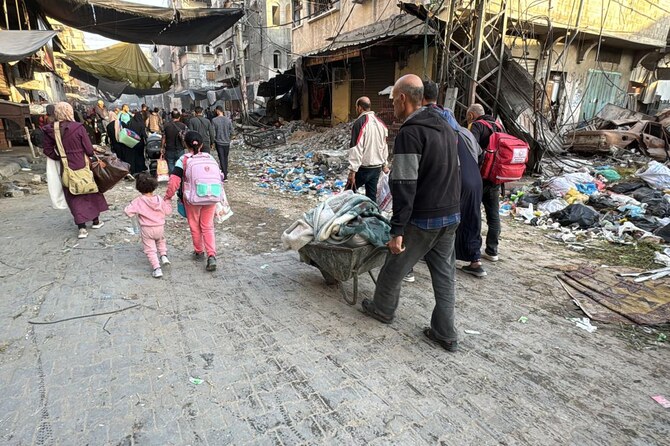
The study says Israel’s bombing campaign created 42 million tonnes of rubble in Gaza, creating major health risks. The destruction of solar panels is particularly dangerous given the lead and other heavy metals they release.
The war in Gaza was sparked by Hamas’s unprecedented attack on Israel on October 7 last year which resulted in the deaths of 1,206 people, mostly civilians, according to an AFP tally of official Israeli figures.
Israel’s bombing and ground offensives in Gaza have killed 42,603 people, a majority civilians, according to data from the health ministry in the Hamas-run territory, figures the UN considers reliable.


UN: Poverty rate in Palestinian territories seen doubling to 74.3% this year
https://arab.news/n3j9e
UN: Poverty rate in Palestinian territories seen doubling to 74.3% this year

- The poverty rate had been 38.8 percent at the end of 2023 but another 2.61 million Palestinians fell into poverty this year
- Even if humanitarian aid is delivered each year, the Palestinian economy will not return to its pre-crisis levels for a decade or more


Algeria inaugurates strategic railway to giant Sahara mine
- The mine is expected to produce 4 million tons per year during the initial phase, with production projected to triple to 12 million tons per year by 2030
- The project is financed by the Algerian state and partly built by a Chinese consortium
ALGEIRS: Algerian President Abdelmadjid Tebboune on Sunday inaugurated a nearly 1,000-kilometer (621-mile) desert railway to transport iron ore from a giant mine, a project he called one of the biggest in the country’s history.
The line will bring iron ore from the Gara Djebilet deposit in the south to the city of Bechar located 950 kilometers north, to be taken to a steel production plant near Oran further north.
The project is financed by the Algerian state and partly built by a Chinese consortium.
During the inauguration, Tebboune described it as “one of the largest strategic projects in the history of independent Algeria.”
This project aims to increase Algeria’s iron ore extraction capacity, as the country aspires to become one of Africa’s leading steel producers.
The iron ore deposit is also seen as a key driver of Algeria’s economic diversification as it seeks to reduce its reliance on hydrocarbons, according to experts.
President Tebboune attended an inauguration ceremony in Bechar, welcoming the first passenger train from Tindouf in southern Algeria and sending toward the north a first charge of iron ore, according to footage broadcast on national television.
The mine is expected to produce 4 million tons per year during the initial phase, with production projected to triple to 12 million tons per year by 2030, according to estimates by the state-owned Feraal Group, which manages the site.
It is then expected to reach 50 million tons per year in the long term, it said.
The start of operations at the mine will allow Algeria to drastically reduce its iron ore imports and save $1.2 billion per year, according to Algerian media.


