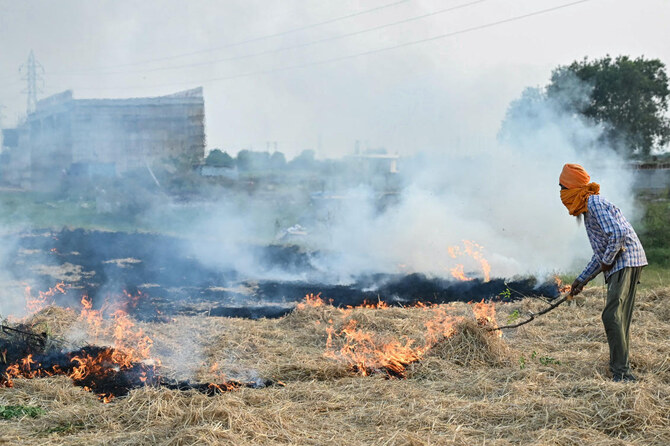
NEW DELHI: At least 16 farmers have been arrested in India’s northern state of Haryana for illegally burning paddy stubble to clear fields, a practice that stokes air pollution in the region around New Delhi at the onset of winter, authorities said on Tuesday.
India’s national capital region battles pollution at this time each year as temperatures fall and cold, heavy air traps construction dust, vehicle emissions and smoke, much of which authorities say travels from the neighboring breadbasket states of Punjab and Haryana.
Delhi, ranked the world’s most polluted capital for four years in a row by Swiss group IQAir, has closed its schools and halted construction projects for brief periods in the past as it looks to tackle the problem.
Police in Haryana’s Kaithal region said that 22 complaints of stubble burning have been registered this year, and 16 people have been arrested.
“Those arrested have been released on bail since this is a bailable offense,” said Birbhan, a deputy superintendent of police, who uses only one name.
Investigations have been launched against almost 100 farmers across Haryana, while fines have been imposed on more than 300, local media reported.
Delhi recorded “very poor” air on Tuesday morning, according to the Central Pollution Control Board (CPCB), with an air quality index (AQI) of 320. An AQI of 0-50 is considered good while anything between 400-500 poses health dangers.
It was the second-most polluted city in the world on Tuesday, a live ranking on IQAir’s website indicated, after only Lahore in neighboring Pakistan.
The environment ministry said Delhi’s daily average AQI was likely to stay in the ‘Very Poor’ category (300-400) in coming days due to unfavorable meteorological and climatic conditions.
To curb Delhi’s pollution authorities have ordered water sprinkling on roads to tackle dust, increasing public bus and metro services and higher parking fees to discourage car use.
Environmentalists say the measures are inadequate.
“These are only emergency measures ... This air pollution mitigation needs a long-term comprehensive solution rather than these ad hoc measures,” said environmentalist Vimlendu Jha.

Sixteen farmers arrested for burning crop waste as pollution rises in north India
Short Url
https://arab.news/j7348
Sixteen farmers arrested for burning crop waste as pollution rises in north India
- Investigations have been launched against almost 100 farmers across Haryana, while fines have been imposed on more than 300
- Delhi is the second-most polluted city in the world on Tuesday, after only Lahore in neighboring Pakistan
Louvre heist probe still aims to ‘recover jewelry’, top prosecutor says
- Police believe they have arrested all four thieves who carried out the brazen October 19 robbery
PARIS: French investigators remain determined to find the imperial jewels stolen from the Louvre in October, a prosecutor has said.
Police believe they have arrested all four thieves who carried out the brazen October 19 robbery, making off with jewelry worth an estimated $102 million from the world-famous museum.
“The interrogations have not produced any new investigative elements,” top Paris prosecutor Laure Beccuau said this week, three months after the broad-daylight heist.
But the case remains a top priority, she underlined.
“Our main objective is still to recover the jewelry,” she said.
That Sunday morning in October, thieves parked a mover’s truck with an extendable ladder below the Louvre’s Apollo Gallery housing the French crown jewels.
Two of the thieves climbed up the ladder, broke a window and used angle grinders to cut glass display booths containing the treasures, while the other two waited below, investigators say.
The four then fled on high-powered motor scooters, dropping a diamond-and-emerald crown in their hurry.
But eight other items of jewelry — including an emerald-and-diamond necklace that Napoleon I gave his second wife, Empress Marie-Louise — remain at large.
Beccuau said investigators were keeping an open mind as to where the loot might be.
“We don’t have any signals indicating that the jewelry is likely to have crossed the border,” she said, though she added: “Anything is possible.”
Detectives benefitted from contacts with “intermediaries in the art world, including internationally” as they pursued their probe.
“They have ways of receiving warning signals about networks of receivers of stolen goods, including abroad,” Beccuau said.
As for anyone coming forward to hand over the jewels, that would be considered to be “active repentance, which could be taken into consideration” later during a trial, she said.
A fifth suspect, a 38-year-old woman who is the partner of one of the men, has been charged with being an accomplice but was released under judicial supervision pending a trial.
Investigators still had no idea if someone had ordered the theft.
“We refuse to have any preconceived notions about what might have led the individuals concerned to commit this theft,” the prosecutor said.
But she said detectives and investigating magistrates were resolute.
“We haven’t said our last word. It will take as long as it takes,” she said.
Police believe they have arrested all four thieves who carried out the brazen October 19 robbery, making off with jewelry worth an estimated $102 million from the world-famous museum.
“The interrogations have not produced any new investigative elements,” top Paris prosecutor Laure Beccuau said this week, three months after the broad-daylight heist.
But the case remains a top priority, she underlined.
“Our main objective is still to recover the jewelry,” she said.
That Sunday morning in October, thieves parked a mover’s truck with an extendable ladder below the Louvre’s Apollo Gallery housing the French crown jewels.
Two of the thieves climbed up the ladder, broke a window and used angle grinders to cut glass display booths containing the treasures, while the other two waited below, investigators say.
The four then fled on high-powered motor scooters, dropping a diamond-and-emerald crown in their hurry.
But eight other items of jewelry — including an emerald-and-diamond necklace that Napoleon I gave his second wife, Empress Marie-Louise — remain at large.
Beccuau said investigators were keeping an open mind as to where the loot might be.
“We don’t have any signals indicating that the jewelry is likely to have crossed the border,” she said, though she added: “Anything is possible.”
Detectives benefitted from contacts with “intermediaries in the art world, including internationally” as they pursued their probe.
“They have ways of receiving warning signals about networks of receivers of stolen goods, including abroad,” Beccuau said.
As for anyone coming forward to hand over the jewels, that would be considered to be “active repentance, which could be taken into consideration” later during a trial, she said.
A fifth suspect, a 38-year-old woman who is the partner of one of the men, has been charged with being an accomplice but was released under judicial supervision pending a trial.
Investigators still had no idea if someone had ordered the theft.
“We refuse to have any preconceived notions about what might have led the individuals concerned to commit this theft,” the prosecutor said.
But she said detectives and investigating magistrates were resolute.
“We haven’t said our last word. It will take as long as it takes,” she said.
© 2026 SAUDI RESEARCH & PUBLISHING COMPANY, All Rights Reserved And subject to Terms of Use Agreement.


