


ISLAMABAD: Pakistan’s finance delegation briefed senior International Monetary Fund (IMF) officials about reforms taken by the government to broaden the country’s tax base and reduce energy costs, the finance ministry said on Tuesday, as Islamabad takes part in the ongoing annual World Bank and IMF meetings in the US.
Pakistan’s Finance Minister Muhammad Aurangzeb left for the US on Monday to attend the annual meetings of the two global financial institutions. Global finance chiefs have gathered in Washington this week to discuss efforts to boost patchy global growth, deal with debt distress and finance green energy transition.
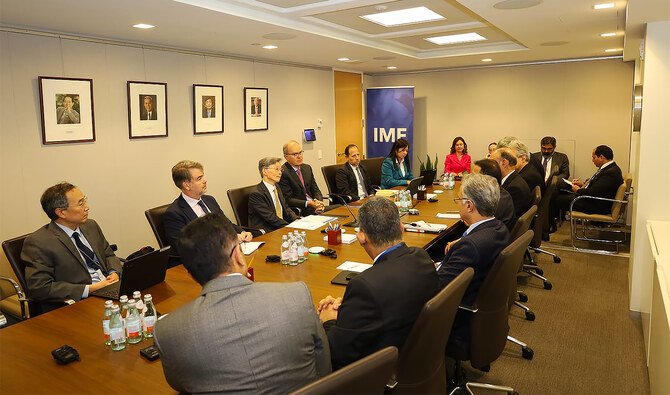
The Pakistani delegation comprising Finance Secretary Imdad Ullah Bosal and central bank Governor Jameel Ahmed, met IMF Deputy Managing Director Kenji Okamura in Washington D.C. On Tuesday, the finance ministry said.
“In the meeting with Kenji Okamura, Deputy Managing Director of the IMF, in Washington DC today, the Pakistan delegation highlighted measures to expand fiscal space by broadening the tax base, aligning the provincial Agricultural Income Tax regime with the federal income tax regime, rationalizing subsidies, rightsizing the government, and reducing energy sector costs,” Pakistan’s finance ministry said.
It said discussions between the two sides also covered stimulating private sector development, building climate resilience and pursuing “prudent monetary and external sector policies.”
Islamabad: Pakistan’s finance delegation briefed senior International Monetary Fund (IMF) officials about reforms taken by the government to broaden the country’s tax base and reduce energy costs, the finance ministry said on Tuesday, as Islamabad takes part in the ongoing annual World Bank and IMF meetings in the US.
Pakistan’s Finance Minister Muhammad Aurangzeb left for the US on Monday to attend the annual meetings of the two global financial institutions. Global finance chiefs have gathered in Washington this week to discuss efforts to boost patchy global growth, deal with debt distress and finance green energy transition.
The Pakistani delegation comprising Finance Secretary Imdad Ullah Bosal and central bank Governor Jameel Ahmed, met IMF Deputy Managing Director Kenji Okamura in Washington D.C. On Tuesday, the finance ministry said.
“In the meeting with Kenji Okamura, Deputy Managing Director of the IMF, in Washington DC today, the Pakistan delegation highlighted measures to expand fiscal space by broadening the tax base, aligning the provincial Agricultural Income Tax regime with the federal income tax regime, rationalizing subsidies, rightsizing the government, and reducing energy sector costs,” Pakistan’s finance ministry said.
It said discussions between the two sides also covered stimulating private sector development, building climate resilience and pursuing “prudent monetary and external sector policies.”
“The need for steadfast implementation of reforms under the External Fund Facility [EFF] was also emphasized,” the ministry added.
The IMF last month agreed to provide Pakistan a $7 billion loan program to bail out its crisis-ridden fragile economy. Islamabad has had to take painful measures to secure the loan, which included revisiting power deals with independent producers, increasing the tax net and removing subsidies for the poor.
Pakistan’s economic reforms also include its decision to auction its loss-making national carrier Pakistan International Airlines (PIA) which has amassed debt worth billions of rupees over the years due to chronic mismanagement. Prime Minister Shehbaz Sharif this month announced his government was terminating purchase agreements with five independent power producers (IPPs) to rein in electricity tariffs as households and businesses buckle under soaring energy costs.
Hiking fuel and food prices pushed inflation in the country to a staggering 38 percent in May 2023. Since then, Pakistan’s macroeconomic indicators have registered gains, with the government reporting that headline inflation decreased to 6.9 percent in September after repeated cuts in the prices of petroleum products.
After inflows from the IMF and a strong stock market performance, Pakistan’s liquid foreign exchange reserves surpassed the $16 billion mark this month, making it the first time in two years it had happened.
“The need for steadfast implementation of reforms under the External Fund Facility [EFF] was also emphasized,” the ministry added.
The IMF last month agreed to provide Pakistan a $7 billion loan program to bail out its crisis-ridden fragile economy. Islamabad has had to take painful measures to secure the loan, which included revisiting power deals with independent producers, increasing the tax net and removing subsidies for the poor.
Pakistan’s economic reforms also include its decision to auction its loss-making national carrier Pakistan International Airlines (PIA) which has amassed debt worth billions of rupees over the years due to chronic mismanagement. Prime Minister Shehbaz Sharif this month announced his government was terminating purchase agreements with five independent power producers (IPPs) to rein in electricity tariffs as households and businesses buckle under soaring energy costs.
Hiking fuel and food prices pushed inflation in the country to a staggering 38 percent in May 2023. Since then, Pakistan’s macroeconomic indicators have registered gains, with the government reporting that headline inflation decreased to 6.9 percent in September after repeated cuts in the prices of petroleum products.
After inflows from the IMF and a strong stock market performance, Pakistan’s liquid foreign exchange reserves surpassed the $16 billion mark this month, making it the first time in two years it had happened.


