Survey finds 87% of Arab Americans intend to vote in US election

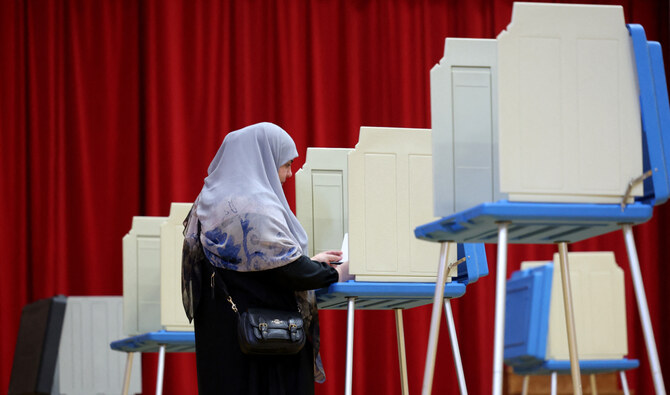
Large Arab-American communities are found in swing states like Michigan. (AFP)
Short Url
Updated 22 October 2024
Follow

Survey finds 87% of Arab Americans intend to vote in US election

  • Poll shows why election candidates would be well advised not take the Arab American vote for granted
  • Women’s engagement with the election process has increased significantly since 2016, when 32 percent did not vote

LONDON: A poll conducted for Arab News by YouGov reveals that 87 percent of Arab Americans intend to vote in next month’s presidential election.

Since 2016, Arab-American participation in presidential elections has grown steadily. Eight years ago, 67 percent of those surveyed turned out to vote, rising to 79 percent in 2020. This year, only 6 percent said they will not bother voting, with 7 percent still undecided.

The intention to vote on Nov. 5 is stronger among men (92 percent) than women (81 percent).  However, women’s engagement with the presidential election process has increased significantly since 2016, when 32 percent did not vote.


Since 2016, Arab-American participation in presidential elections has grown steadily. (AFP)

This fell to 26 percent in 2020, and now only 11 percent said they will not vote next month, with 8 percent still undecided. 

Older respondents are more likely to vote, with 90 percent of those over 55 years of age signaling their intention to do so, compared with 84 percent of 18-34-year-olds.

Read our full coverage here: US Elections 2024: What Arab Americans want

Most likely to head to the polls are those who live in the west and south (where 92 and 91 percent respectively intend to vote), people educated up to post-graduate level (97 percent), and those on an annual salary of $80,000 or more (94 percent).

Overall, 80 percent of those polled believe their vote matters. Seventy-four percent of Arab-American women believe their vote matters, compared with 86 percent of men.

Historically, many Arab Americans have felt that their vote did not count for much, “but that’s no longer the case at all because of where that constituency is,” Firas Maksad, a senior fellow at the Middle East Institute, told the Arab News podcast “Frankly Speaking.”

Large Arab-American communities are found in “states like Michigan, that are going to be crucial, and even in Georgia (there is) a significant population and in Northern Virginia.

“So although the Arab-American community is relatively small — perhaps some 1 percent of the general American population — in elections so tightly contested as they are today, not only at the general national level but in the pivotal swing states like Michigan, Georgia and Pennsylvania, the margin here is 0.5 percent one way or the other, and that makes the Arab-American vote a crucial constituency to win.”

The poll shows that all candidates would be well advised not to take the Arab-American vote for granted — 84 percent say regardless of whether an election is looming, they keep up with political developments either most of the time (44 percent) or some of the time (40 percent).


Australia hits Afghan Taliban officials with sanctions, travel bans

Updated 6 sec ago
Follow

Australia hits Afghan Taliban officials with sanctions, travel bans

  • The Taliban has said it respects women’s rights, in line with its interpretation of Islamic law and local custom
  • The measures were part of a new Australian government framework that enabled it to “directly impose its own sanctions and travel bans to increase pressure on the Taliban, targeting the oppression of the Afghan people,” Wong said

SYDNEY: Australia on Saturday imposed financial sanctions and travel bans on four officials in Afghanistan’s Taliban government over what it said was a deteriorating human rights situation in the country, especially for women and girls.
Australia’s Foreign Minister Penny Wong said the officials were involved “in the oppression of women and girls and in undermining good governance or the rule of law” in the Taliban-run country.
Australia was one of several nations which in August 2021 pulled troops out of Afghanistan, after being part of a NATO-led international force that trained Afghan security forces and fought the Taliban for two decades after Western-backed forces ousted the Islamist militants from power.
The Taliban, since regaining power in Afghanistan, has been criticized for deeply restricting the rights and freedoms of women and girls through bans on education and work.
The Taliban has said it respects women’s rights, in line with its interpretation of Islamic law and local custom.
Wong said in a statement the sanctions targeted three Taliban ministers and the group’s chief justice, accusing them of restricting access for girls and women “to education, employment, freedom of movement and the ability to participate in public life.”
The measures were part of a new Australian government framework that enabled it to “directly impose its own sanctions and travel bans to increase pressure on the Taliban, targeting the oppression of the Afghan people,” Wong said.
Australia took in thousands of evacuees, mostly women and children, from Afghanistan after the Taliban retook power in the war-shattered South Asian country, where much of the population now relies on humanitarian aid to survive.