

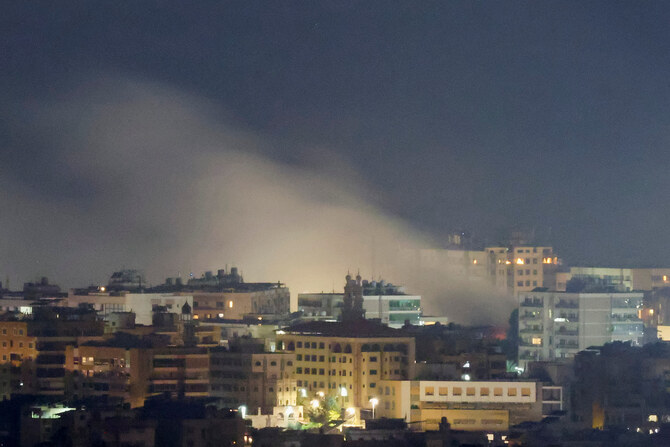

JERUSALEM: A strike hit near Beirut's Rafik Hariri University Hospital in Beirut late on Monday, a hospital source told Reuters, adding that it appeared the strike hit the hospital's parking lot.
The Israeli army said earlier on Monday its forces were pummelling Hezbollah’s financial arm, hitting more than two dozen targets including a bunker with tens of millions of dollars in cash and gold.
The strikes since Sunday night mark an expansion of Israel’s campaign against the Iran-backed group after a year of cross-border exchanges that escalated in late September into a full-blown war.
Israeli forces are now seeking to degrade the movement’s ability to fund its operations.
“The Israeli Air Force carried out a series of precise strikes on these Hezbollah financial strongholds,” military spokesman Rear Admiral Daniel Hagari said in a televised briefing.
“One of our main targets last night was an underground vault with tens of millions of dollars in cash and gold. The money was being used to finance Hezbollah’s attacks on Israel.”
He did not specify whether all of the money was destroyed by the strike.
Hagari then referenced a separate bunker also allegedly filled with cash and gold under a hospital in the capital Beirut, but said the vault had not been targeted yet by the Israeli military.
“According to the estimates we have, there is at least half a billion dollars in dollar bills and gold stored in this bunker,” Hagari said.
“This money could and still can be used to rebuild the state of Lebanon.”
Earlier Monday, Israeli military chief Lt. Gen. Herzi Halevi said more than two dozen targets belonging to Al-Qard Al-Hassan — a financial firm linked to Hezbollah — were hit.
“We struck close to 30 targets across Lebanon,” Halevi said in a statement, after strikes began Sunday night against the US-sanctioned association that Israel accuses of financing “Hezbollah’s terrorist operations.”
The announcements came as the army said it continued to hammer an array of Hezbollah positions across Lebanon, including strikes against about 300 targets in the previous 24 hours.
Al-Qard Al-Hassan is a lifeline for mainly Muslim Shiite communities battling a years-long financial crisis that has locked Lebanese out of their bank deposits.
The financial firm, officially registered as a charity, has been offering customers credit in exchange for gold deposits on an interest-free basis since the 1980s.
Its beneficiaries are mainly Shiite Muslims, but in a country where a five-year economic crisis has forced many into desperation, Christians and Sunni Muslims have also turned to its services.
The United States has long sanctioned the association, accusing Hezbollah of using it as a cover to mask its financial activities and gain access to the international financial system.
On Sunday evening, Israel struck Al-Qard Al-Hassan branches in Beirut, the eastern Bekaa Valley and south Lebanon, Lebanese official media said.
Al-Qard Al-Hassan says it has more than 30 branches nationwide, mainly in Hezbollah bastions including Beirut’s southern suburbs, but also in central Beirut and in other major cities such as Sidon and Tyre.
Israel in late September widened the focus of its military operations to Lebanon after nearly a year of war against Hezbollah’s Palestinian ally Hamas in the Gaza Strip.


