ISLAMABAD: Pakistan on Monday began the process to choose the new chief justice of the country, following the passage of a controversial constitutional amendment that empowered parliament to appoint the top judge among other changes.
The current Chief Justice Qazi Faez Isa is due to retire this Friday. Previously, the Supreme Court’s second-most senior judge automatically became the chief justice when the top judge retired at age 65, but analysts say there had been concerns within the government circles that senior judges below Isa and in the high courts had shown leniency to Khan in a number of cases.
In an extraordinary session that began on Sunday and continued overnight into Monday, Pakistan’s parliament passed the 26th Constitutional Amendment that allows a 12-member parliamentary committee to pick the chief justice from a panel of three senior-most judges of the Supreme Court.
“I have the honor to invite your kind attention to Article 175A of the Constitution of the Islamic Republic of Pakistan, whereby the chief justice of Pakistan is to be nominated by the special parliamentary committee from among the three most senior judges of the Supreme Court,” Speaker Ayaz Sadiq wrote in a letter to parliamentary heads of political parties in the National Assembly, lower house of parliament.
“Foregoing in view, MNAs [members of the National Assembly] from your party may be nominated for the said committee, accordingly.”
The parliamentary committee will comprise eight members from the National Assembly and four from the Senate, the upper house of parliament.
Sadiq also wrote to Senate Chairman Yusuf Raza Gilani to nominate four senators for the panel.
Pakistani politicians have long complained about judicial overreach into matters of governance, stoking tensions between the judiciary and legislature.
Former prime minister Imran Khan’s Pakistan Tehreek-e-Insaf (PTI) opposition party and the legal fraternity opposed the amendment, saying the changes were aimed at curtailing the powers of judiciary.
Barrister Aqeel Malik, the government’s legal adviser, told Arab News the process of appointing judges to high courts as well as selecting the chief justice from a panel of three senior most judges required greater parliamentary oversight and input.
“This in no way curtails the judiciary’s powers, but it does ensure parliamentary oversight and a greater role in the selection and appointment of judges, all within the constitutional framework,” he said.
“This will ensure not just the seniority principle, but of course other considerations such as legal wisdom, acumen and overall general administrative experience.”
Malik said the parliamentary committee would begin its deliberations immediately and it has until Wednesday to send its recommendations to the prime minister, based on a majority vote among the three senior-most judges for the appointment of the chief justice of Pakistan.
Pakistan’s top court has become a battleground between the government and jailed former Prime Minister Imran Khan, ruling on issues ranging from a controversial national election to a potential military court trial for Khan and his supporters.
Former cricket star Khan, 71, has been in jail for over a year. His 2022 removal from office and subsequent clashes with the military have triggered Pakistan’s worst political turmoil in decades.
“It is a black day in our constitutional history and for judicial independence,” Gohar Ali Khan, chairman of Khan’s party, said as the Pakistan parliament moved to pass the 26th constitutional amendment in wee hours of Monday.


Pakistan begins process to choose new top judge after passage of contentious constitutional amendment

https://arab.news/8c7zp
Pakistan begins process to choose new top judge after passage of contentious constitutional amendment

- Pakistan parliament has allowed a 12-member parliamentary committee to pick chief justice from a panel of three senior-most judges
- Previously, the Supreme Court’s second-most senior judge automatically became the chief justice when the top judge retired at age 65

Qatar, Pakistan resolve to boost strategic, economic cooperation at Doha talks
- Both countries urge dialogue on Afghanistan amid renewed border tensions between Islamabad and Kabul
- Discussions focus on bilateral trade and investment, energy, defense, manpower and labor and culture
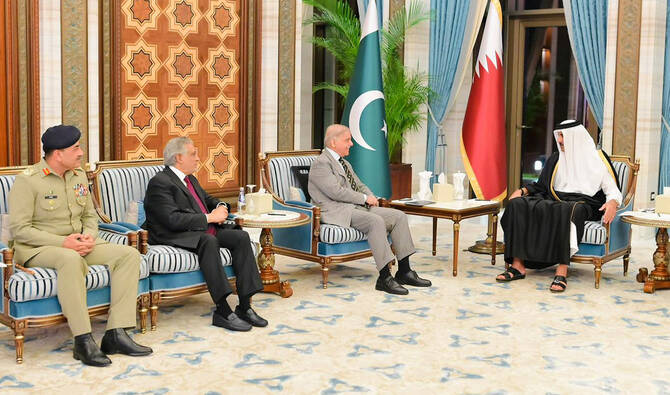
ISLAMABAD: Pakistan and Qatar on Tuesday agreed to deepen their strategic and economic cooperation during high-level talks between Prime Minister Shehbaz Sharif and his Qatari counterpart Sheikh Mohammed bin Abdulrahman bin Jassim Al Thani, Sharif’s office said.
Sharif visited Qatar along with a high-level delegation on the invitation of Qatari emir Sheikh Tamim bin Hamad Al Thani. The Pakistani premier also held meetings with Qatar’s trade and defense ministers to discuss cooperation in various domains.
The visit came at a time when Pakistan is seeking closer economic engagement with Gulf partners amid its broader push to stabilize the economy and attract investment, while maintaining security and defense cooperation with key regional states.
During their meeting in Doha, PM Sharif and Qatar’s Sheikh Mohammed discussed bilateral relations and exchanged views on regional and international developments, according to the Pakistan prime minister’s office.
“They reaffirmed the strong brotherly relations between Pakistan and Qatar and expressed satisfaction at the growing momentum in political, economic and institutional ties,” Sharif’s office said.
“Discussions focused on enhancing cooperation in the fields of trade and investment, energy, defense, manpower and labor and culture, with both sides stressing the importance of their task force to accelerate cooperation in all these areas.”
Pakistan and Qatar maintain strong trade and investment ties. In 2022, the office of Qatar’s emir said the Qatar Investment Authority planned to invest $3 billion in Pakistan, targeting sectors including transport, aviation, education, health, media, technology and labor.
Nearly 300,000 Pakistanis live and work in Qatar, according to Pakistan’s foreign office, with many employed in health, education, engineering and public services, as well as construction and transport. The two countries engage through forums such as the Bilateral Political Consultations and the Joint Ministerial Commission.
Sharif said he had productive discussions with Qatar’s emir, Sheikh Tamim bin Hamad Al Thani, on how the two sides could transform their brotherly ties into mutually beneficial economic relationships.
“We also took stock of the regional situation,” he said on X. “Pakistan and Qatar will continue to work together for peace and stability in the region and beyond.”
DIALOGUE WITH AFGHANISTAN
Earlier, Sharif and Qatar’s Deputy PM Sheikh Saoud Al-Thani discussed the situation in Afghanistan and called for dialogue to support regional stability.
The meeting took place amid renewed tensions after Islamabad carried out airstrikes last week on what it described as Tehreek-e-Taliban Pakistan (TTP) targets inside Afghanistan. Kabul said the strikes killed civilians and vowed to respond to what it called a violation of its sovereignty.
“Regional developments were also discussed, in particular the situation in Iran and Afghanistan,” Sharif’s office said in a statement. “Both sides emphasized the importance of dialogue, de-escalation and collective efforts to promote peace and stability in the region.”
This was the second time in less than six months that Pakistan conducted airstrikes in Afghanistan. The last strikes triggered heavy, weeklong clashes between the neighbors along their border before Qatar and Turkiye mediated a ceasefire between them in Oct. last year.
Separately, Sharif held meetings with Qatar’s State Minister for Trade Dr. Ahmed bin Mohammed Al-Sayed and a delegation of the Qatar Businessmen Association (QBA), highlighting Pakistan’s investment-friendly reforms.
He invited QBA members to explore opportunities in infrastructure, logistics, energy, agriculture, technology and export-oriented manufacturing, his office said.