Pakistan Navy seizes narcotics worth $145 million in Arabian Sea operation

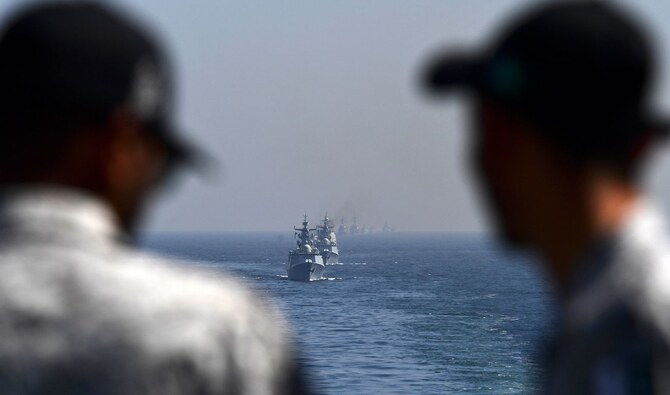
Pakistan's soldiers look at Naval ships of participating countries take part in a multinational naval exercise 'AMAN-23' in the Arabian Sea near Pakistan's port city of Karachi on February 13, 2023. (AFP/File)
Short Url
Updated 21 October 2024
Follow

Pakistan Navy seizes narcotics worth $145 million in Arabian Sea operation

  • The cache included 2,000 kilograms of hashish, 370kg ice or crystal meth, and 50kg heroin
  • The seized drugs were handed over to the Anti-Narcotics Force, the Pakistani military says

ISLAMABAD: Pakistan Navy has seized a sizeable cache of narcotics worth $145 million during an operation in the Arabian Sea, the Pakistani military said on Monday.
The seized narcotics included 2,000 kilograms of hashish, 370kg ice or crystal meth and 50kg heroin, according to the Inter-Services Public Relations (ISPR), the Pakistani military’s media wing.
The seized cache was handed over to the Anti-Narcotics Force.
“Pakistan Navy is always active to prevent all kinds of illegal activities in the maritime boundaries of the region,” the ISPR said in a statement.
The development came days after Pakistan Navy seized 1.3 tons of narcotics, valued at approximately $26 million, during a targeted operation in the North Arabian Sea, according to a statement issued by the navy.
The operation, codenamed as ‘Himalayan Spirit,’ was conducted by Pakistan Navy ship Zulfiqar, which was assisted by the US Navy and US Coast Guard ships in intercepting suspicious fishing boats.


Pakistan launches digital tools to trace life insurance claims, tighten motor insurance enforcement

Updated 6 sec ago
Follow

Pakistan launches digital tools to trace life insurance claims, tighten motor insurance enforcement

  • SECP rolls out SMS-based Life Insurance Policy Finder, orders insurers to join Motor Insurance Repository
  • The regulator says centralized data will help authorities verify coverage, reduce long-unclaimed benefits

KARACHI: Pakistan’s securities regulator on Monday announced two digital initiatives aimed at overhauling how insurance data is stored and accessed, in a push to strengthen enforcement, improve transparency and make it easier for citizens to trace insurance coverage.

The Securities and Exchange Commission of Pakistan (SECP) announced in two separate statements it had introduced a nationwide Life Insurance Policy Finder to help families identify policies held by deceased relatives. It also directed all non-life insurers to join a centralized Motor Insurance Repository (MIR).

Both systems, developed with the Central Depository Company (CDC), seek to address longstanding gaps in a sector where weak records, low compliance and limited data-sharing have left motorists, policyholders and beneficiaries without reliable recourse.

“The Securities and Exchange Commission of Pakistan (SECP), in collaboration with the Central Depository Company of Pakistan Limited (CDC) and the Insurance Association of Pakistan (IAP), has introduced the Life Insurance Policy Finder Service,” it said in one of the statements. “This initiative is designed to facilitate the general public in locating life insurance policies of deceased loved ones.”

“The service addresses a long-standing challenge faced by families who remain unaware of life insurance policies held by their deceased relatives,” it added. “This lack of awareness often results in legitimate claims and benefits remaining unclaimed for years.”

The SECP said the initiative aims to strengthen consumer protection, promote transparency and provide structured and secure access to insurance benefits for rightful heirs and beneficiaries.

Under the new policy-finder service, which goes live on Dec. 15, individuals can send the CNIC number of the deceased via SMS to 99833.

If a policy exists, the relevant insurer will contact the beneficiary to verify details and guide them through the claims process. Life insurers and family takaful operators have also been instructed to participate fully and respond to queries within set turnaround times.

Separately, on the motor insurance side, all non-life insurers underwriting vehicle policies are required to sign a service-level agreement with the CDC within 60 days and begin uploading complete and validated policy data to the MIR.

The repository will allow provincial and federal authorities to verify third-party insurance coverage, a requirement that exists on paper but remains loosely enforced nationwide.

The SECP said the measures form part of its broader effort to promote digital transformation, improve compliance and safeguard consumer interest.

“A centralized and validated data repository will allow authorities to verify insurance coverage efficiently, addressing significant gaps in compliance,” it added.