

Lulu Retail to offer 25% stake in IPO on ADX 

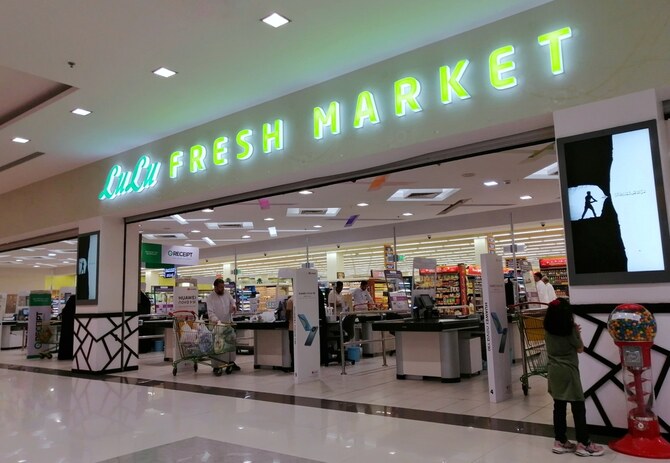
Lulu Fresh Market shop in Al-Ahsa, Saudi Arabia. Shutterstock
Short Url
Updated 21 October 2024
Follow

Lulu Retail to offer 25% stake in IPO on ADX 

  • IPO is scheduled to run from Oct. 28 to Nov. 5, with the final offering price to be determined on Nov. 6
  • Lulu expects to attract strong interest due to its dominant market position across the GCC region

RIYADH: Hypermarket chain operator Lulu Retail Holdings has announced its intention to float 2.58 billion shares, representing 25 percent of the company, on the Abu Dhabi Securities Exchange. 

The initial public offering is scheduled to run from Oct. 28 to Nov. 5, with the final offering price to be determined on Nov. 6, according to a press release. 

This follows UAE-based Spinney’s recent share listing on the Dubai Financial Market in May, with Lulu Retail's IPO marking the fourth listing on the ADX this year. 

Lulu expects to attract strong interest due to its dominant market position across the Gulf Cooperation Council region, where it operates 240 stores across six countries, including 103 in the UAE. 

Yusuff Ali, founder, chairman and non-executive director of Lulu Retail, said: “It’s with immense pride that we announce the planned IPO of Lulu Retail on ADX, bringing to market the largest pan-GCC full-line retailer by selling space, sales and number of stores.” 

He added: “Integral to our growth is the vision and ambition of the UAE, Saudi Arabia and the other GCC nations where strong national leadership is enabling positive demographic and consumption trends and driving impressive economic growth.”  

The expected listing date for the shares on the ADX is Nov. 14. The offering will be accessible to UAE retail investors, professional investors, and senior executives within the company. 

“We’re looking forward to welcoming new shareholders to Lulu and are sure they will share our passion for the company and excitement for the future,” added Ali. 

According to the press statement, Lulu aims to maintain a total dividend payout ratio of 75 percent of annual distributable profits after tax, with payouts occurring twice a year.

“Our scale is combined with a track record of delivering robust revenue growth, attractive profit margins and a well-defined growth strategy built around enhancing and delivering greater value from our existing stores, expanding our store network, delivering operational efficiencies and growing our high-value private label and loyalty program,” said Saifee Rupawala, CEO of Lulu Retail.  

He noted the GCC retail market presents a $100 billion opportunity over the next five years, with significant growth potential in Saudi Arabia. 

In April, Lulu announced plans to launch new hypermarkets in Makkah and Madinah, further expanding its retail portfolio in Saudi Arabia.  

Jabal Omar Development Co. is developing the site in Makkah, while Al Manakha Urban Project Development Co. is overseeing the development in Madinah. 


Saudi stock market opens its doors to foreign investors

Updated 06 January 2026
Follow

Saudi stock market opens its doors to foreign investors

RIYADH: Foreigners will be able to invest directly in Saudi Arabia’s stock market from Feb. 1, the Kingdom’s Capital Market Authority has announced.

The CMA’s board has approved a regulatory change which will mean the capital market, across all its segments, will be accessible to investors from around the world for direct participation.

According to a statement, the approved amendments aim to expand and diversify the base of those permitted to invest in the Main Market, thereby supporting investment inflows and enhancing market liquidity.

International investors' ownership in the capital market exceeded SR590 billion ($157.32 billion) by the end of the third quarter of 2025, while international investments in the main market reached approximately SR519 billion during the same period — an annual rise of 4 percent.

“The approved amendments eliminated the concept of the Qualified Foreign Investor in the Main Market, thereby allowing all categories of foreign investors to access the market without the need to meet qualification requirements,” said the CMA, adding: “It also eliminated the regulatory framework governing swap agreements, which were used as an option to enable non-resident foreign investors to obtain economic benefits only from listed securities, and the allowance of direct investment in shares listed on the Main Market.”

In July, the CMA approved measures to simplify the procedures for opening and operating investment accounts for certain categories of investors. These included natural foreign investors residing in one of the Gulf Cooperation Council countries, as well as those who had previously resided in the Kingdom or in any GCC country. 

This step represented an interim phase leading up to the decision announced today, with the aim of increasing confidence among participants in the Main Market and supporting the local economy.

Saudi Arabia, which ‌is more than halfway ‍through an economic plan ‍to reduce its dependence on oil, ‍has been trying to attract foreign investors, including by establishing exchange-traded funds with Asian partners in Japan and Hong Kong.