

NATO’s Rutte: North Korea sending troops to Ukraine would escalate conflict

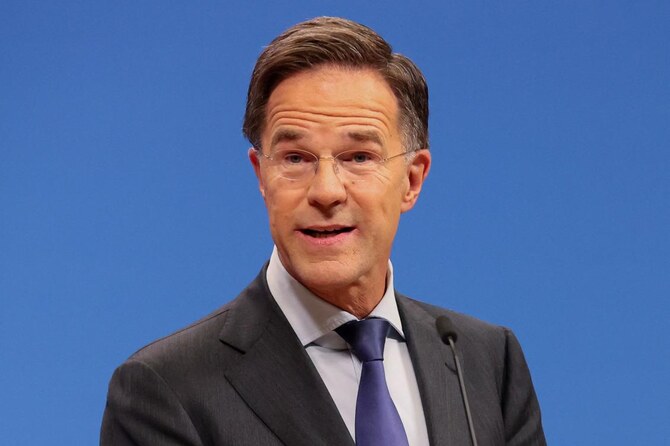
NATO Secretary General Mark Rutte adresses a press conference during a NATO Defence Ministers meeting in Brussels, Belgium. (File/AFP)
Short Url
Updated 21 October 2024
Follow

NATO’s Rutte: North Korea sending troops to Ukraine would escalate conflict

  • South Korea summons Russian envoy to protest North Korea troop dispatch

BRUSSELS: If North Korea were to send troops to Ukraine to fight on Russia’s behalf it would significantly escalate the conflict, NATO Chief Mark Rutte said on social media platform X on Monday.
Rutte, who took office at NATO at the start of the month, said he had a discussion with South Korean President Yoon Suk-yeol about the alliance’s close partnership with Seoul, focusing on defense industrial cooperation and the interconnected security of the Euro-Atlantic and Indo-Pacific regions.
South Korea’s foreign ministry summoned on Monday the Russian ambassador in Seoul in protest over what it has called the dispatch of North Korean troops to Russia for deployment in Ukraine and pledged a joint international response.
South Korea’s first vice foreign minister Kim Hong-kyun called in Georgy Zinoviev, the top Russian envoy to Seoul, and urged the immediate withdrawal of North Korean soldiers from Russia, the ministry said in a statement.
Kim said the participation of North Korean troops in the war in Ukraine violated UN resolutions and the UN charter and posed serious threats to the security of South Korea and beyond.
“We condemn North Korea’s illegal military cooperation, including its dispatch of troops to Russia, in the strongest terms,” the ministry quoted Kim as saying.
“We will respond jointly with the international community by mobilizing all available means against acts that threaten our core security interests.”
Phone calls to the Russian embassy went unanswered. The ministry said Zinoviev told Kim that he would relay the message to Moscow.

Meanwhile Russia on Monday vowed to maintain cooperation with North Korea after reports of Pyongyang’s troops being trained to fight for Moscow in Ukraine.
“North Korea is our close neighbor and partner and we develop relations in all areas and it’s our sovereign right. We will continue developing this cooperation further,” Kremlin spokesman Dmitry Peskov told journalists, while declining to answer a question on whether Russia is using North Korean troops.

Ukraine’s President Volodymyr Zelensky said last week that North Korea was preparing to send 10,000 soldiers to help Moscow’s war effort, and that some North Korean officers were already deployed on Russian-occupied Ukrainian territory.
The West has long accused North Korea of supplying weapons to Russia. Rutte and the Pentagon both said last week that they have found no evidence yet of a North Korean military presence on the ground in Ukraine.


After nearly 7 weeks and many rumors, Bolivia’s ex-leader reappears in his stronghold

Updated 20 February 2026
Follow

After nearly 7 weeks and many rumors, Bolivia’s ex-leader reappears in his stronghold

  • Morales was Bolivia’s first Indigenous president who served from 2006 until his fraught 2019 ouster and subsequent self-exile
  • He dismissed rumors fueled by local politicians and fanned by social media that he would try to flee the country

LA PAZ: Bolivia’s long-serving socialist former leader, Evo Morales, reappeared Thursday in his political stronghold of the tropics after almost seven weeks of unexplained absence, endorsing candidates for upcoming regional elections and quieting rumors he had fled the country in the wake of the US seizure of his ally, Venezuela’s ex-President Nicolás Maduro.
The weeks of hand-wringing over Morales’ fate showed how little the Andean country knows about what’s happening in the remote Chapare region, where the former president has spent the past year evading an arrest warrant on human trafficking charges, and how vulnerable it is to fears about US President Donald Trump’s potential future foreign escapades.
The media outlet of Morales’ coca-growing union, Radio Kawsachun Coca, released footage of Morales smiling in dark sunglasses as he arrived via tractor at a stadium in the central Bolivian town of Chimoré to address his supporters.
Morales, Bolivia’s first Indigenous president who served from 2006 until his fraught 2019 ouster and subsequent self-exile, explained that he had come down with chikungunya, a mosquito-borne ailment with no treatment that causes fever and severe joint pain, and suffered complications that “caught me by surprise.”
“Take care of yourselves against chikungunya — it is serious,” the 66-year-old Morales said, appearing markedly more frail than in past appearances.
He dismissed rumors fueled by local politicians and fanned by social media that he would try to flee the country, vowing to remain in Bolivia despite the threat of arrest under conservative President Rodrigo Paz, whose election last October ended nearly two decades of rule by Morales’ Movement Toward Socialism party.
“Some media said, ‘Evo is going to leave, Evo is going to flee.’ I said clearly: I am not going to leave. I will stay with the people to defend the homeland,” he said.
Paz’s revival of diplomatic ties with the US and recent efforts to bring back the Drug Enforcement Administration — some 17 years after Morales expelled American anti-drug agents from the Andean country while cozying up to China, Russia, Cuba and Iran — have rattled the coca-growing region that serves as Morales’ bastion of support.
Paz on Thursday confirmed that he would meet Trump in Miami on March 7 for a summit convening politically aligned Latin American leaders as the Trump administration seeks to counter Chinese influence and assert US dominance in the region.
Before proclaiming the candidates he would endorse in Bolivia’s municipal and regional elections next month, Morales launched into a lengthy speech reminiscent of his once-frequent diatribes against US imperialism.
“This is geopolitical propaganda on an international scale,” he said of Trump’s bid to revive the Monroe Doctrine from 1823 in order to reassert American dominance in the Western Hemisphere. “They want to eliminate every left-wing party in Latin America.”