

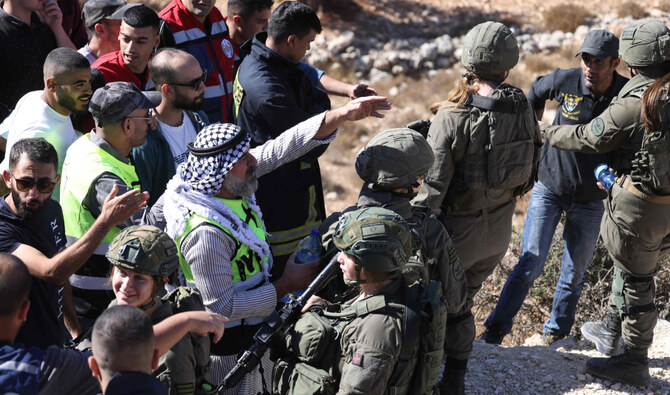

AL-ZAWAYDA: After a year of relentless war, Gaza’s olive harvest is set to suffer, while in the occupied West Bank, Palestinian farmers fear tending to their groves due to settler attacks.
For generations, olive harvests have been central to Palestinian life and culture.
“We are happy that the olive season has started, but we are afraid because we are in a state of war,” said Rami Abu Asad, who owns a farm in Deir Al-Balah, central Gaza.
Workers picking the olives by hand stay alert, listening for drones or warplanes that could bomb without warning.
“But it is evident (to Israeli forces) that we are workers, and we do nothing else,” he said, noting a sweeping Israeli military operation in Jabalia, less than 20 km last year, which resulted in the deaths of 1,206 people, mostly civilians, according to an AFP tally of official Israeli figures.
Israel’s retaliatory onslaught in Gaza has killed 42,603 people, a majority of them civilians, according to data from the Health Ministry in the territory, which the UN considers reliable.
The ongoing war has reduced vast areas of Gaza to rubble, with about 68 percent of the territory’s agricultural regions damaged by the conflict and farmers unable to fertilize or irrigate their land, the UN says.
“The number of remaining olive trees is minimal, and the costs are very high,” Asad added.
Jamal Abou Shaouish, an agricultural engineer, expects this year’s harvest in Gaza to net just 15,000 tonnes, sharply down from around 40,000 tonnes in the years before the war.
Supply shortages and destruction caused by the war will also impact the quality of olives while pressing prices have soared due to the lack of fuel needed to run the machinery required for sorting and pressing the oil.
In the West Bank, the harvest has been marred by perennial fears of attacks by Israeli settlers, who regularly prevent Palestinians from accessing their olive groves or outright destroy their orchards.
For Khaled Abdallah, he has made the tough decision not to harvest the olives this season on his land near the Beit El settlement.
“I didn’t even consider going to these lands close to the colony because the situation is hazardous,” he said, saying he will instead focus on harvesting olives from a separate property in the village of Jifna, north of Ramallah.
Like other Palestinians who own olive groves near the settlements, Abdallah coordinated with Israeli advocacy organizations to obtain special permits for the crops.
“But there are no longer any rights organizations capable of protecting us from settler attacks, and there is no longer any coordination,” he lamented.
Olive groves have long been essential to the economy and culture of the West Bank but have also been the site of bloody clashes between farmers and encroaching Israeli settlers for decades, with the disputes hinging on access to land.


