

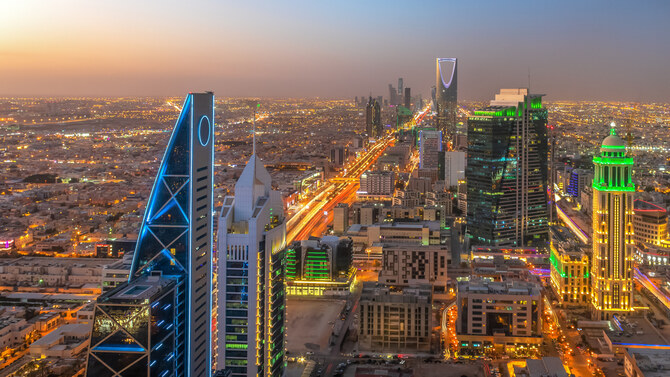

RIYADH: Rents for Grade A office spaces in Riyadh reached SR2,090 ($556.43) per sq. meter annually in the first half of this year, a 19 percent increase from the same period in 2023.
According to JLL, Riyadh added approximately 52,000 sq. meters of office space, bringing the total market supply to 5.2 million sq. meters. Grade A office spaces command a premium due to their prime location, infrastructure, and modern amenities.
The rise in demand for high-quality office space in Riyadh aligns with Saudi Arabia’s ambition to position the capital as a global business and investment hub.
“In the capital, we continue to see significant levels of demand from both government-related entities and the private sector, although the former still accounts for the majority of demand. From the private sector, we note that the average occupier space requirements have increased considerably over the course of the year,” stated JLL.
It added: “Both of these cohorts are increasingly looking to occupy office developments in the north of Riyadh for a number of reasons, including but not limited to ease of access and egress the emergence of new, high-quality office options.”
The real estate agency further noted that no new office supply had been added in Jeddah during the first half of this year, keeping the total stock stable at 1.21 million sq. meters.
The report projected that approximately 249,000 sq. meters and 48,000 sq. meters of gross leasable area are expected to be delivered in Riyadh and Jeddah, respectively, in the second half of this year.
“Despite considerable levels of new supply scheduled to be delivered over the course of the year, looking ahead, we expect that the trajectory of the market in the second half of the year will remain on a similar course to that seen in the first half of the year,” said JLL.
The agency added that strong pre-leasing levels for upcoming institutional-quality developments, combined with a significant level of pent-up demand in the market — particularly from incumbents looking to upgrade their office space — will continue to underpin rental and occupancy growth in Riyadh and Jeddah.
Earlier this month, another analysis by Knight Frank revealed that residential transaction values in Saudi Arabia surged 25 percent year on year in the third quarter of 2024, totaling SR35.4 billion.
The Knight Frank report added that the volume of deals also increased by 12 percent, reaching 45,924 agreements, highlighting strong demand in the Kingdom’s housing market.
This trend follows a continued increase in demand over the last several quarters as Saudi Arabia experiences growth in local and expatriate populations amid efforts to attract investment and advance diversification projects.
Residential sector outlook
According to the report, Riyadh witnessed the delivery of 16,200 units in the first half of this year, bringing the overall stock to 1.46 million units.
Some 11,300 residential dwellings were delivered in Jeddah during the first six months, increasing the total to 891,000.
“The residential sector in Riyadh and Jeddah recorded a robust start to the year, with a substantial increase in the number of delivered residential units. The surge in demand for residential units, driven by the younger generation’s preference for independent living arrangements, has prompted an innovation wave in housing design,” said JLL.
The report highlighted that sale prices experienced a 10 percent year on year increase in June in Riyadh, while average rents witnessed an annual increase of 9 percent.
In Jeddah, sale prices rose by 5 percent in the first half of this year compared to the same period in 2023, while average rents increased by 4 percent.
The analysis added that the residential real estate sector in Saudi Arabia is also facing challenges, including rising land costs — particularly in Riyadh — volatile construction expenses influenced by global economic headwinds, capacity constraints in the local market, increasing shipping charges, and high financing costs.
“As a result, we are seeing that in parts of the market, the scheduled delivery schedules are slipping, which in turn is impacting potential transactional activity as owner-occupiers and investors approach a wait-and-see approach,” said JLL.
JLL added that both Riyadh and Jeddah will see the delivery of 16,000 residential units in the second half of this year.
Retail market
JLL stated that no major malls were completed in Riyadh during the first half of this year, with the total organized retail stock remaining stable at 3.48 million sq. meters.
Jeddah, however, witnessed the completion of several zones at Souq 7, adding approximately 106,000 sq. meters of retail space and bringing the total supply to 2.16 million sq. meters.
In the remaining part of the year, the capital and Jeddah are anticipated to receive an additional 77,000 sq. meters and 112,000 sq. meters of retail gross leasable area.
“Our outlook for the retail sector in Saudi Arabia remains positive in the long-term, with the sector being supported by a broadening range of demand drivers, increasing retail expenditure, and the growth in the number of tourists,” said JLL.
It added: “Riyadh, in particular, is striving to become a top global tourist destination, driving a greater emphasis on providing high-quality retail offerings. Shopping centers in the Kingdom are adapting to socio-economic changes by incorporating essential features such as cinemas, F&B (food and beverage) establishments, and entertainment facilities.”
Hospitality sector
JLL noted that Saudi Arabia’s hospitality sector demonstrated strong performance in the first half of this year, driven by the increased number and variety of entertainment facilities, the promotion of sports, and the introduction of new destination drivers.
According to the report, the average occupancy rate among hotels in Saudi Arabia increased by one percentage point year-on-year in the first half of 2024, while the average daily rate increased by 7 percent, and revenue per available room also rose by 8 percent during the same period.
“The outlook for the hospitality sector is positive, with the tourism industry set to be a major contributor to growth and diversification efforts,” said JLL.
It concluded: “Planned investments of $800 billion over the next 10 years, along with a robust pipeline of flagship events such as the Asian Cup 2027, Formula 1 races, Asian Winter Games 2029, Expo 2030, and FIFA World Cup 2034, are expected to drive the sector’s long-term fundamentals.”


