UN condemns Israeli airstrikes in Gaza’s Beit Lahiya

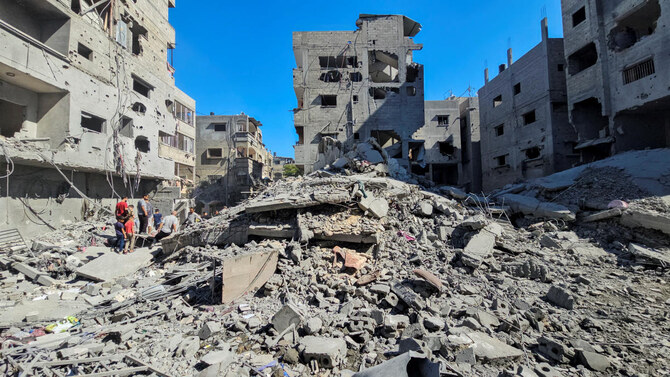
Palestinians gather at the site of Israeli strikes on houses and residential buildings in Beit Lahiya, in the northern Gaza Strip October 20, 2024. (Reuters)
Short Url
Updated 20 October 2024
Follow

UN condemns Israeli airstrikes in Gaza’s Beit Lahiya

  • Total of 87 people were killed or missing under the rubble after an Israeli attack on Beit Lahiya in northern Gaza, the enclave’s health ministry said Sunday

JERUSALEM: The UN peace envoy for the Middle East on Sunday condemned continued attacks on civilians after Israeli airstrikes in Gaza’s Beit Lahiya killed dozens late on Saturday.
“This follows weeks of intensified operations resulting in scores of civilian fatalities and near total lack of humanitarian aid reaching populations in the north,” said Tor Wennesland, the UN Coordinator for the Middle East Peace Process.
Israel’s military said it intensified attacks in northern Gaza in early October to prevent Hamas militants from regrouping.
A total of 87 people were killed or missing under the rubble after an Israeli attack on Saturday on Beit Lahiya in northern Gaza, the enclave’s health ministry said on Sunday.
The Israeli military has said it was investigating reports of the incident, which left one of the highest casualty tolls in months.
Gaza’s health ministry says the strikes have killed hundreds since the Israeli campaign escalated.


Iran offers concessions on nuclear program

Updated 7 sec ago
Follow

Iran offers concessions on nuclear program

  • Atomic energy chief says it will dilute enriched uranium if US eases sanctions

TEHRAN: Iran offered on Monday to dilute its highly enriched uranium if the US lifts sanctions.

Mohammad Eslami, head of the country’s Atomic Energy Organization, did not specify whether this included all sanctions on Iran or only those imposed by the US.

The new move follows talks on the issue in Oman last week that both sides described as positive and constructive.

Diluting uranium means mixing it with blend material to reduce the enrichment level, so that the final product does not exceed a given enrichment threshold.
Before US and Israeli strikes on its nuclear facilities in June last year, Iran had been enriching uranium to 60 percent, far exceeding the 3.67 percent limit allowed under the now-defunct nuclear agreement with world powers in 2015.
According to the UN’s nuclear watchdog, Iran is the only state without nuclear weapons that is enriching uranium to 60 percent.
The whereabouts of more than 400 kg of highly enriched uranium that Iran possessed before the war is also unknown. UN inspectors last recorded its location on June 10. Such a stockpile could allow Iran to build more than nine nuclear bombs if enrichment reached 90 percent.
Supreme leader Ayatollah Ali Khamenei urged Iranians on Monday to resist foreign pressure.
“National power is less about missiles and aircraft and more about the will and resolve of the people,” Khamenei said. “Show it again and frustrate the enemy.”
Nevertheless, despite this defiance, Iran has signaled it could come to some kind of deal to dial back its nuclear program and avoid further conflict with Washington.