

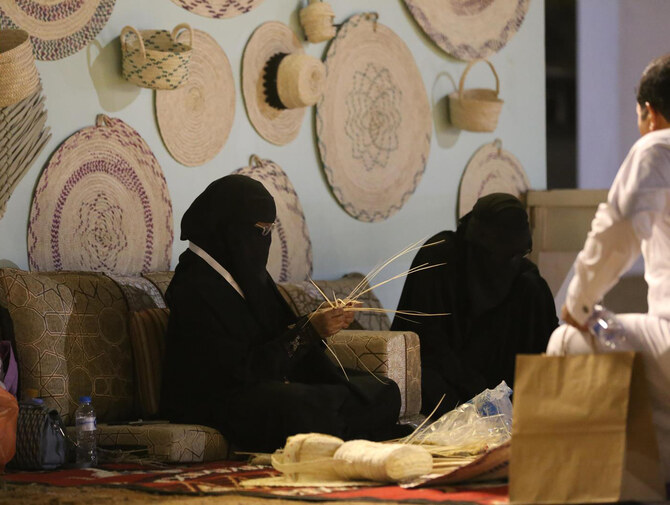
Saudi women make their mark at Madinah Dates Season exhibition

1 / 3
2 / 3
3 / 3
Short Url
Updated 20 October 2024
Follow

Saudi women make their mark at Madinah Dates Season exhibition

  • Region is central to Saudi Arabia’s food security goals, Vision 2030

Riyadh: Women and girls from the Madinah region made their presence felt at the 2024 Madinah Dates Season exhibition, which was held next to Quba Mosque.

They conducted arts and cooking workshops, organized the crowd flow, participated in marketing, and displayed various types of dates and date by-products, the Saudi Press Agency reported on Sunday.

Malak Al-Juhani, a date vendor who was participating in the exhibition for a second time, said that her experience and enhanced marketing skills had contributed to increased sales and helped her cater to visitors seeking popular, sought-after dates.

Chef Enayat Anbar Khan, who has over 17 years of experience in the field, said that her workshops on date processing and traditional crafts improved skills and knowledge and helped women exchange experiences.

She added that the tasting and cooking section offered consultations on the nutritional value of dates, as well as a variety of recipes.

A group of women specialized in sewing, embroidery, engraving, and wood carving were also participating to showcase key professional skills in these fields and to train visitors to the exhibition.

Sections featuring families working in the cottage industry displayed over 30 varieties of traditional dishes, along with various date-based juices and other products.

The Madinah Dates Season, which continues until the end of the year, celebrates local agriculture, innovation, and tradition, and contributes to the region’s sustainable development.

Madinah, with 5.6 million palm trees and an annual production of 263,000 tonnes, is central to Saudi Arabia’s food security goals and Vision 2030.

The season features auctions of harvests from more than 29,000 farms, highlighting a range of date varieties, including anbara, ajwa, safawi, barhi, khudri, sukkari, and medjool.


Saudi reserve records critically endangered Ruppel’s vulture

Updated 4 sec ago
Follow

Saudi reserve records critically endangered Ruppel’s vulture

RIYADH: King Abdulaziz Royal Reserve Development Authority has announced the sighting and documentation of a Ruppel’s vulture (Gyps rueppellii) within the boundaries of the reserve — a landmark environmental and historical event.

This is the third officially documented record of the species at national level and the first of its kind in the central and eastern regions of the Kingdom, the Saudi Press Agency reported.

The sighting carries global significance given the conservation status of the vulture, which is classified as critically endangered by the International Union for Conservation of Nature, following the loss of more than 90 percent of its population throughout its original range in Africa over the past three decades.

The appearance of this rare bird in King Abdulaziz Royal Reserve adds a new entry to the limited record of its sightings in the Kingdom, which began in Aseer region in 1985, followed by a sighting in 2018, and another in AlUla in September 2025. 

Its latest recording in central and eastern Saudi Arabia is considered an important environmental indicator of the quality of natural habitats provided by the reserve.

Globally, Ruppel’s vulture faces major threats, including poisoning from pesticides, electrocution, collisions with power lines, and the loss of nesting sites as a result of urban expansion and land-use change. 

Additional challenges include the decline of carrion resulting from changes in livestock-rearing practices, illegal hunting for use in traditional beliefs, and the adverse effects of climate change on its breeding areas and migratory routes.

The vulture is primarily found in the African Sahel and is considered extremely rare in the Arabian Peninsula. Its sighting in King Abdulaziz Royal Reserve underscores the Kingdom’s leading role in conserving biodiversity and supporting the objectives of Saudi Vision 2030 for protecting ecosystems.

It also reflects the success of the authority’s efforts to protect wildlife and restore ecosystems, positioning the reserve as a safe and attractive habitat for rare and native species.