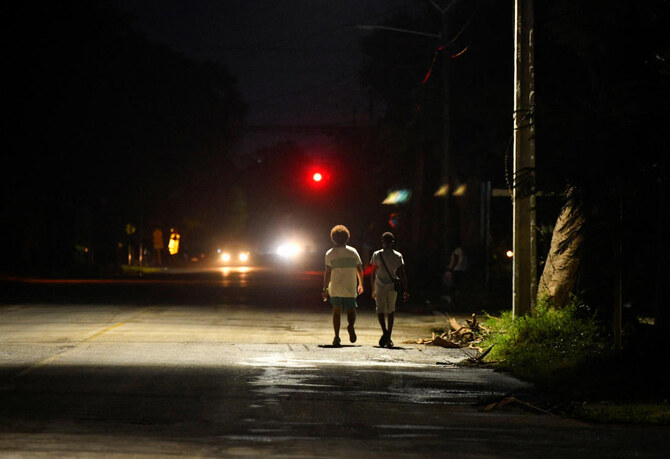
HAVANA: Cuba’s efforts to restore power to the island were derailed for a third time late on Saturday, Cuban authorities said shortly before midnight, leaving millions in the dark and raising fresh questions over the viability of the government’s bid to reestablish electrical service.
Cuba’s national electrical grid first crashed around midday on Friday after the island’s largest power plant shut down. The grid collapsed again on Saturday morning, state-run media reported.
By early evening, authorities reported some progress restoring power before announcing the grid had once again collapsed.
“Tonight at 10:25 p.m. the total disconnection of the national electro-energetic system occurred again,” the Havana Electric company said on Telegram late on Saturday.
The post was later removed from the company’s Telegram feed. It was not immediately clear why the post was removed, but millions were still without power on early on Sunday.
Cuba’s energy ministry said shortly after the Havana Electric post that it was working to reestablish service, adding that “another disconnection” had occurred in the “western sub-system,” which includes the capital Havana.
“The process of reestablishing the electrical system continues to be complex,” the ministry said on X.
A third grid collapse marks a major setback in the government’s efforts to quickly restore power to exhausted residents already suffering from severe food, medicine and fuel shortages.
Reuters reporters witnessed two small protests overnight, one in Marianao and the other in the Cuatro Caminos area of Havana. Various videos of protests elsewhere in the capital began to crop up on social media late on Saturday, though Reuters was not able to verify their authenticity.
Internet traffic dropped off sharply in Cuba on Saturday, according to data from Internet monitoring group NetBlocks, as vast power outages made it all but impossible for most island residents to charge phones and get online.
“Network data show that Cuba remains largely offline as the island experiences a second nationwide power outage,” Netblocks said on Saturday.
Even before the grid failures, a dire electricity shortfall on Friday had forced Cuba’s Communist-run government to send non-essential state workers home and cancel school for children as it sought to conserve fuel for power generation.
The government has blamed weeks of worsening blackouts — as long as 10 to 20 hours a day across much of the island — on deteriorating infrastructure, fuel shortages and rising demand.
Cuba also blames the US trade embargo, as well as sanctions instituted by then-President Donald Trump, for ongoing difficulties in acquiring fuel and spare parts to operate and maintain its oil-fired plants.
The US has denied any role in the grid failures.


![]()

Cuba suffers third major setback in restoring power to island, millions still in dark
Short Url
https://arab.news/vcref
Cuba suffers third major setback in restoring power to island, millions still in dark
Latest updates


© 2026 SAUDI RESEARCH & PUBLISHING COMPANY, All Rights Reserved And subject to Terms of Use Agreement.