Pakistan’s naval chief tours Dutch shipyard, briefed on ship maintenance and construction

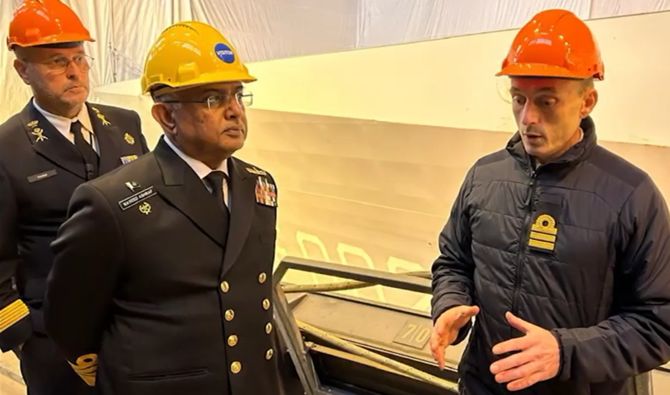
Chief of Naval Staff (CNS) Admiral Naveed Ashraf (center) on a tour of a shipyard during his official visit to the Netherlands on October 19, 2024. (Photo courtesy: ISPR)
Short Url
Updated 19 October 2024
Follow

Pakistan’s naval chief tours Dutch shipyard, briefed on ship maintenance and construction

  • Pakistan has been actively working to bolster its naval capabilities through induction of advanced warships
  • Both sides discussed greater interaction between their armed forces through exercises, exchange programs

ISLAMABAD: Chief of Naval Staff (CNS) Admiral Naveed Ashraf took a detailed tour of a shipyard during his official visit to the Netherlands, where he was briefed on the maintenance and construction of various ships, according to a statement released by the Naval Headquarters in Islamabad on Saturday.
Pakistan has been actively working to bolster its naval capabilities through the induction of advanced warships. Recently, it inducted PNS Babur and PNS Hunain, two state-of-the-art vessels, into its fleet.
These warships are part of a broader effort to enhance maritime security and operational readiness. PNS Babur, constructed in Turkiye, and PNS Hunain, an offshore patrol vessel from Romania, are equipped with cutting-edge technology to address both surface and air threats.
This move underscores Pakistan’s focus on modernizing its navy to protect its maritime interests​
“Chief of Naval Staff Admiral Naveed Ashraf called on Military and Naval Leadership of the Netherlands during an official visit [to that country],” the official statement informed, adding that professional matters of mutual interest, including bilateral defense collaboration, came under discussion.
It said the naval chief underscored the importance of enhancing interactions between the armed forces of both countries through exercises and training exchange program.
“Later on, the Naval Chief visited DAMEN Shipyard of Royal Netherlands Navy and Zeven De Provincién Class Frigate,” the statement continued. “During his visits CNS was given a detailed briefing on ships’ maintenance and construction activities.”
Admiral Ashraf also visited Royal Netherlands Navy Headquarters and called on Commander Royal Netherlands Navy, Vice Admiral René Tas.
During the meeting, matters of defense ties and mutual bilateral naval collaboration and regional maritime security were discussed.
The naval chief highlighted the contribution of Pakistan Navy toward regional maritime peace and stability through its initiative of Regional Maritime Security Patrols (RMSP) and participation in Combined Maritime Force.
The statement said his visit to the Netherlands was expected to further augment and expand defense ties between the two countries.


Pakistan seafood exports rise 22 percent in last six months on strong Gulf, Asia demand

Updated 5 sec ago
Follow

Pakistan seafood exports rise 22 percent in last six months on strong Gulf, Asia demand

  • Fisheries is a vital pillar of the national maritime economy that supports livelihoods of millions of Pakistanis, particularly in coastal communities
  • Maritime Affairs Minister Junaid Anwar Chaudhry stresses the need for strict regulatory compliance, sustainable fishing to protect marine biodiversity

KARACHI: Pakistan’s seafood exports climbed 22% over the past six months buoyed by strong demand from Gulf and Asian markets, the country’s Press Information Department said, citing official data.

KARACHI: Pakistan’s marine fisheries sector posted strong growth as its seafood exports rose to 122,629.11 metric tons, valued at $253.24 million, between July and December 2025, the Press Information Department said on Friday, citing Maritime Affairs Minister Junaid Anwar Chaudhry.

Pakistan’s exports stood at 102,942.05 metric tons worth $208.25 million during the corresponding period of the previous year, according to the Marine Fisheries Department data. The sector recorded a year-on-year increase of 19.1% in volume and 21.6% in value.

Fisheries is a vital pillar of the national maritime economy that supports livelihoods of millions of Pakistanis, particularly in coastal communities along the Arabian Sea in Sindh and Balochistan provinces, according to the maritime affairs minister.

Historically contributing around 1% to GDP, the sector has rebounded from pandemic-era disruptions through expanded processing capacity, improved cold-chain logistics, and stricter certification aligned with international standards.

“The performance reflects the growing competitiveness of Pakistan’s marine fisheries in global markets,” Chaudhry, who noted sustained export momentum from July till December, was quoted as saying by the PID.

According to the data, frozen fish remained the leading export category, accounting for 26,669.37 metric tons valued at $53.33 million. Shrimps and prawns followed with earnings of $40.46 million, while frozen cuttlefish generated $36.13 million. Other products, including shrimp meal, crabs, sardines, mackerel, flatfish species and fish meal, also contributed to higher export receipts, underscoring diversification and growth in value-added processing.

“China retained its position as Pakistan’s largest export destination, importing more than 83,602 metric tons worth $149.2 million — nearly 59% of total seafood exports— driven by steady demand for high-quality frozen products,” PID said.

“Thailand ranked second with imports valued at $31.3 million, mainly shrimps and prawns, supported by Pakistan’s HACCP-certified (Hazard Analysis and Critical Control Point-certified) processing standards.”

The United Arab Emirates, Malaysia, and Japan followed, with rising shipments of cuttlefish and fish meal.

Chaudhry said that market diversification efforts have also expanded exports to the European Union, Saudi Arabia, Vietnam, Kuwait, and the United States.

Monthly export figures showed consistent growth, peaking at $56.42 million in November and $55 million in December, aided by seasonal demand and logistical improvements. Non-tax revenue from the fisheries sectors also increased to Rs127.7 million (approximately $460,000), up from Rs118 million a year earlier.

Chaudhry attributed the gains to government initiatives such as collaboration with the International Maritime Organization (IMO) on sustainable fishing practices and investments in port infrastructure in Karachi and Gwadar.

“These developments signal the fisheries sector’s rising contribution to foreign exchange earnings and economic stability,” he said, stressing the need for strict regulatory compliance and sustainable fishing to protect marine biodiversity.