NAPLES: The United States would like to see Israel scale back some of its strikes in and around the Lebanese capital of Beirut, US Defense Secretary Lloyd Austin said on Saturday.
“The number of civilian casualties has been far too high,” he told reporters at a G7 defense gathering in the Italian city of Naples. “We’d like to see Israel scale back on some of the strikes it’s taking, especially in and around Beirut, and we’d like to see things transition to some sort of negotiation that will allow civilians on both sides of the border to return to their homes.”
Tens of thousands of people have fled Beirut’s southern suburbs — once a densely populated zone that also housed Hezbollah offices and underground installations — since Israel began regularly targeting the zone approximately three weeks ago.
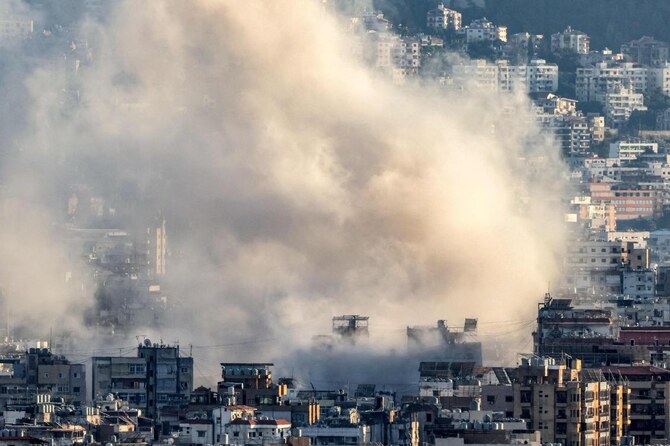
On Saturday afternoon, Israel carried out heavy strikes on several locations in the city’s southern suburbs, leaving thick plumes of smoke wafting over the city horizon throughout the evening.
The strikes came as Hezbollah fired salvos of rockets at northern Israel, with one drone directed at Prime Minister Benjamin Netanyahu’s holiday home, his spokesman said.

US wants to see Israel scale back some of Beirut strikes, Austin says
https://arab.news/jqwr2
US wants to see Israel scale back some of Beirut strikes, Austin says
- “The number of civilian casualties has been far too high,” he told reporters at a G7 defense gathering in the Italian city of Naples.
- “We’d like to see things transition to some sort of negotiation that will allow civilians on both sides of the border to return to their homes“
Israeli settlers burn tents, vehicles in West Bank village
- Videos show masked men rampaging into the Palestinian village of Susiya near Hebron and burning vehicles and property
- Similar attacks have become common as settlers seek to control large swathes of land in the West Bank
SUSIYA, West Bank: Israeli settlers set fire to vehicles and tents in the Palestinian village of Susiya on Tuesday night, residents said, in the latest incident of settler violence against Palestinians in the Israeli-occupied West Bank.
Videos verified by Reuters showed a masked group of men, who residents said were Israeli settlers, approaching the village near the city of Hebron, and later burning vehicles and Palestinian property.
“They attack us almost every day, repeatedly, because we live near the main road...Last night they burned everywhere,” Halima Abu Eid, a Susiya resident told Reuters on Wednesday.
The Israeli military said they had dispatched soldiers to deal with reports of “deliberate burnings of Palestinian property” and had opened an investigation into the incident.
Violence by Israeli settlers against Palestinians in the West Bank has increased sharply since the beginning of the war in Gaza in October 2023, with over 800 Palestinians displaced due to settler attacks in 2026 according to United Nations data.
Attacks where masked settlers arrive at night to destroy Palestinian property or attack residents have become common, as Israeli settlers seek to control large swathes of land in the West Bank.
An Israeli official previously blamed settler violence on a “fringe minority,” although Reuters reporting has shown well-organized plans to take Palestinian land in public settler social media channels.
The United Nations has documented at least 86 instances of settler violence from February 3 to 16, leading to the displacement of 146 Palestinians and the injury of 64.
Israeli indictments of settler violence are rare. At the end of 2025, Israeli monitoring group Yesh Din said of the hundreds of cases of settler violence it had documented since October 7, 2023, only 2 percent resulted in indictments. Israel’s far-right governing coalition has enabled the rapid spread of settlements, with some ministers openly stating they want to “bury” a Palestinian state.
Most world powers deem Israel’s settlements, on land it captured in a 1967 war, illegal, and numerous UN Security Council resolutions have called on Israel to halt all settlement activity.
Israel disputes the view that its settlements are unlawful and it cites biblical and historical ties to the land.


