

Italy defense minister warns G7 over ‘deteriorated’ security framework

Italian Defense Minister Guido Crosetto has warned that forecasts for near future ‘cannot be positive. (Reuters)
Short Url
Updated 19 October 2024
Follow

Italy defense minister warns G7 over ‘deteriorated’ security framework

  • Guido Crosetto: Tensions fueled by ‘a common driver: the confrontation between two different, perhaps incompatible, visions of the world’

NAPLES: The global security framework is growing increasingly precarious due to competing world visions, Italian Defense Minister Guido Crosetto told his peers at a meeting of the Group of Seven wealthy democracies that kicked off in Naples on Saturday.

The G7 gathering marks the group’s first ministerial meeting dedicated to defense and comes as the West grapples with the Russian advance in Ukraine and a spiraling conflict in the Middle East between Israel and its regional enemies.

There is also deep concern over China’s military activities around Taiwan and heightened tensions along the border of North and South Korea.

“The brutal Russian aggressions in Ukraine and the indeed critical situation in Middle East, combined with the profound instability of sub-Saharan Africa and the increasing tension in the Indo-Pacific region, highlight a deteriorated security framework,” Crosetto said in his opening speech.

Italy holds the G7 rotating presidency for 2024. The group also includes the United States, Canada, Britain, France, Germany and Japan, with European Union and NATO representatives also attending the gathering in the southern Italian city.

Warning that forecasts for near future “cannot be positive,” Crosetto said tensions were fueled by “a common driver: the confrontation between two different, perhaps incompatible, visions of the world.”

On the one side are the countries and organizations that believe in a world order based on international law, said Crosetto, who is a prominent member of Italian Prime Minister Giorgia Meloni’s right-wing Brothers of Italy party.

“On the other side, (there are) those who systematically disrespect democracy to pursue their objectives, including by a deliberate use of military force.”

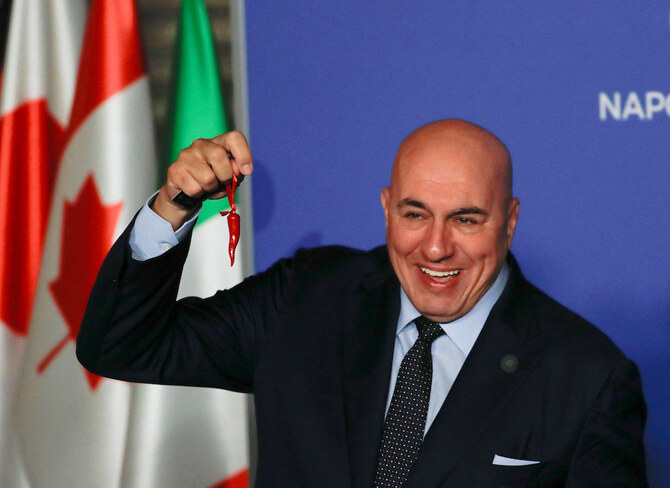
Before the meeting, Crosetto welcomed photographers holding a model of a tiny red animal horn, a symbol of good luck according to time-honored Neapolitan tradition.


Modi starts Mideast-Africa tour as India-Oman free-trade pact nears completion

Updated 6 sec ago
Follow

Modi starts Mideast-Africa tour as India-Oman free-trade pact nears completion

  • Oman’s Shoura Council approved the trade deal’s draft last week
  • Modi begins trip in Amman, heading to Addis Ababa and Muscat

NEW DELHI: Prime Minister Narendra Modi left New Delhi on Monday for a tour covering Jordan, Oman and Ethiopia, as his government looks to strengthen partnerships with West Asia and Africa and finalize a free-trade deal with Muscat.

Modi’s four-day trip will start in Amman, at the invitation of King Abdullah.

“I am sure this visit will boost bilateral linkages between our nations,” Modi said on social media upon his arrival in Jordan, where he was received by Prime Minister Jafar Hassan.

On Tuesday, he is scheduled to arrive in Addis Ababa for his first state visit to Ethiopia. A day later, he will be in Muscat, where the Shoura Council last week approved the draft Comprehensive Economic Partnership Agreement with India.

“If it is signed during this visit, it will significantly deepen the economic ties between India and Oman. And it will open up a new chapter in the history of India-Oman trade and commercial relationship,” Ministry of External Affairs Secretary Arun Chatterjee told reporters ahead of Modi’s departure.

He said Modi would be accompanied by a high-level delegation for his second visit to Oman, after his last trip in February 2018. It also follows the visit of Oman’s Sultan Haitham bin Tariq to India in December 2023.

Free-trade negotiations between India and Oman began in November 2023, with the first round in New Delhi and the second in Muscat.

When the talks concluded in March 2024, Oman sought revisions on market-access terms and the final signature was postponed.

Announcements of the deal’s possible finalization have been made in the past few months by India’s Commerce and Industry Minister Piyush Goyal and the Omani ambassador to New Delhi, Issa Saleh Al-Shibani.

It would be its second with a GCC country after a 2022 trade deal with the UAE, as India has been trying to reach a similar agreement with the whole bloc.

“The framework is expected to be the same as the UAE’s, that is, a Comprehensive Economic Partnership Agreement. This is significant given that the progress on India-GCC FTA has been slow and non-consequential so far,” said Muddassir Quamar, associate professor at the School of International Studies, Jawaharlal Nehru University.

While Oman is one of Delhi’s smaller GCC trading partners — trailing behind the UAE and Saudi Arabia, with bilateral trade about $10 billion — it remains strategically important, particularly in energy and logistics.

“The FTA is likely to give a boost to India-Oman economic and trade relations, especially of goods and services. (It is) important given India has worked to enhance its trade and economic relations with the Gulf countries that are (among) the most dynamic and fast-expanding global economies,” Quamar told Arab News.

“It is also important because there is immense potential for Indian businesses and industries to partner with their Gulf and Omani partners in contributing to the diversification and economic growth plans.”