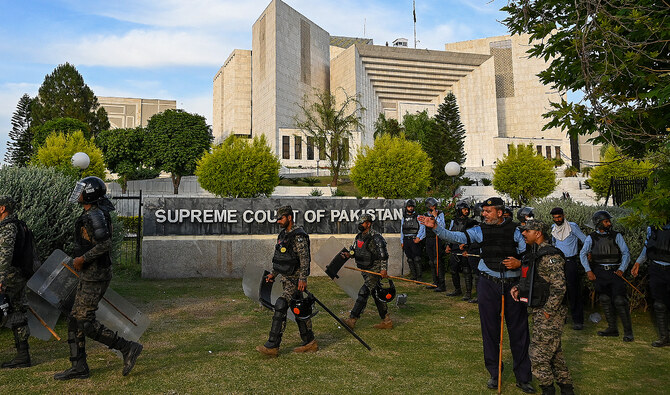
ISLAMABAD: Prime Minister Shehbaz Sharif’s administration suffered a blow on Friday when the Supreme Court of Pakistan ruled that recent amendments to election laws cannot override its previous verdict on the distribution of reserved parliamentary seats, which had benefited ex-premier Imran Khan’s opposition Pakistan Tehreek-e-Insaf (PTI) party.
The court’s latest ruling could impact the government, which had to work hard after the February 8 general elections to secure a majority by aligning with other winning political factions before benefiting from the allocation of more than its share of reserved seats for women and minorities. These seats are distributed to political parties in proportion to their election victories to ensure the inclusion of underrepresented groups in the political process.
The Supreme Court’s earlier verdict in July had reversed the Election Commission of Pakistan’s (ECP) decision, which denied these seats to PTI after its candidates were forced to contest the national polls as independents following the party’s loss of its electoral symbol. Although PTI-aligned candidates won the most seats, the ECP distributed its share of reserved seats to other factions, citing that they were only allocated to political parties, not independent candidates.
In August, the government amended election laws after the court’s July verdict that the ECP had misinterpreted its previous decision, which stripped PTI of its election symbol. These changes were widely seen as an effort to prevent PTI from claiming its share of reserved seats.
“The amendments made in the Elections Act after the release of our Short Order will have no bearing and the Commission is bound to implement the judgment passed by the Supreme Court of Pakistan, in its letter and spirit, without seeking any further clarification,” the court said after the ECP sought guidance regarding the implementation of the July verdict after election law amendments.
ELECTIONS BILL
The Elections (Second Amendment) Bill of August says if a candidate does not submit a declaration of his affiliation with a political party to the returning officer before seeking the allotment of an election symbol, he or she shall be “deemed to be considered as an independent candidate and not a candidate of any political party.”
Another amendment says if a political party fails to submit its list for reserved seats within the prescribed time period, it would not be eligible for reserved seats at a later stage. A third amendment says a winning independent candidate’s decision to join a political party after elections was irrevocable.
All the legal changes were widely viewed as being directed against PTI, whose candidates had to join the Sunni Ittehad Council (SIC) after the elections to claim their share of reserved seats, as the ECP believed PTI had no parliamentary presence and was therefore ineligible.
Under the election bill, party candidates who contested as independents and later joined the SIC could no longer be allowed to rejoin their original party.
The Supreme Court’s July decision recognized PTI as a political party even after losing its election symbol.
Friday’s ruling marks the second such clarification of the court’s verdict to the ECP.
Last month, the election regulatory body filed a petition seeking guidance on the matter, only to be rebuked for employing “dilatory tactics” and instructed to implement the verdict immediately.


![]()

Pakistan’s top court: Election law changes can’t overturn reserved seats verdict seen as favoring Imran Khan
Short Url
https://arab.news/yqgvf
Pakistan’s top court: Election law changes can’t overturn reserved seats verdict seen as favoring Imran Khan
- The court ruling deals a blow to PM Sharif’s administration that may lose some of its parliamentary seats
- Ruling comes after the ECP sought guidance regarding the court’s July verdict after election law changes
Latest updates


Recommended


© 2026 SAUDI RESEARCH & PUBLISHING COMPANY, All Rights Reserved And subject to Terms of Use Agreement.