

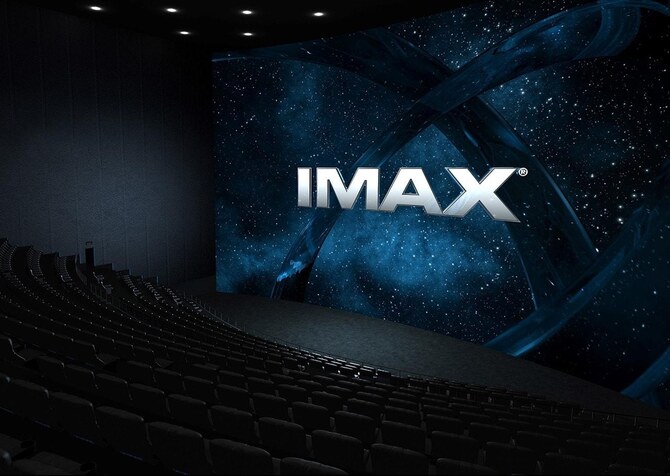
IMAX in talks for first local Saudi Arabia feature film

The goal is to have 50 IMAX screens in the Kingdom in the next five years, says CEO Richard Gelfond. (Supplied)
Short Url
Updated 18 October 2024
Follow

IMAX in talks for first local Saudi Arabia feature film

  • Plan for more cinemas and content, says CEO Richard Gelfond
  • IMAX eyeing Saudi Arabia, Mideast, to open a flagship location

DUBAI: IMAX Corp. is holding advanced talks with a Saudi Arabia company to produce a local feature film in the next few years, the company’s CEO Richard Gelfond told Arab News during a recent interview.

In Saudi Arabia, the long-term plan is to “not only build a significant theater network, but also lean into the content side,” he said.

IMAX currently has 10 cinemas in the Kingdom, with 22 more set to open in partnership with the top four exhibitors.

This includes the partnership with Saudi Arabia’s largest exhibitor, muvi Cinemas, to open four new IMAX screens by 2025 across the Kingdom.

The goal is to have 50 IMAX screens in the Kingdom in the next five years, said Gelfond.

He said that like everybody else they were “surprised” when Saudi Arabia announced the reopening of cinemas in 2018, and “were fairly early into the market.”

IMAX opened its first screen in the Kingdom in 2019. Since then, the country has consistently ranked among IMAX’s top 20 markets worldwide and was the No. 14 market globally in 2024.

The Kingdom is an “excellent location” for IMAX due to the young movie-going population that has a high disposable income, likes quality and is willing to pay for it, he explained.

Moreover, he added, IMAX has been in other Middle Eastern countries for a long time and has been involved in local, successful movies, so “this (Saudi Arabia) wasn’t a startup opportunity.”

For example, IMAX was involved in the making of the 2009 film “Journey to Mecca” and the 1992 film “Fires of Kuwait.”

“Saudi Arabia has really proven in a short period of time that the population really wants something special and the best and cutting-edge (movies and entertainment), and not just something that was done years ago,” Gelfond said.

He added that IMAX was eyeing Saudi Arabia, and other markets in the Middle East region, to open a flagship location.

This would be similar to international ones such as the British Film Institute in London, Lincoln Square in New York City, Grand Cinema Sunshine in Tokyo, and IMAX Sydney in Australia.

A delegation from the company recently visited the region and met with potential investors and partners to explore opportunities for collaboration, he said.

Last year, over 20 percent of IMAX’s box office revenue came from local productions across China, Japan, India, Indonesia, Thailand and Korea, Gelfond said.

Many of these productions, particularly Indian and Japanese films, are popular in Saudi Arabia, along with Hollywood films and local-language content.

He said that what makes the firm’s “economics work” is not only establishing IMAX screens but generating box office success from Hollywood and local films.

He added that it makes sense to “accelerate” network growth and maximize revenues by doing both “the theaters and the content side.”

“IMAX is probably one of the few truly global entertainment brands, and one of the keys to our success has been mixing Hollywood content with local-language content,” Gelfond added.


Israel arrests 2 Turkish CNN journalists over live broadcast outside IDF HQ

Updated 03 March 2026
Follow

Israel arrests 2 Turkish CNN journalists over live broadcast outside IDF HQ

  • Police said reporter Emrah Cakmak and cameraman Halil Kahraman were detained on suspicion of filming a sensitive security facility
  • Since the Gaza war began, restrictions have expanded significantly, including tighter limits on filming soldiers on duty and sensitive or strategic sites

LONDON: Israeli police have arrested two Turkish CNN journalists who were broadcasting live outside the Israel Defense Forces’ headquarters in Tel Aviv.

Police said the pair were detained on suspicion of filming a sensitive security facility, according to the Israel Police Spokesperson’s Unit.

Reporter Emrah Cakmak and cameraman Halil Kahraman, from the network’s Turkish-language channel, had been reporting near the IDF’s Kirya military headquarters on Tuesday after Iran launched another missile barrage at Tel Aviv and other parts of central Israel.

During the live broadcast, two men believed to be soldiers approached the crew and seized the reporter’s phone, according to initial reports and a video circulating online that could not be independently verified.

Police said officers were dispatched after receiving reports of two people carrying cameras and allegedly broadcasting in real time for a foreign outlet.

Israel’s long-standing military censorship system, overseen by the IDF Military Censor, has long barred journalists and civilians from publishing material deemed harmful to national security.

Since the Gaza war began, restrictions have expanded significantly, including tighter limits on filming soldiers on duty and sensitive or strategic sites.

After a series of similar incidents involving foreign media — most of them Palestinian citizens of Israel working for Arab-language and international media, along with foreign journalists — during the 12-Day War, Israeli police halted live international broadcasts from missile impact sites, citing concerns that exact locations were being revealed.

The Government Press Office later imposed a blanket ban on live coverage from crash and impact areas.

Communications Minister Shlomo Karhi and National Security Minister Itamar Ben-Gvir subsequently ordered that all foreign journalists obtain prior written approval from the military censor before broadcasting — live or recorded — from combat zones or missile strike locations.

Police said that when officers asked the CNN Turk crew to identify themselves, they presented expired press cards and were taken in for questioning.

Burhanettin Duran, head of Turkiye’s Directorate of Communications, condemned the arrests as an attack on the press and said Ankara is working to secure the journalists’ release.