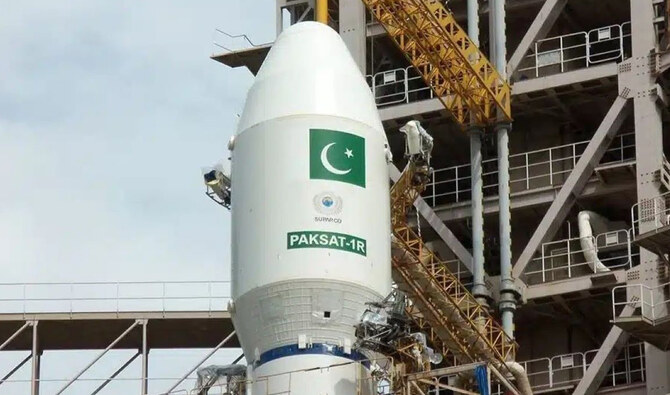
ISLAMABAD: Pakistan’s first multi-mission communication satellite, PAKSAT MM1, is now fully operational, state media reported on Thursday, describing the move as a significant milestone in the country’s space and digital development.
In May, Pakistan launched the PAKSAT MM1 with Chinese assistance into space from China’s Xichang Satellite Launch Center, in a ceremony broadcast live by the Pakistan Space and Upper Atmosphere Research Commission (SUPARCO), the country’s national space agency.
The satellite has been conceived keeping in view the growing needs of the South Asian country in the broad spectrum of communication and connectivity.
“The success of PAKSAT-MM1 will transform Pakistan’s communication infrastructure, which will benefit various IT sectors,” the Radio Pakistan broadcaster reported.
“The satellite will provide services such as television broadcasting, community Internet, and tele-education to promote local industries.”
Pakistan’s ranking has improved by 14 points in the United Nations E-Governance Development Index — a comprehensive assessment tool that evaluates the digital government landscape across all UN member states — according to the state broadcaster.
The country now stands at 136 in overall ranking which was at 150 in 2022.
“This satellite will also increase Internet connectivity in remote areas which will further the government’s vision of Digital Pakistan,” the report read.

Pakistan’s first multi-mission communication satellite becomes operational
https://arab.news/yfbc3
Pakistan’s first multi-mission communication satellite becomes operational
- PAKSAT MM1 to aid in South Asian nation’s space and digital development
- The satellite will usher in digital era by providing Internet to remote areas
Pakistan launches double-decker buses in Karachi after 65 years to tackle transport woes
- Karachi citizens will be able to travel in double-decker buses from Jan. 1, says Sindh government
- City faces mounting transport challenges such as lack of buses, traffic congestion, poorly built roads
ISLAMABAD: The government in Sindh province on Wednesday launched double-decker buses in the provincial capital of Karachi after a gap of 65 years, vowing to improve public transport facilities in the metropolis.
Double-decker buses are designed to carry more passengers than single-deck vehicles without taking up extra road space. The development takes place amid increasing criticism against the Sindh government regarding Karachi’s mounting public transport challenges and poor infrastructural problems.
Pakistan’s largest city by population faces severe transportation challenges due to overcrowding in buses, traffic congestion and limited bus options. Commuters, as a result, rely on private vehicles or unregulated transport options that are often unsafe and expensive.
“Double-decker buses have once again been introduced for the people of Karachi after 65 years,” a statement issued by the Sindh information ministry said.
Sindh Transportation Minister Sharjeel Inam Memon and Local Government Minister Syed Nasir Hussain Shah inaugurated the bus service. The ministry said the facility will be available to the public starting Jan. 1.
The statement highlighted that new electric bus routes will also be launched across the entire province starting next week. It added that the aim of introducing air-conditioned buses, low-fare services, and fare subsidies is to make public transport more accessible to the people.
The ministry noted that approximately 1.5 million people travel daily in Karachi using the People’s Bus Service, while around 75,000 passengers use the Orange Line and Green Line BRT services.
“With the integration of these routes, efforts are being made to benefit up to 100,000 additional people,” the ministry said.


