

How AI-driven robotics is transforming healthcare in Saudi Arabia

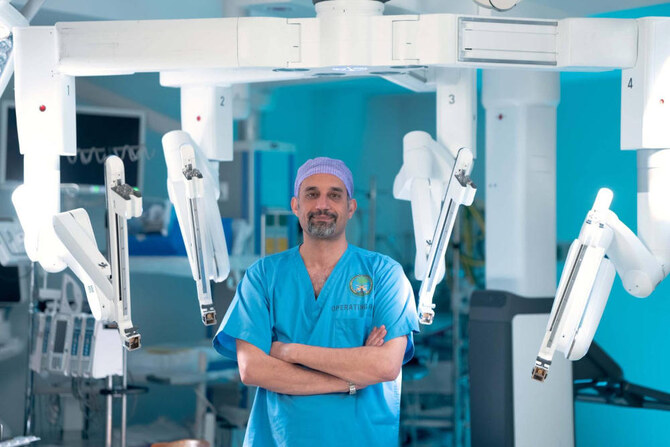
AI is an invaluable tool, providing insights that improve our decision- making in the operating room, said Dr. Feras Khaliel, Head of cardiac surgery and director of robotics at KFSHRC. (Supplied)
Short Url
Updated 17 October 2024
Follow

How AI-driven robotics is transforming healthcare in Saudi Arabia

RIYADH: Robots have lived among us for years, from our factory assembly lines to the autonomous vehicles sorting our parcels. Now, with rapid advances in artificial intelligence, our robot companions are taking on even more sophisticated tasks — even heart surgery.

With their precision and steadiness of hand, robots are able to perform delicate procedures often beyond the abilities of even the most skilled human surgeons, proving less invasive for the patient, offering faster recovery times, and reducing the risk of post-op infection.

According to the World Economic Forum, the market for robot-assisted surgery is expected to surpass $14 billion by 2026. Having invested heavily in health sector innovation, Saudi Arabia is already making significant strides in the adoption of AI-driven robotics in medicine.

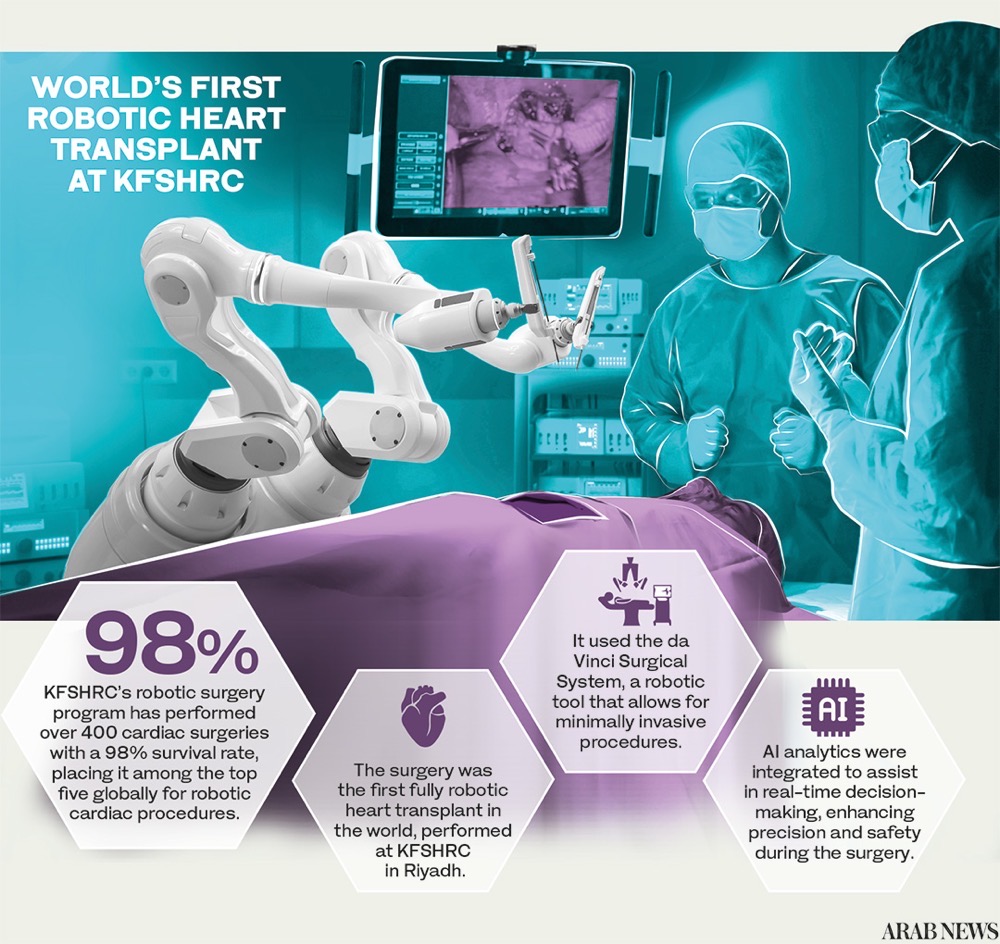
In September, a cardiac team at King Faisal Specialist Hospital and Research Center in Riyadh achieved a historic milestone by performing the world’s first fully robotic heart transplant on a 16-year-old boy who was facing end-stage heart failure.
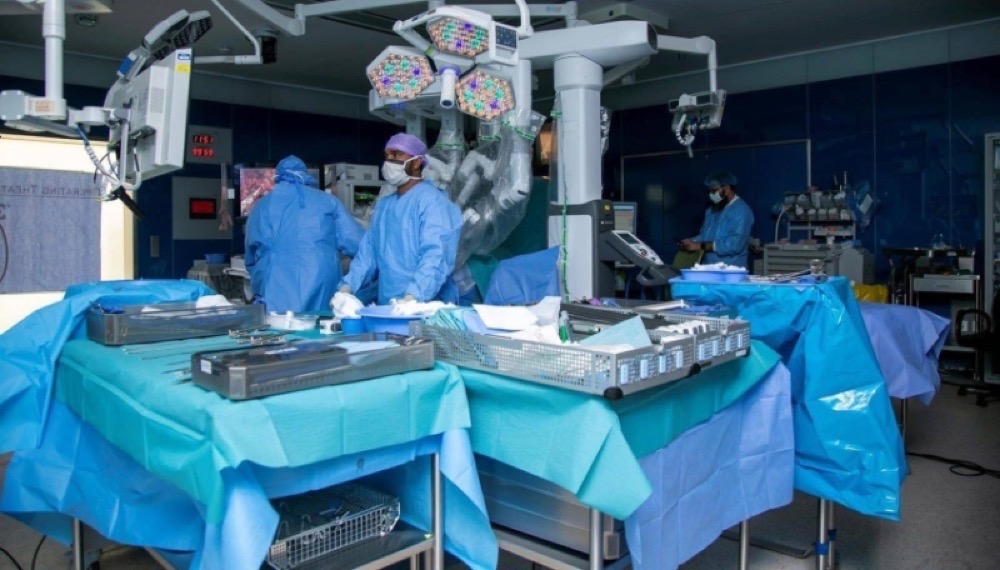
Dr. Feras Khaliel, head of cardiac surgery and director of the Robotics and Minimally Invasive Surgery Program at KFSHRC, said the success of the procedure represents a monumental leap in robot-assisted surgery, and highlights AI’s game-changing role.

“AI is an invaluable tool,” Khaliel told Arab News. “It allows us to process a substantial amount of data in real time, providing insights that improve our decision-making in the operating room. But it’s not replacing surgeons — it’s enhancing what we can do.”

The surgery was conducted using the Da Vinci Surgical System, a robotic platform renowned for its precision and control, developed by the US biotechnology company Intuitive Surgical.

Combined with AI, it provides real-time analytics during surgery, continuously processing data, offering clinical insights, and allowing for instant adjustments.

DID YOU KNOW?

1. Saudi Arabia performed the world’s first fully robotic heart transplant at King Faisal Specialist Hospital and Research Center.

2. The surgery used the Da Vinci Surgical System, renowned for its precision and real-time analytics.

3. Robotic surgery offers less invasive procedures, faster recovery times, and reduced post-operative risks.

4. KFSHRC ranks among the top five centers for robotic heart procedures globally, with a 98% survival rate.


Da Vinci Xi is the world’s most widely used multiport robotic surgery system, able to perform a wide array of medical procedures.

The system’s robotic arms, guided by human hands, allow doctors to operate through tiny incisions, thereby avoiding the open-chest incisions normally required for major heart surgery.

“We’ve always known the potential of robotic systems, but seeing it applied to something as intricate as a heart transplant was extraordinary,” said Khaliel. “The precision we achieved would have been impossible using conventional techniques.”

By incorporating AI, the team was able to make critical decisions with extreme accuracy, responding instantly to any changes in the patient’s condition.
To ensure the patient’s safety, the team conducted rigorous preoperative simulations, practicing the entire procedure seven times over three consecutive days. This allowed them to define every step and minimize potential complications.

Each step of the surgery was calibrated for precision. The robotic instruments underwent multiple tests to ensure optimal performance, and the team continuously monitored the data system throughout the procedure.

This minimally invasive approach not only reduced the risk of complications, but also significantly shortened the patient’s recovery time and minimized scarring, marking a major advancement in transplant surgery.

“The success of this groundbreaking surgery really came down to a few key elements; the advanced technology, meticulous planning, rigorous simulations, and flawless team coordination,” said Khaliel.

Opinion

This section contains relevant reference points, placed in (Opinion field)

Data collected during the surgery — such as precision metrics, patient response, and system performance indicators — will be analyzed to refine future techniques. This will not only improve the robotic surgery program, but also contribute to broader research in robotic transplants.

Khaliel believes AI will play a growing role in surgery, becoming a real-time partner in the operating room, offering predictive insights and optimizing surgical pathways. Indeed, human surgeons will continue to have a place, applying their expertise and intuition.

The advent of AI-driven robotics will, however, transform how he and his colleagues work together as a team and will demand highly specialized technical skills and proficiencies in the use of advanced robotics and the ability to interpret data-driven insights provided by AI.

KFSHRC is no stranger to medical firsts. With more than 400 robotic cardiac surgeries already under its belt, the hospital ranks among the top five centers for robotic heart procedures worldwide.

Its Robotic Cardiac Surgery Program has achieved a 98 percent survival rate, performing complex surgeries such as multi-valve operations and aortic valve replacements.

The success of this latest robotic heart transplant opens the way for more complex procedures to be performed with greater safety and efficiency.

KFSHRC’s leadership in robotics and AI not only improves patient outcomes, but also positions the Kingdom as an emerging world leader in healthcare innovation.


Standing alongside passionate, innovative teachers from around the world humbling and inspiring: Saudi teacher

Updated 8 sec ago
Follow

Standing alongside passionate, innovative teachers from around the world humbling and inspiring: Saudi teacher

  • Saeed Salem Abdullah Al-Zahrani, a primary teacher from Jubail, named in the top 50 shortlist for $1 million GEMS Global Teacher Prize 2026

RIYADH: Saeed Salem Abdullah Al-Zahrani, a primary school teacher at Al-Mutrafiyah Elementary School in Jubail Industrial City, has been shortlisted for the GEMS Education Global Teacher Prize 2026.

Al-Zahrani has been named on the top 50 shortlist for the prize, a Varkey Foundation initiative organized in collaboration with UNESCO.

He was selected from over 5,000 nominations and applications from 139 countries.

Now in its 10th year, the $1 million prize is the largest of its kind. It was set up to recognize one exceptional teacher who has made an outstanding contribution to the profession as well as to shine a spotlight on the important role teachers play in society.

By unearthing thousands of stories of heroes who have transformed young people’s lives, the prize hopes to bring to life the exceptional work of teachers all over the world.

Reacting to his shortlisting, Al-Zahrani told Arab News: “I am extremely honored to be among the top 50 finalists for the Global Teacher Prize. Standing alongside so many passionate and innovative teachers from around the world is both humbling and inspiring.

“I extend my sincere thanks to the Varkey Foundation, GEMS Education, and UNESCO for recognizing the vital work that teachers carry out every day. Teachers everywhere help ignite curiosity and give young people the confidence to pursue their ambitions, and I am proud to be part of this mission,” he added.

“This prize has provided us a global platform to amplify the voice of teachers and has entrusted us with a deeper responsibility to continue working toward more impactful and humane education — one that believes the mission of education transcends borders and makes a real difference in the lives of individuals and communities,” he said.

Al-Zahrani is a distinguished Saudi educator, renowned for his innovative programs and commitment to inclusive, high-quality education. Teaching at Al-Mutrafiyah Elementary School. He has developed initiatives such as “The Challenge,” “Maher,” and “Steps,” improving reading, writing, and learning outcomes for students of all abilities.

These programs have been adopted in Royal Commission kindergartens and praised by the Minister of Education Yousef Al-Benyan.

Holding a doctorate in linguistics and a masters in counseling psychology, Al-Zahrani integrates storytelling, interactive digital tools, and personalized learning to ensure every student reaches their potential.

He has published research in peer-reviewed journals, presented internationally, and trained teachers across Saudi Arabia and beyond.

Founder of the Global Teacher Prize, GEMS Education, and The Varkey Foundation, Sunny Varkey, said: “Congratulations, Saeed. The Global Teacher Prize was created with a simple mission: to shine a light on teachers like you — educators whose dedication, creativity, and compassion deserve to be celebrated and shared with the world. Your work extends far beyond the classroom — it touches lives and shapes the world.”

UNESCO Assistant Director-General for Education Stefania Giannini, said: “Congratulations to this year’s top 50 finalists. UNESCO is honored to stand alongside the Global Teacher Prize in celebrating the extraordinary commitment of teachers everywhere. Our world is navigating profound challenges — from teacher shortages and rapid technological shifts to the urgent demands of climate action. If we are to build a just, inclusive and sustainable future, we must recognize a simple truth: we cannot rise to this moment unless we invest in teachers.”

GEMS Education is one of the world’s leading private K-12 education providers, educating more than 200,000 students of more than 175 nationalities across its global network of owned and managed schools. With nearly half a million alumni, GEMS has built a legacy of impact that spans generations and continents. Established in Dubai in 1959, GEMS remains a family-founded and family-led organization.

The prize is open to working teachers who teach children in compulsory schooling or who are between the ages of 5-18. Teachers who educate children age 4 and over in a government-recognized curriculum are also eligible, as are teachers working on a part-time basis, and teachers of online courses. It is open to teachers in every kind of school and, subject to local laws, in every country in the world.

Teachers applying for the Global Teacher Prize are assessed on teaching practices, how they innovate to address local challenges, achieve demonstrable learning outcomes, impact the community beyond the classroom, help children become global citizens, improve the teaching profession, and gain recognition from external bodies.

The prize will now be narrowed down to the top 10 finalists, and the winner will be chosen by the Global Teacher Prize Academy, made up of prominent individuals, and announced at the World Governments Summit, taking place in Dubai Feb. 3-5, 2026.