ISLAMABAD: Pakistan’s central bank on Thursday said structural impediments such as low savings, falling investment and an unfavorable business environment continue to pose challenges to its macroeconomic stability.
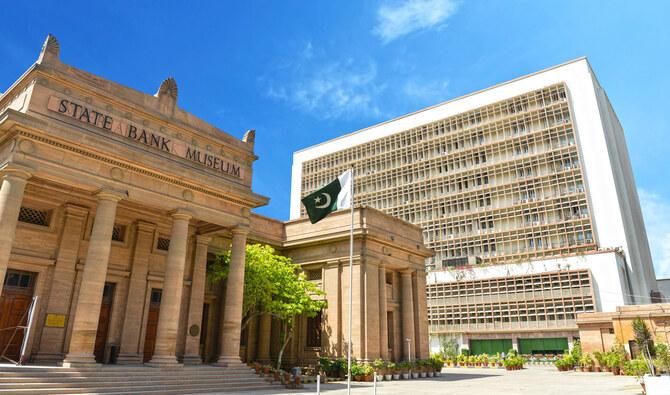
The State Bank of Pakistan released its annual report on the state of the country’s economy on Thursday, observing that Pakistan’s macroeconomic conditions had improved due to the government’s stabilization policies, successful engagement with the International Monetary Fund (IMF), reduced uncertainty, and favorable global economic environment.
After suffering from a prolonged economic crisis, Pakistani authorities have reported that the country’s foreign exchange reserves have improved while its stock market has seen record gains this year. Inflation in the country has also dropped to 6.9% in September this year from a staggering 38 percent in May 2023.
“Notwithstanding these positive developments, the report highlights that a host of structural impediments continue to pose challenges to sustaining macroeconomic stability,” the SBP said in a press release.
“Falling investment amid low savings, unfavorable business environment, lack of research & development, and low productivity, alongside climate change risks continue to constrain the economy’s growth potential,” it added.
The report pointed out that longstanding inefficiencies in the energy sector have resulted in the accumulation of circular debt. noting that the government has started to address energy sector challenges through “substantial price adjustments.”
However, the report said that there is a need to broaden these efforts by introducing sectoral policy and regulatory reforms.
“These reforms are also necessary to address the issue of inefficiencies in the State-owned Enterprises (SOEs) that continue to be a drain on fiscal resources, which are already constrained by low tax-to-GDP ratio,” the report pointed out.
The SBP also noted that it had kept a tight monetary policy that remained unchanged mostly throughout the outgoing fiscal year at 22 percent. It spoke of the reforms introduced by the SBP in foreign exchange companies and the government’s administrative actions to bring order in foreign exchange and commodity markets.
“The government continued the fiscal consolidation, with the primary balance posting a surplus for the first time in 17 years,” it said.
The SBP said the government’s fiscal consolidation efforts and the lagged impact of its tight monetary policy stance are anticipated to further weaken inflationary pressures in FY25.
“In addition, the continued fiscal consolidation is also expected to support further decline in inflation,” the report said.
“Further, the recent outturns suggest the average inflation to fall below the earlier projected range of 11.5 – 13.5% in FY25.”


![]()

Structural impediments pose challenges to Pakistan’s macroeconomic stability — central bank
Short Url
https://arab.news/jk84c
Structural impediments pose challenges to Pakistan’s macroeconomic stability — central bank
- Central bank’s annual report cites low savings, falling investment, energy sector woes as structural impediments
- Average rate of inflation expected to fall below projected range of 11.5 – 13.5% in FY25, says SBP report
Latest updates


Recommended


© 2026 SAUDI RESEARCH & PUBLISHING COMPANY, All Rights Reserved And subject to Terms of Use Agreement.