

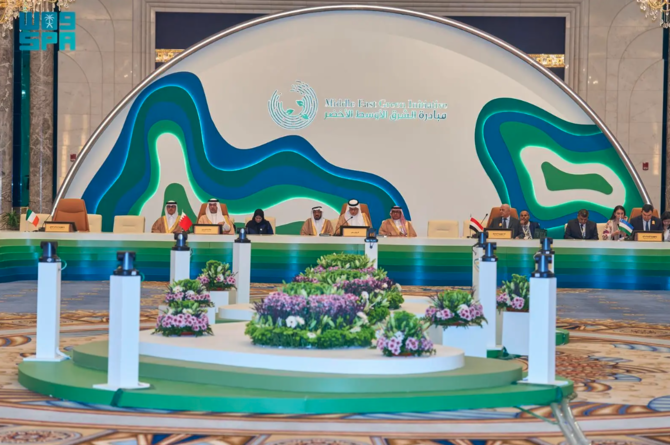
Middle East Green Initiative expands as 11 countries sign up

The inaugural session of the Middle East Green Initiative Ministerial Council session. SPA
Short Url
Updated 17 October 2024
Follow

Middle East Green Initiative expands as 11 countries sign up

RIYADH: A major regional effort to combat climate change gained momentum as 11 countries joined the Middle East Green Initiative during its first Ministerial Council session in Jeddah.    

Led by Saudi Arabia, the initiative aims to address environmental challenges across the region and contribute to global climate targets. The session, attended by representatives from 29 countries and international organizations, underscored the Kingdom’s commitment to fostering cooperation in environmental efforts.   

Among the new members are Algeria, Chad, Kenya, and Senegal. Burkina Faso, Lebanon, and Gambia have also joined the initiative. Nigeria, Guinea, and the Central African Republic were additionally confirmed as members. 

In addition to the new regional members, the UK was welcomed as a non-regional contributor with observer status, according to a press release.   

This comes as the council emphasized the critical role of these new members in achieving the initiative’s ambitious objectives. It also encouraged more regional and non-regional countries to participate, highlighting the importance of technical and financial support to meet both regional and global environmental goals.    

Saudi Minister of Environment, Water, and Agriculture Abdulrahman Al-Fadley highlighted the need for enhanced regional collaboration to protect the environment and boost food and water security, safeguard biodiversity, and preserve ecosystems.   

During the inaugural session, the minister noted that the initiative represents a significant step toward improving regional governance in combating desertification, drought, and climate change challenges.   

MGI’s key target is planting 50 billion trees across the Middle East, restoring 200 million hectares of degraded land. Saudi Arabia will plant 10 billion trees within its borders, while the remaining 40 billion will be planted across the region over the coming decades. 

During the session, Al-Fadley confirmed that the initiative launched by Crown Prince Mohammed bin Salman in 2021 represents the first regional alliance of its kind, aimed at mitigating the impacts of climate change across the Middle East and North Africa.

He noted that the final version of the initiative’s charter was agreed upon during the founding countries’ ministerial meeting in October 2022.

The minister emphasized the need for collective efforts in the Middle East to tackle environmental challenges such as desertification and drought.

The ministerial statement from the meeting outlined several key decisions. The council approved the organizational structure and internal policies of the MGI secretariat, appointed the MGI secretary-general, and designated the MGI Fund Trustee, paving the way for the initiative’s implementation phase.

The council also reaffirmed its commitment to enhancing regional collaboration to combat land degradation, desertification, and drought while addressing their severe environmental and socio-economic impacts.

It expressed anticipation for the 16th session of the Conference of the Parties to the UN Convention to Combat Desertification or COP16 scheduled to take place in Riyadh in December.

The council called on UNCCD parties and relevant stakeholders to actively participate in COP16, positioning it as a crucial platform for addressing global land degradation and drought challenges.

As the council advocates for support of COP16 outcomes, it aims to make the event a historic turning point in enhancing global efforts to combat land degradation, halt desertification, accelerate land restoration, and improve drought resilience. 


Global brands shut Middle East stores as conflict causes chaos

Updated 03 March 2026
Follow

Global brands shut Middle East stores as conflict causes chaos

  • Luxury brands and retailers close stores in Middle East
  • Conflict threatens the region that has ‌been luxury’s fastest growing
  • Mass-market retailers monitor situation, adjust operations in region

PARIS: In Dubai and other major Middle Eastern shopping hubs, many stores are closed or operating with a skeleton staff as the escalating conflict in the ​region causes chaos for businesses and travel.

The US-Israeli air war against Iran expanded on Monday with no end in sight, with Tehran firing missiles and drones at Gulf states as it retaliates for a weekend of bombing that killed Iran’s supreme leader and reportedly killed scores of Iranian civilians, including a strike on a girls’ primary school.

Chalhoub Group, which runs 900 stores for brands from Versace and Jimmy Choo to Sephora across the region, said its stores in Bahrain were closed, while other markets, including the UAE, Saudi Arabia, and Jordan remained open though staff attendance was “voluntary.”

“We operate with a lean team formed of members who volunteered and feel comfortable to come to the store,” Chalhoub’s Vice President of Communications Lynn al ‌Khatib told Reuters, adding ‌that the company’s leadership team personally visited Dubai Mall and Mall of the Emirates ​on ‌Monday ⁠morning to check ​in ⁠with workers.

E-commerce giant Amazon closed its fulfillment center operations in Abu Dhabi, suspended deliveries across the region and instructed its employees in Saudi Arabia and Jordan to remain indoors, Business Insider reported on Monday, citing an internal memo.

Gucci-owner Kering said its stores were temporarily closed in the UAE, Kuwait, Bahrain and Qatar and it has suspended travel to the Middle East.

Luxury growth engine under threat

Shares in luxury groups LVMH, Hermes, and Cartier-owner Richemont were down 4 percent to 5.7 percent on Monday afternoon as investors digested the knock-on impacts of the conflict.

The Middle East still accounts for a small share of global spending on luxury — between 5 percent and 10 percent, according ⁠to RBC analyst Piral Dadhania. But the region was “luxury’s brightest performer” last year, according to consultancy ‌Bain, while sales of expensive handbags have stalled in the rest of the ‌world.

Now, shuttered airports have put an abrupt stop to tourism flows into ​the region and missile strikes — including one that damaged Dubai’s ‌five-star Fairmont Palm hotel — are likely to dissuade travelers, particularly if the conflict drags on.

“If you assume that it’s ‌a $5 billion to $6 billion (travel retail) market and let’s say it’s going to be shut down for a month, we are talking about hundreds of millions of dollars that are definitely at risk,” said Victor Dijon, senior partner at consultancy Kearney.

If Middle Eastern shoppers cannot travel to Paris or Milan, that could also hurt luxury sales in Europe, he added.

Luxury brands have been investing in lavish new stores and exclusive events ‌across the region. Cartier unveiled a “high-jewelry” exhibition in Dubai’s Keturah Park just days before the conflict started.

Cartier and Richemont did not reply to requests for comment.

Luxury conglomerate LVMH ⁠has also bet big on ⁠the region. Last month, its flagship brand Louis Vuitton staged an exhibition at the Jumeirah Marsa Al Arab hotel, and beauty retailer Sephora launched its first Saudi beauty brand.

LVMH does not report specific figures for the region, but in January Chief Financial Officer Cecile Cabanis said the Middle East has been “displaying significant growth.” LVMH did not reply to a request for comment on how its business may be impacted by the conflict.

The Middle East has also attracted new investment from mass-market players. Budget fashion retailer Primark said in January that it plans to open three stores in Dubai in March, April and May, followed by stores in Bahrain and Qatar by the end of the year.

“Primark is set to open its first store in Dubai at the end of March but clearly this is a fast-moving situation which we are monitoring closely,” a spokesperson for Primark-owner Associated British Foods said.

Apple stores in Dubai will remain closed until Thursday morning, the company’s website showed, while Swedish fast-fashion retailer ​H&M said its stores in Bahrain and Israel are ​closed.

Consumer goods group Reckitt has told all employees in the Middle East to work from home, temporarily closed its Bahrain manufacturing site and suspended all business travel to the region until further notice.