Pakistan’s Educast partners with Islamic Development Bank to provide critical support to Afghans

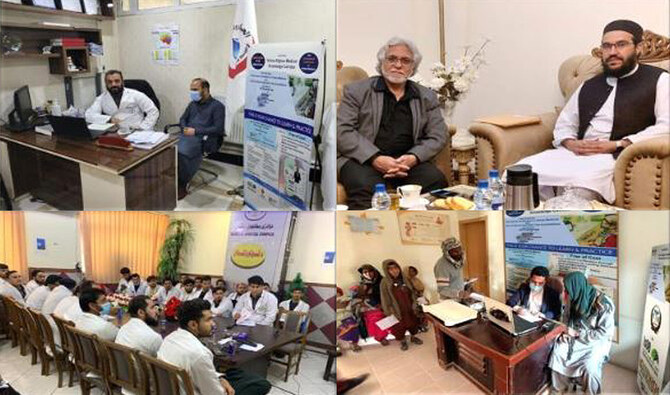
This handout photo, released by EduCast on June 9, 2024, digital health and education platform, shows officials assisting Afghans in need of medical and livelihood. (EduCast/File)
Short Url
Updated 17 October 2024
Follow

Pakistan’s Educast partners with Islamic Development Bank to provide critical support to Afghans

  • Project plans to empower ‘thousands of Afghan female doctors’ in the field of digital health and telemedicine
  • Educast provided 1,000 consultations during the pilot phase in six Afghan provinces, benefitting 5,000 people

KARACHI: A Pakistan-based global telehealth and online training technology provider has partnered with the Islamic Development Bank and Afghanistan Humanitarian Trust Fund to deliver critical support to Afghans in need of medical and livelihood assistance in their country, according to a statement on Wednesday.
Karachi-based Educast is a digital health and education platform that provides virtual training and telemedicine services. The Fund, established by the Islamic Development Bank in collaboration with the Organization of Islamic Cooperation (OIC), has sought its assistance to help Afghan nationals.
“The Islamic Development Bank and Afghanistan Humanitarian Trust Fund have joined forces to provide critical humanitarian aid to Afghanistan, and their telehealth and clinical support program is making a significant impact,” said a statement released by the Pakistani firm. “Through its partnership with Educast … they’re able to reach remote and underserved areas.”
“The program’s operational details include deploying smart hubs for enhanced education, constructing and operationalizing health facilities, and providing essential health care services to vulnerable communities,” the statement added.
Educast said the key components of the programs include providing remote health services, training local health care professionals through online programs and setting up smart hubs to serve as educational facilities in 20 provinces of Afghanistan.
It also highlighted its aim to empower “thousands of Afghan female doctors,” medical students and health care workers in the field of digital health and telemedicine.
The statement informed the pilot phase of the project had already been carried out in six Afghan provinces, during which 1,000 consultations were provided, benefiting 5,000 individuals.
Educast also trained 1,500 local health care professionals, and work on setting up 20 medical education facilities is underway.
The statement further noted the partnership demonstrated the power of collaborative humanitarian efforts.
“The success of the pilot phase serves as a model for scalable, impactful interventions in conflict-affected regions,” it added.


Pakistan says EU notes progress on rights commitments during GSP+ compliance discussions

Updated 20 December 2025
Follow

Pakistan says EU notes progress on rights commitments during GSP+ compliance discussions

  • The review formed part of a wide-ranging EU-Pakistan Joint Commission meeting held in Brussels
  • The two sides also covered irregular migration, climate cooperation and safe Afghan refugee return

ISLAMABAD: The European Union reviewed Pakistan’s compliance with its preferential GSP+ trade scheme this week and welcomed progress on key human rights commitments, according to a statement on Saturday, as Islamabad seeks to protect access to European markets vital for its export-led growth strategy.

The EU’s Generalized Scheme of Preferences Plus (GSP+) grants duty-free access to most European markets for eligible developing countries in return for their commitment to implement 27 international conventions covering human rights, labor standards, environmental protection and good governance. Pakistan, which has benefited from the scheme since 2014, is one of the biggest beneficiaries, with the EU its second-largest trading partner and a destination for roughly a third of its exports.

Pakistan’s GSP+ status has come under scrutiny in the past after, in April 2021, the European Parliament adopted a resolution calling for an immediate review, citing concerns over violence against religious minorities, curbs on media freedom and broader human rights issues. The move followed widespread anti-France protests in Pakistan over the publication of anti-Islamic caricatures, which EU legislators said raised questions about Islamabad’s commitment to fundamental freedoms.

“Both sides reviewed Pakistan’s progress on the implementation of the 27 international conventions as required under the GSP+ framework,” the foreign office said in a statement circulated in Islamabad. “The EU welcomed progress made in bringing Pakistan’s application of the death penalty in line with international standards and encouraged further steps in this regard.”

“It also recognised important first steps against torture, as well as the creation of a Commission on Minorities,” it added.

IRREGULAR MIGRATION, CLIMATE COOPERATION

The discussions took place during the 15th meeting of the EU–Pakistan Joint Commission, held in Brussels on Dec. 17, where officials also addressed irregular migration, including cooperation on the return and readmission of migrants without legal status, and legal mobility pathways under the bloc’s broader migration framework.

The foreign office statement came just a day after Greek authorities said they rescued more than 500 migrants from a fishing boat in the Mediterranean, adding that the group included several Pakistani nationals, highlighting continued migration pressures despite tighter controls.

Climate cooperation was another focus, with both sides reviewing ongoing collaboration on climate resilience, disaster risk reduction and sustainable development, areas of growing importance for Pakistan after repeated climate-related shocks.

The meeting also touched on the situation of Afghan refugees.

The statement said the EU welcomed the ongoing discussions between Pakistan and the UN refugee agency “to identify and compile a list of vulnerable cases, to ensure their adequate protection.”

“The EU appreciated that Pakistan is hosting millions of Afghan nationals for over four decades,” it continued. “They emphasised that any return must be safe, dignified and in line with international standards.”

The two sides agreed to continue engagement under the EU–Pakistan Strategic Engagement Plan, a framework guiding cooperation on political dialogue, trade, development, security and people-to-people exchanges, with the next joint commission meeting scheduled to be held in Islamabad next year.