WASHINGTON: Israel has a right to target Iran-backed militant group Hezbollah even as it may be hiding in civilian buildings in Lebanon, but should do so in a way that protects civilians, State Department spokesperson Matthew Miller said on Wednesday.
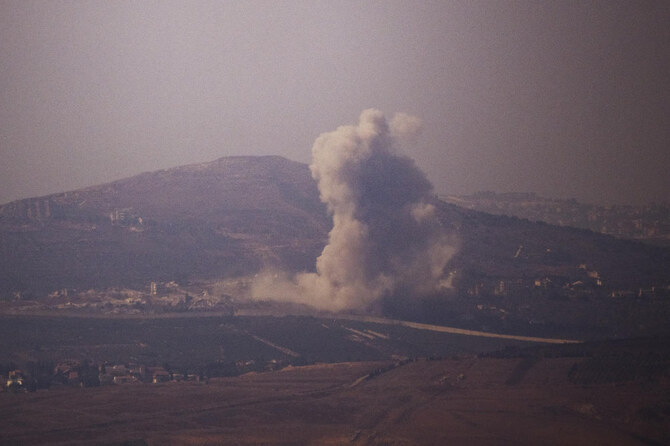
Asked at a regular press briefing about an Israeli airstrike that destroyed the municipal headquarters in the southern Lebanon town of Nabatieh that killed 16 people including the mayor, Miller said he could not comment on the specific strike, but “we don’t want to see civilian buildings destroyed.”
“We understand that Hezbollah does operate at times from underneath civilian homes, inside civilian homes. We’ve seen footage that has emerged over the course of the past two weeks of rockets and other military weapons held in civilian homes,” he said.
“Israel does have a right to go after those legitimate targets, but they need to do so in a way that protects civilian infrastructure, protects civilians,” he said.
Washington supports limited incursions by Israel to attack and degrade Hezbollah, but the US opposes a broad bombing campaign on Beirut and attacks that don’t avoid civilian harm, Miller said.
Lebanese officials denounced Wednesday’s attack, which also wounded more than 50 people in Nabatieh, a provincial capital, saying it was proof that Israel’s campaign against the Hezbollah armed group was now shifting to target the Lebanese state.
Lebanon’s caretaker Prime Minister Najib Mikati said the strike hit civilians meeting to coordinate relief efforts.
Miller said if Israel intentionally targeted such a meeting that would be “unacceptable,” but said the circumstances would need to be verified.
Defense Minister Yoav Gallant, on a visit to northern Israel near the border, said Israel would not halt its assault on Hezbollah to allow negotiations.
“Hezbollah is in great distress,” he said according to a statement from his office. “We will hold negotiations only under fire. I said this on day one, I said it in Gaza, and I am saying it here.”

US State Department affirms Israel’s right to target Hezbollah in Lebanon, urges civilian protection
https://arab.news/b7cdv
US State Department affirms Israel’s right to target Hezbollah in Lebanon, urges civilian protection
- “We’ve seen footage that has emerged over the course of the past two weeks of rockets and other military weapons held in civilian homes,” Miller said
- Washington supports limited incursions by Israel to attack and degrade Hezbollah
Kurdish rebels say ready to resist Iran
- Tehran has repeatedly accused the ‘terrorists’ of serving Israeli interests
PENJWEN: From their hideouts in the Iraqi mountains near Iran, leftist Kurdish rebels say they are ready to fight Iran, but hope for an uprising before they intervene, with or without US support.
After saying that he would be “all for” a Kurdish offensive on Iran, US President Donald Trump appeared to backtrack Saturday, saying he did not want such an attack.
Senior commander Roken Nerada of the Party of Free Life of Kurdistan, or PJAK, said: “If there is an attack on the Kurdish people ... then with every means ... we are ready to resist as we always have.”
“I think we can achieve our rights without the help of the US or any other country,” said Nerada, 39, who joined the rebels 17 years ago.
HIGHLIGHTS
• Iran has designated Kurdish rebels as terrorists, and many have previously fought its security forces in areas along the border.
• Just before the war, PJAK joined a coalition of Kurdish rebel parties seeking to overthrow the Iranian government and secure self-determination.
Like other Iranian Kurdish rebel groups, PJAK has bases in the mountains of Iraq’s northern autonomous Kurdistan region, but it also maintains hideouts in majority-Kurdish areas inside Iran.
Iran has designated Kurdish rebels as terrorist organizations, and many have previously fought its security forces in Kurdish-majority areas along the border.
But in recent years, under political pressure mostly from their Iraqi hosts, they have largely refrained from armed activity — raising questions about their current capacity to lead an armed offensive against Iran.
Since the Middle East war began late last month with a wave of US-Israeli strikes on Iran, Tehran has repeatedly struck Kurdish militants’ positions in Iraq, accusing them of serving Western or Israeli interests.
Just before the war, and after anti-government protests in Iran, PJAK joined a coalition of Kurdish rebel parties seeking to overthrow the Iranian government and secure self-determination.
“We are ready to fight, especially after what they did 50 days ago,” PJAK fighter Shwan said, referring to the crackdown on the protests in Iran that left thousands dead.
Amid reports that rebels might collaborate with the US, Tehran threatened to target “all facilities” in Iraq’s Kurdistan if Kurdish militants cross the border.
But on Saturday, Trump said “we’re not looking to the Kurds going in.”
“We don’t want to make the war any more complex than it already is,” he added.
Amir Karimi, another commander in PJAK, said last week that the “Americans are already in the area, and we have had a dialogue.”
It was “a political exchange ... to get to know each other,” Karimi said, adding that “a ground attack is not on the table at this stage.”
“From a strategic and tactical point of view, we believe it wouldn’t be a good idea,” he added, warning that Iranian forces have reinforced the borders.
“The Kurds will need guarantees to secure a democratic Iran,” he said.


